
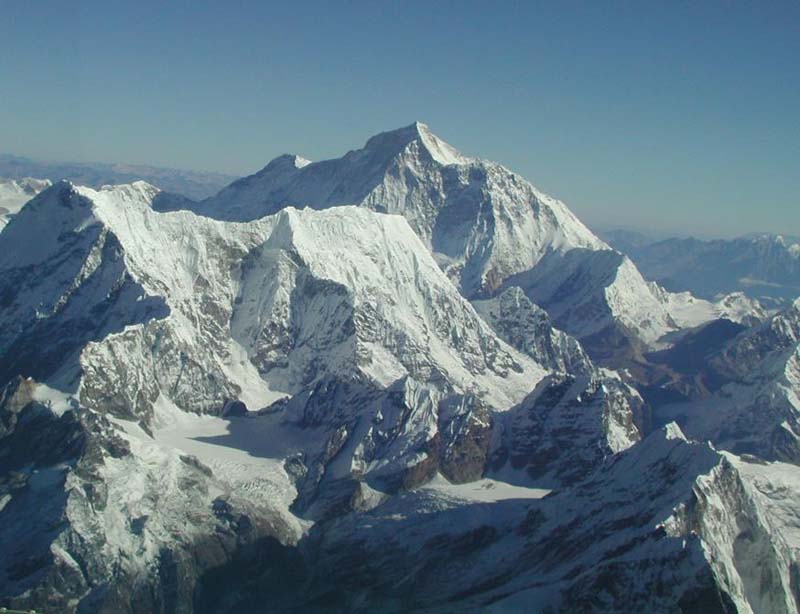
The first Everesters were obliged to trek 400 arduous miles from Darjeeling across the Tibetan plateau simply to reach the foot of the mountain. Their knowledge of the deadly effects of extreme altitude were scant, and their equipment was pathetically inadequate by modern standards. Yet in 1924 a member of the third British expedition, Edward Felix Norton, reached an elevation of 28,126 feet� just 900 feet below the summit� before being defeated by exhaustion and snow blindness. It was an astounding achievement that was probably not surpassed for twenty-nine years.
I say �probably� because of what transpired four days after Norton�s summit assault. At first light on June 8, two other members of the 1924 British team, George Leigh Mallory and Andrew Irvine, departed the highest camp for the top. The two climbers failed to return to their tent that night, however, and neither Mallory or Irvine was ever seen again. Whether one or both of them reached the summit before being swallowed by the mountain and into legend has been fiercely debated ever since.
In the spring of 1953 a large British team became the third expedition to attempt Everest from Nepal. On May 28, following two and a half months of prodigious effort, a high camp was dug tenuously into the Southeast Ridge at 27,000 feet. Early the following morning Edmund Hillary, a rangy New Zealander, and Tenzing Norgay, a highly skilled Sherpa mountaineer, set out for the top breathing bottled oxygen. The climbing was strenuous and sketchy, but Hillary persisted...Fighting exhaustion, the two climbers continued up the undulating ridge above. Hillary wondered, �rather dully, whether we would have enough strength left to get through. I cut around the back of another hump and saw that the ridge ahead dropped away and we could see far into Tibet. I looked up and there above us was a rounded snow cone. A few whacks of the ice-axe, a few cautious steps, and Tenzing and I were on top.� And thus, shortly before noon on May 29, 1953, did Hillary and Tenzing become the first men to stop atop Mount Everest.
Straddling the top of the world, one foot in China and the other in Nepal, I cleared the ice from my oxygen mask, hunched a shoulder against the wind, and stared absently down at the vastness of Tibet. I understand on some dim, detached level that the sweep of earth beneath my feet was a spectacular sight. I�d been fantasizing about this moment, and the release of emotion that would accompany it, for many months. But now that I was finally here, actually standing on the summit of Mount Everest, I just couldn�t summon the energy to care.
It was early in the afternoon of May 10, 1996. I hadn�t slept in fifty-seven hours. The only food I�d been able to force down over the preceding three days was a bowl of ramen soup and a handful of peanut M&Ms. Weeks of violent coughing had left me with two separated ribs that made ordinary breathing an excruciating trial. At 29,028 feet up in the troposphere, so little oxygen was reaching my brain that my mental capacity was that of a slow child. Under the circumstances, I was incapable of feeling much of anything except cold and tired.
A human plucked from sea level and dropped on the summit of Everest would lose consciousness within minutes and quickly die. A well-acclimatized climber can function at that altitude with supplemental oxygen-but not well, and not for long. The body becomes far more vulnerable to pulmonary and cerebral edema, hypothermia, frostbite. Each member of our team was carrying two orange, seven-pound oxygen bottles.
Bottled oxygen does not make the top of Everest feel like sea level. Ascending above the South Summit with my regulator delivering two liters of oxygen per minute, I had to stop and draw three or four heaving lungfuls of air after each ponderous step. The systems we were using delivered a lean mix of compressed oxygen and ambient air that made 29,000 feet feel like 26,000 feet. But they did confer other benefits that weren't so easily quantified, not the least of which was keeping hypothermia and frostbite at bay.
I�d arrived on the summit a few minutes after Anatoli Boukreev, a Russian climbing guide working for an American commercial expedition, and just ahead of Andy Harris, a guide on the New Zealand-based team to which I belonged. I snapped four quick photos of Harris and Boukreev striking summit poses, then turned and headed down. My watch read 1:17 P.M. All told, I�d spent less than five minutes on the roof of the world.
A moment later, I paused to take another photo, this one looking down the Southeast Ridge, the route we had ascended. Training my lens on a pair of climbers approaching the summit, I noticed something that until that moment had escaped my attention. To the south, where the sky had been perfectly clear just an hour earlier, a blanket of clouds now hid Pumori, Anna Dablam, and the lesser peaks surrounding Everest.
Later� after six bodies had been located, after a search for two others had been abandoned, after surgeons had amputated the gangrenous right hand of my teammate Beck Weathers� people would ask why, if the weather had begun to deteriorate, had climbers on the upper mountain not heeded the signs? Why did veteran Himalayan guides keep moving upward, ushering a gaggle of relatively inexperienced amateurs� each of whom had paid as much as $65,000 to be taken safely up Everest� into an apparent death trap?
