
Eighteen years ago I read an article about a special paleontological site, Dinosaur State Park, located in Rocky Hill, Connecticut, just south of Hartford. I saved that article with hopes of someday visiting what Connecticut claims to be one of the largest on-site displays of dinosaur tracks in the world.
That �someday� arrived this summer on our trip to the Eastern U.S. New England seems a strange place to be chasing dinosaurs; however, some of the earliest American dinosaur discoveries were made there. The Connecticut Valley, underlain by Mesozoic sedimentary rocks, is famous for a number of dinosaur trackways unearthed there beginning in the nineteenth century.
The Dinosaur State Park trackway was accidentally discovered in 1966, about four feet beneath the surface, by a bulldozer operator who was excavating a rocky site for a future state building. The plans for a new building quickly changed to a state park as many more tracks were uncovered on the site. Today, there are about 500 tracks visible under a dome and another 1500 have been reburied outside of the building for preservation.
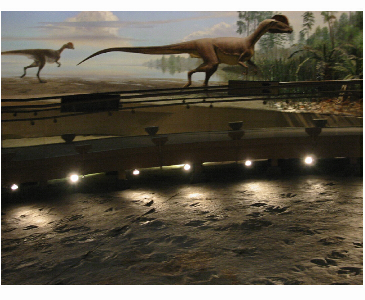
The day of our planned visit was a wet one, so we pulled out our rain suits we had packed for such weather. Upon our arrival to the park, we found the large 55,000 square foot geodesic dome exhibit center a pleasant refuge from the rain. Inside we discovered, was the main feature of this state park; hundreds of dinosaur footprints, wonderfully preserved in situ and creatively exhibited for the visitor. An elevated walkway over the gently dipping bedrock allowed us to view the trackways closely while surrounded by life-like murals of late Triassic/early Jurassic life and realistic dioramas featuring Dilophosaurus, Coelophysis and Anchisaurus. Special lighting and sound effects created the illusion that dinosaurs were alive and walking though the environment under the dome. An occasional simulated thunderstorm complete with lightning added to the effect.
The majority of the tracks, scattered across a thin layer of sandstone bedrock, are from 10 to 16 inches in length and spaced 3.5 to 4.5 feet apart. They appear to have been made by a number of clawed, three-toed, biped individuals and travel in all directions across the surface of the rock. Some of the tracks are faint impressions while others are deep and clearly visible. One of the sets of tracks on display seems to have been made by an individual that was floating in shallow water as only the tips of the toes are visible in the prints.
The type of dinosaur track displayed at Dinosaur State Park, Eubrontes giganteus is found throughout the Connecticut Valley and was first described and named by Edward Hitchcock of Amherst College, Massachusetts in 1836. This was the very first dinosaur track to be scientifically described from anywhere. Naturally, Eubrontes (pronounced you-BRONT-tees) was designated as Connecticut�s state fossil in 1991.
No skeletal remains have been found with Eubrontes tracks to reveal exactly which species of dinosaur they belong to. The carnivorous dinosaur Dilophosaurus, a medium-sized theropod whose tracks and skeletal remains have been discovered in Arizona, is thought to be similar to the size and shape of the Connecticut Valley track-maker. Dilophosaurus measured about twenty feet long and walked on its hind legs. Until skeletal remains are discovered with Eubrontes tracks, the originator of the trackways will remain a mystery.
A special track plastering area has been set aside outdoors for visitors to make plaster copies of the Eubrontes fossil tracks. Large pieces of bedrock with negative imprints of Eubrontes are available for making positive casts of the tracks. Due to the wet conditions we were unable to make casts but did enjoy hiking the nature trail and viewing some of the living fossil plants such as ginkgoes and katsuras, that have been planted in the arboretum. While hiking we found that individual Eubrontes specimens have been included in the landscaping of the state park... peeking out from under the shrubs by the parking lot, mortared into the top of a stone retaining wall, hidden among the plantings of the garden area.
Connecticut�s Dinosaur State Park is a wonderful site I highly recommend to anyone interested in fossils. If your experience is like mine, it may be eighteen years or longer before you get the chance. In the meantime, spend some time reading more about dinosaur discoveries in the Eastern U.S.
REFERENCES �
Dino Land State Fossils: http://www.geocities.com/stegob/eubrontesconnecticut.html.
Dinosaur State Park: www.dinosaurstatepark.org.
Dinosaur State Park Brochure. Connecticut Department of Environmental Protection: 2001.
Dinosaurs and the History of Life - Lecture 13 Early Jurassic: http://www.ldeo.columbia.edu/dees/courses/v1001/tr_j.extinct.html.
Gaffney, Eugene S. Dinosaurs. New York: Golden Press, 1990.
Hillinger, Charles. �Dinosaur Lovers Making Tracks to State Park.� The Saginaw News, 15 December, 1985.
Norman, David. The Illustrated Encyclopedia of Dinosaurs. New York: Crescent Books, 1985.
Prehistoric Connecticut: http://www.geobop.com/paleozoo/World/NA/US/CT/.
Svarney, Thomas E. and Patricia Barnes-Svarney. The Handy Dinosaur Answer Book. Farmington Hills, Michigan: Visible Ink Press, 2000.
The State Fossil: http://www.ct.gov/ctportal/cwp/view.asp?a=885&q=246498.
ZoomDinosaurs.com Dinosaur and Paleontology Dictionary: http://www.enchantedlearning.com/subjects/dinosaurs/glossary/indexe.shtml.
