Kummerċ Ġust: Ħtieġa Globali u
Prijorità Ekonomika
WORLFEST: Il-Jum Dinji tal-Kummerċ Ġust 2002
Festi fl-irħula tal-Bangladexx, logħob tal-futbol
fil-Ġappun, u korijiet
fl-Olanda: fil-ħames kontinenti differenti, fl-4 ta' Mejju, ħaddiema u nies
oħra involuti fil-Kummerċ Ġust se jiċċelebraw l-ewwel Jum Dinji tal-Kummerċ
Ġust.
 Med2000 Local Action Group (Grupp għat-Tielet Dinja) u l-Koperattiva Kummerċ
Ġust flimkien mal-Fondazzjoni St Michael, Inizjamed u Ritmi (Grupp
għat-Tielet Dinja), qed tieħu sehem fl-ewwel Jum Dinji tal-Kummerċ Ġust,
2002, li se jkun iċċelebrat fl-4 ta' Mejju, bl-isem ta' WORLFEST.
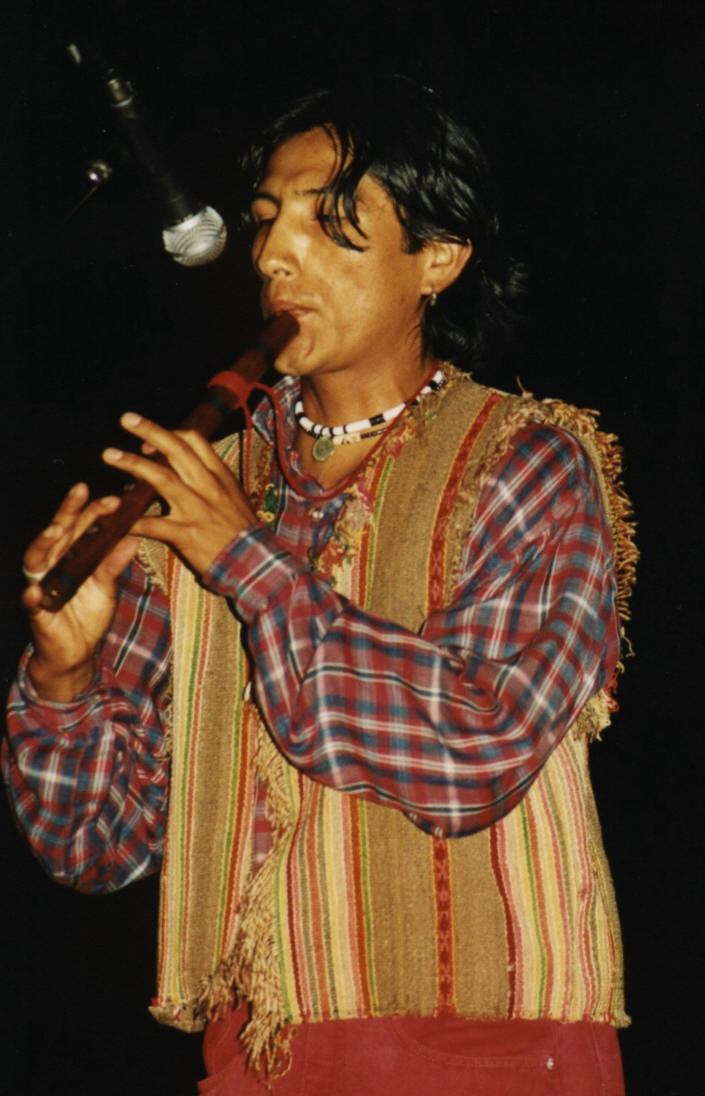
(Fir-ritratt: Iskay)
Med2000 Local Action Group (Grupp għat-Tielet Dinja) u l-Koperattiva Kummerċ
Ġust flimkien mal-Fondazzjoni St Michael, Inizjamed u Ritmi (Grupp
għat-Tielet Dinja), qed tieħu sehem fl-ewwel Jum Dinji tal-Kummerċ Ġust,
2002, li se jkun iċċelebrat fl-4 ta' Mejju, bl-isem ta' WORLFEST.
(Fir-ritratt: Iskay)
WORLDFEST qed tiċċelebra l-Kummerċ Ġust biex tifraħ lill-bdiewa u n-nies
tas-sengħa tar-riżultati li qed jiksbu u tal-prodotti ta' kwalita' li qed
jwasslu fis-suq, biex jgħarraf lill-konsumaturi kif jistgħu jagħmlu
differenza b'dak li jonfqu, u biex kumpaniji oħra jsiru jafu kif jistgħu
jagħtu sehemhom fl-iżvilupp sostenibbli permezz tal-Kummerċ Ġust.
 Is-Sibt,
4 ta' Mejju, int u familtek mistiedna tiġu fil-grounds tal-Fondazzjoni St
Michael, Pembroke, biex tqattgħu ġurnata f'ambjent nadif u rilassanti li se
jkun mimli b'attivitajiet f'ġieħ WORLDFEST, jum iċ-ċelebrazzjoni tal-Kummerċ
Ġust. Attivitajiet sportivi, Car Wash organizzat mis-St Michael Foundation
Scouts, mużika etnika live, u Re-Use Centre fejn kotba u oġġetti oħra li ma
tridux aktar jistgħu jiġu użati mill-ġdid huma ftit milll-attivitajiet li se
jseħħu matul dan il-jum.
Is-Sibt,
4 ta' Mejju, int u familtek mistiedna tiġu fil-grounds tal-Fondazzjoni St
Michael, Pembroke, biex tqattgħu ġurnata f'ambjent nadif u rilassanti li se
jkun mimli b'attivitajiet f'ġieħ WORLDFEST, jum iċ-ċelebrazzjoni tal-Kummerċ
Ġust. Attivitajiet sportivi, Car Wash organizzat mis-St Michael Foundation
Scouts, mużika etnika live, u Re-Use Centre fejn kotba u oġġetti oħra li ma
tridux aktar jistgħu jiġu użati mill-ġdid huma ftit milll-attivitajiet li se
jseħħu matul dan il-jum.
 Madankollu se ssibu anke taħditiet pubbliċi dwar l-Edukazzjoni Globali u
l-Kummerċ Ġust għall-għalliema tal-iskejjel primarji u sekondarji, u
seminars pubbliċi minn Clementina Carbone, il-Kap tal-Liceo Vincenzo de'
Paoli f'Reggio Calabria. L-iskola għażlet li ma tibqax tbigħ prodotti ta'
l-ikel tal-kumapniji kbar. Minflok waqqfet koperattiva immexxija
mill-istudenti stess. Din il-koperattiva tbigħ biss prodotti ġusti.
Madankollu se ssibu anke taħditiet pubbliċi dwar l-Edukazzjoni Globali u
l-Kummerċ Ġust għall-għalliema tal-iskejjel primarji u sekondarji, u
seminars pubbliċi minn Clementina Carbone, il-Kap tal-Liceo Vincenzo de'
Paoli f'Reggio Calabria. L-iskola għażlet li ma tibqax tbigħ prodotti ta'
l-ikel tal-kumapniji kbar. Minflok waqqfet koperattiva immexxija
mill-istudenti stess. Din il-koperattiva tbigħ biss prodotti ġusti.
Se
jkun hemm taħdita pubblika oħra minn Stefano Magnoni,
li huwa l-koordinatur u membru fundatur ta' Chico Mendes - l-akbar ħanut ta'
kummerċ ġust fl-Italja. Magnoni ipparteċipa f'numru ta' proġetti ta' kummerċ
ġust fin-nofsinhar tad-dinja u għandu ukoll esperjenza vasta
fl-organizzazzjoni ta' korsijiet fuq is-suġġett. Jikteb ukoll fir-rivista
Taljana dwar l-ekonomija soċjali Altreconomia.
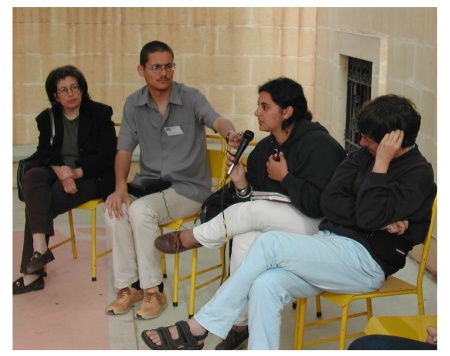 Taħdita
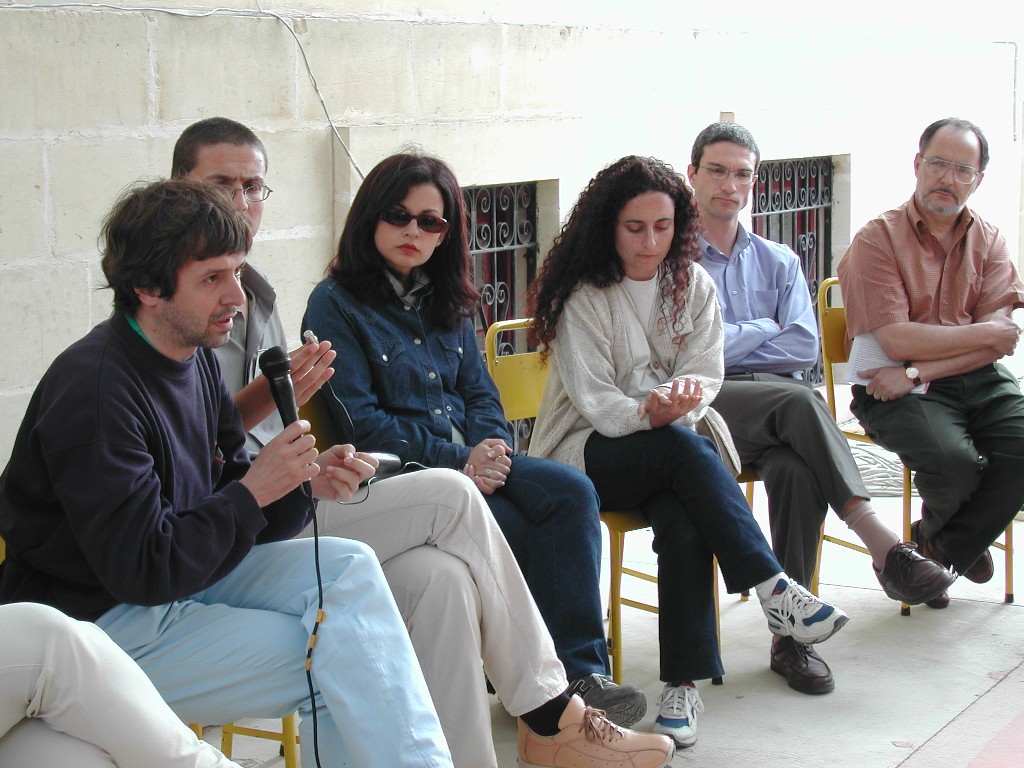
oħra se ssir minn Anna Bucca (it-tielet mix-xellug), li hi l-President ta’
l-ARCI Catania, dwar sehem il-Kummerċ Ġust f'ekonomija globalizzata. Kemm
Magnoni kif ukoll Bucca pparteċipaw fil-Forum Soċjali Globali li sar f'Porto
Alegre, il-Brażil, aktar kmieni dis-sena.
Taħdita
oħra se ssir minn Anna Bucca (it-tielet mix-xellug), li hi l-President ta’
l-ARCI Catania, dwar sehem il-Kummerċ Ġust f'ekonomija globalizzata. Kemm
Magnoni kif ukoll Bucca pparteċipaw fil-Forum Soċjali Globali li sar f'Porto
Alegre, il-Brażil, aktar kmieni dis-sena.
Matul il-ġurnata L-ARKA, l-uniku ħanut Malti ta' kummerċ ġust u inizjattiva
bla qliegħ li jinsab 306, Triq San Pawl, Valleta, se jsalpa 'l barra
mill-Belt u jankra mal-bosta tined tal-Kummerċ Ġust li se jkunu mtellgħin
fil-grounds tas-St Michael's. Dawn it-tined se jkunu mimlija ikel, ornamenti
u ħwejjeġ oħra maħduma f'pajjiżi varji fl-Afrika, l-Asja, l-Amerika tan-Nofs
u t'Isfel u mibjugħa skond il-kriterji tal-Kummerċ Ġust. WORLDFEST jiġi fi
tmiemu b' performance live mid-Drum Circle workshop. Wara l-kunċerti riċenti
ta' RITMI, b' Mousse' Ndiaye and Renzo Spiteri, dan ta' l-aħħar se jkun qed
jmexxi l-istudenti tal-livell avvanzat tad-Drum Circle f'ċelebrazzjoni
mużikali tal-Jum Dinji tal-Kummerċ Ġust.
Carol Wills, Direttriċi Eżekuttiva tal-IFAT (Federazzjoni Internazzjonali
tal-Kummerċ Alternattiv) tgħid dan: "Il-moviment tal-Kummerċ Ġust ma jistax
jaċċetta l-livell ta' faqar dinji li jeżisti llum. Nemmnu li nistgħu nbiddlu
d-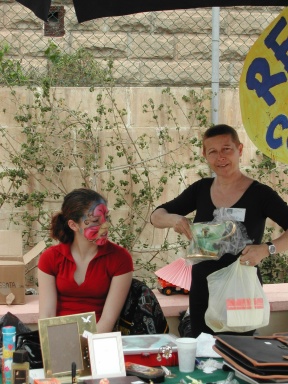 dinja. Bix-xiri ta' prodotti tal-kummerċ ġust il-konsumatur jista' jgħin
biex dil-bidla sseħħ, u jtejjeb l-għajxien tal-ħaddiema li sfaw
marġinalizzati minħabba l-globalizzazzjoni. Il-Jum Dinji tal-Kummerċ Ġust
fl-4 ta' Mejju huwa opportunità liema bħalha biex nies mid-dinja kollha juru
fehmthom dwar il-bżonn ta' dinja aktar ġusta."
dinja. Bix-xiri ta' prodotti tal-kummerċ ġust il-konsumatur jista' jgħin
biex dil-bidla sseħħ, u jtejjeb l-għajxien tal-ħaddiema li sfaw
marġinalizzati minħabba l-globalizzazzjoni. Il-Jum Dinji tal-Kummerċ Ġust
fl-4 ta' Mejju huwa opportunità liema bħalha biex nies mid-dinja kollha juru
fehmthom dwar il-bżonn ta' dinja aktar ġusta."
Vince Caruana, mill-Grupp għat-Tielet Dinja u Kordinatur Ġenerali ta'
WORLDFEST, qal dan "Ir-regoli dinjija tal-kummerċ m'humiex favur il-foqra u
l-ambjent. Il-Jum Dinji tal-Kummerċ Ġust juri li hemm triq oħra li tagħmel
il-ġid lill-foqra u lid-dinja kollha. WORLFEST se tagħti opportunità
lill-konsumatur Malti jagħmel att ta' ġustizzja filwaqt li jieħu gost u jmur
lura d-dar b'biċċa xogħol unika jew bott kafè ta’ kwalità."
Għal aktar informazzjoni ibagħtu email lil [email protected] jew
[email protected] jew ċemplu L-Arka: 2124 4865.
Karsten Xuereb
April 2002
 Fair
Trade: a global passion and an economic priority
Fair
Trade: a global passion and an economic priority
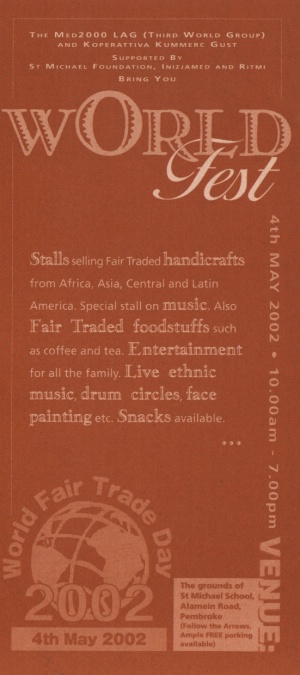
WORLDFEST: World Fair Trade Day 2002
Picnics and festivities in Bangladeshi villages, football matches in Japan,
choirs singing across the Netherlands: on five different continents on May
4th,
the producers and people involved in Fair Trade will celebrate the first
ever
World Fair Trade Day.
Med2000 Local Action Group (Third World Group) and Koperattiva Kummerċ Ġust,
in collaboration with St. Michael Foundation, Inizjamed and Ritmi (Third
World Group), is taking part in the first ever
World Fair Trade Day, 2002 being held on 4th May.
WORLDFEST is being held to celebrate Fair Trade and tell the world
about it, to honour the achievements of grassroots farmers and
craftspeople who create quality products
for the market, to tell consumers how their spending
power can make a difference and to tell other companies how they can
make a contribution to sustainable
development through Fair Trade.
 On Saturday, 4th May, you and your families are invited to visit the grounds
at the St Michael Foundation for Education,
Pembroke, to enjoy a day out in a cleaner, greener
environment which will be full of various activities marking
WORLDFEST: World Fair Trade Day 2002. Sports activities in aid of
Fair Trade products, a Car Wash organised by the
St Michael Foundation Scouts, live ethnic music,
face painting and a Re-Use Centre where unwanted gifts and books and
other articles can have their life extended are a few of the events
taking place.
On Saturday, 4th May, you and your families are invited to visit the grounds
at the St Michael Foundation for Education,
Pembroke, to enjoy a day out in a cleaner, greener
environment which will be full of various activities marking
WORLDFEST: World Fair Trade Day 2002. Sports activities in aid of
Fair Trade products, a Car Wash organised by the
St Michael Foundation Scouts, live ethnic music,
face painting and a Re-Use Centre where unwanted gifts and books and
other articles can have their life extended are a few of the events
taking place.
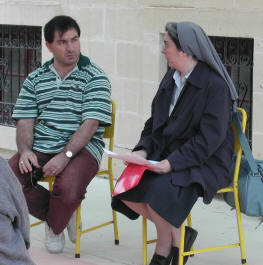 However, there will also be public talks on Global Citizenship Education and
Fair Trade for Primary and Secondary School Teachers and a Public
Seminar by Clementina Carbone, Head Teacher of the
Vincenzo de' Paoli school in Reggio Calabria. This
school has decided to stop selling foodstuffs by multinational
companies in their canteen. Instead it has formed an innovative
cooperative, Nosotros, managed by the students
themselves and selling only fair trade foodstuffs.
However, there will also be public talks on Global Citizenship Education and
Fair Trade for Primary and Secondary School Teachers and a Public
Seminar by Clementina Carbone, Head Teacher of the
Vincenzo de' Paoli school in Reggio Calabria. This
school has decided to stop selling foodstuffs by multinational
companies in their canteen. Instead it has formed an innovative
cooperative, Nosotros, managed by the students
themselves and selling only fair trade foodstuffs.
Another public seminar will be delivered by Stefano Magnoni, who is a
founding member and general coordinator of Chico
Mendes - the largest Italian Fair Trade shop. He
has participated in a number of fair trade projects in the southern
hemisphere and also has extensive experience in leading courses on
fair trade.
Stefano is a regular
contributor to Altreconomia -
one of Italy's leading
magazines on social economy. Finally Anna Bucca, President of ARCI Catania, will be speaking
about the role of Fair Trade in a globalized
economy. Both Magnoni and Ms Bucca have attended
the Global Social Forum held at Porto Alegre, Brasil, earlier this
year, as part of their commitment to creating a better and fairer
global community.
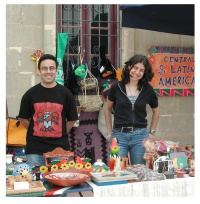
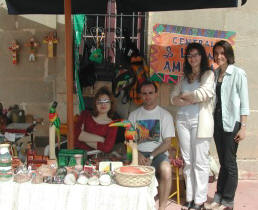 Throughout the day L-ARKA, Malta's only fair trade shop which is a
non-profit initiative which is located at 306, St.
Paul's Street, Valleta will be moving out of
Valletta and setting anchor at the various Fair Trade stalls that will
be set up at the St Michael's grounds. These stalls will be full of
foodstuffs, handicrafts from various countries in
Africa, Asia and Latin and Central America and
clothes, among others, produced under international Fair Trade
criteria). The whole day will be brought to an end by a live
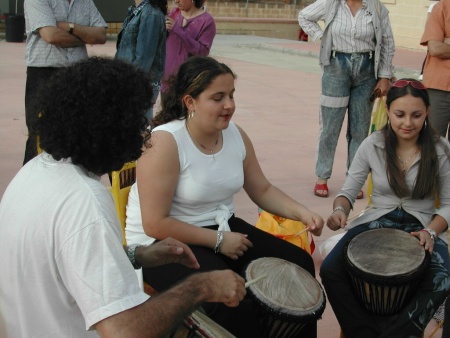
perfomance by the Drum Circle workshop. After the
recent succesful RITMI live concert, which
featured Moussé Ndiaye and Renzo Spiteri, the
latter will be leading the advanced students of
the Drum Circle in a musical celebration of this year's
World Fair Trade Day.
Throughout the day L-ARKA, Malta's only fair trade shop which is a
non-profit initiative which is located at 306, St.
Paul's Street, Valleta will be moving out of
Valletta and setting anchor at the various Fair Trade stalls that will
be set up at the St Michael's grounds. These stalls will be full of
foodstuffs, handicrafts from various countries in
Africa, Asia and Latin and Central America and
clothes, among others, produced under international Fair Trade
criteria). The whole day will be brought to an end by a live
perfomance by the Drum Circle workshop. After the
recent succesful RITMI live concert, which
featured Moussé Ndiaye and Renzo Spiteri, the
latter will be leading the advanced students of
the Drum Circle in a musical celebration of this year's
World Fair Trade Day.
Carol Wills, Executive Director of IFAT (International Federation for
Alternative Trade) says, "The levels of poverty in the world today
are unacceptable to the Fair Trade movement. We
believe it is possible to change the world. By
buying Fair Trade products consumers can demonstrate their
commitment to that change, and improve the livelihoods of producers
who have been left on the margins by
globalisation. World Fair Trade Day on 4 May is a
wonderful opportunity for people everywhere to speak out for a fairer
world."
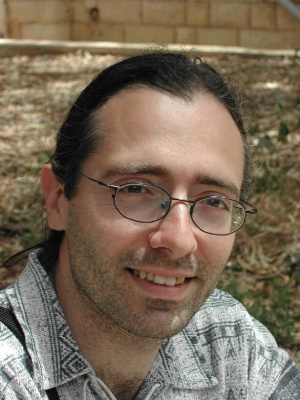 Vince
Caruana, of the Third World Group, and General Coordinator of WORLDFEST, has
this to say "World trade rules are loaded against poor people and the
environment. World Fair Trade Day is a clear proof that there exists
another path that benefits poor people and the
planet. WORLFEST is an excellent
opportunity for Maltese consumers to bring about justice while having fun
and to return home with a unique handicraft or
tasteful jar of coffee".
Vince
Caruana, of the Third World Group, and General Coordinator of WORLDFEST, has
this to say "World trade rules are loaded against poor people and the
environment. World Fair Trade Day is a clear proof that there exists
another path that benefits poor people and the
planet. WORLFEST is an excellent
opportunity for Maltese consumers to bring about justice while having fun
and to return home with a unique handicraft or
tasteful jar of coffee".
For further information send an email to [email protected]
or
[email protected] or phone L-Arka on 2124 4865.
Petition by Maltese Civil Society about Trade and Poverty
We, Civil
Society Organisations (CSOs) gathered in Malta on the 4th of May 2002 to
mark the first ever World Fair Trade Day believe that trade should be the
means by which poor people can lift themselves out of poverty. We also
believe that trade should protect the environment for all of us and not
destroy it and the lives that depend upon it. For trade to be this positive
force the international rules that govern it need to be changed.
We CSOs ask you world leaders to share our concern for the world’s poorest
people by ensuring that:
• Poor countries be allowed to sell their goods in rich countries, free from
the barriers and obstacles that disadvantage them
• Poor countries will have the right to support their vulnerable producers
and, where necessary, protect them from international competition that would
destroy their livelihood
• Multilateral Environmental Agreements negotiated with universal
intergovernmental participation will in fact protect people and the planet
and not be subordinated to WTO rules
Your real commitment to the above will give new hope to millions of people
worldwide; their lives depend on the choices we are making today.
Vince Caruana
4
May, 2002
Pembroke, Malta
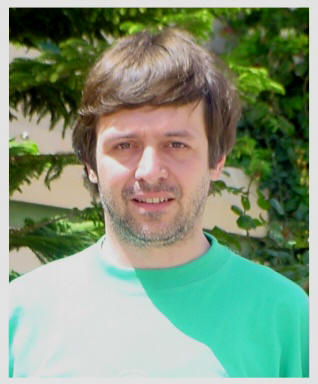 Stefano
Magnoni is vice president of the CTM consortium, chief importer and
distributor of Fair Trade products in Italy, and director of the biggest
fair trade cooperative in Italy, Chico Mendes. He spoke to
Gillian Bartolo about fair trade.
Stefano
Magnoni is vice president of the CTM consortium, chief importer and
distributor of Fair Trade products in Italy, and director of the biggest
fair trade cooperative in Italy, Chico Mendes. He spoke to
Gillian Bartolo about fair trade.
1.How did you come to work in this field?
I was a researcher at the University of Milan in environmental physics on
radioactive pollution, shortly after the Chernobyl disaster, and involved at
the same time in the Fair Trade cooperative as a volunteer. Then in 1996 the
Milan cooperative had become so big, it was impossible to run on a voluntary
basis. So I decided to look into joining, took a month's leave and visited
the countries where the projects were taking place in Africa and Asia. I
decided I could get more work satisfaction by throwing myself completely
into this field instead of working as a physics researcher, and have no
regrets. I've been in the business for five years full time now.
2. How does Chico Mendes operate?
We buy 90% of our products from the CTM consortium and the rest we buy
directly from small producers: one in Brazil, one in Senegal and one in
India. What happens is that when the projects produce a considerable amount
of products they sell them to the Consortium, which distributes them to
World Shops on a national level. When they are small, we buy directly from
them.
3. What is the belief system that drives Fair Trade?
Behind it all is a strong desire for justice and respect for human dignity. It
is scandalous that there are millions of people who don’t earn a just wage
or enough to live, to send their kids to school, buy medicines. Fair Trade
is tied to the Peace Movement and testifies that it is possible to find
different ways for sustainable development.
4. Are the Churches involved in the fair trade
movement?
The Catholic world is involved. Fair Trade is not religious, not
confessional. But the first group that spearheaded fair trade in Holland was
a group connected to the Catholic Church. Since then Fair Trade
organisations work separately although both Catholic and Protestant churches
have created a fertile ground for its development. Our slogan is "Trade not
aid", which explains very well and synthetically what we want. There should
be aid in the form of charity when there are big disasters for example, but
there must be continued support too, through trade, which is not
exploitative.
5. How is fair trade organised in Europe?
All over Europe, on the micro level there are so called World Shops: about
3,500 in all, mostly in England, Holland, Belgium, Germany and more recently
in Italy, Portugal. These are organised into about eight Alternative Trade
Organisations (ATOs) which import the products and distribute them. CTM is
one of these organisations. There are some that are very small and
specialised furnishing only one country and others which are much larger
like CTM which import hundreds of products from different centres of
production. There are about 300 separate producers from whom ATOS buy. And
these range from the small family group to to huge cooperatives of three
thousand members in Mexico which produce organic coffee. There is a huge
variety.
6. Are you making a difference and to whom?
We are a drop in the ocean but we begin with some products to be something a
bit more. Some products have reached significant commercial levels. The most
striking is example is in Switzerland where 15% - 20% of bananas come
through fair trade organisations. Many factors have contributed to this
including a strong campaign by some Swiss NGOs and especially two big
supermarket chains Migros and Coop who buy Fair Trade bananas. There are
some other cases which are smaller but also significant, such as in Germany,
where Fair Trade coffee accounts for 2% of the internal market. Fair Trade
products are also distributed in supermarkets. As a result in Europe labels
of certification have been created which allowed for bigger distribution.
The labels certify that the product such as coffee was bought from small
producers, paid at a price fixed by fair trade, on a long term contract, and
that the producers were paid in advance. Labelling has brought a diffusion
on the European level that the World Shops would not have managed on its
own.
7. What do producers and importers consumerist gain
from fair trade?
As an importer you need to have high objectives. The most beautiful thing is
that you see your action has an immediate result. When you contact a very
small, very marginal group of producers and you commit yourself to buying
their products for a year or two, at a higher price than they normally
receive, this group of producers becomes more stable, more solid, increases
production, manages to solve its daily problems of survival. We do little
comparatively, but there are many thousands of people who live better thanks
to this initiative. Of course we mustn't stop here. We have to think bigger.
My experience in the last 14 years is that we have had a lot of success. We
never thought Fair Trade in Italy and in Europe would grow so much, that in
Italy we would have to change our warehouse and buy one three times as big.
So Fair Trade has become an activity that produces economic results and give
satisfaction in its own right, and not only because of the ideals that go
into it.
8. And for the consumer?
From studies carried out at European Universities, the consumer's attitude
is changing towards the product. The consumer is becoming more and more
interested in having a 'clean' product under every aspect: a product that is
effective, that doesn’t pollute, that doesn’t destroy the environment, that
was produced in a way that respects workers' dignity, where there is no
exploitation of minors or adults. In Italy these studies reveal that between
10 and 15% of the population say they are prepared to pay higher prices for
socially clean products. Even if they don’t do so, when it comes to the
crunch, the survey results still signify changing attitudes. I say that if
we fair trade operators manage to penetrate 5% of the Italian market, this
is already an enormous acquisition.
9. How does the fact that the rest of world trade is
controlled by a few multinationals affect you?
This is one of the reasons we got involved in Fair Trade in the first place.
We know there are huge interests, big multinationalis that dominate the
market and it is a challenge for us to show that even with our meagre means
we can make a dent in this monopoly.
The interesting thing that is happening is that the multinationals are very
attentive to the changes in consumer attitudes. We have learnt that a number
of multinationals are studying the phenomenon of Fair Trade, and it is
expected in the next few years that one of these multinationals will launch
a product claiming it is socially clean or a product of fair trade. Things
are changing. So there are two aims for us developing on parallel lines. We
do something to dent these monopolies. At the same time if in doing so the
monopolies begin to feel the need to change the way they trade, this is an
even bigger victory for us.
10. Isn't there the risk that they only pretend to be
clean?
There is this risk. It is almost certain in my opinion. So one has to work
even harder as a consumer movement. One has to raise awareness in consumers.
Consumers need to be much more aware of what they are buying. Monitoring of
production is important.
11. How does your movement attract people in the first
world to work in it when it offers smaller profits and lower wages?
 At the level of volunteers, it is not a problem because there is the innate
wish for justice in some people. For those who need to earn a living too,
the kind of people who join our movement are people who have spent a number
of years working in traditional jobs but are unhappy because of their work
conditions. Normally the world of profit is very competitive. So people earn
a lot but are milked dry. Many people feel they've had enough of this world.
Perhaps they have made enough money, bought their house, have a few savings,
and are prepared to earn even half the amount to have a work place that is
more serene, more tranquil. It's happening. They are also looking for
something that makes more sense of their life, has more purpose. Because
people don’t work only to earn a wage, and work can be very alienating
spiritually. If I work at a job I don’t like which is competitive, stressful
and earn good money, I end up spending it to go on holiday and forget work.
At the level of volunteers, it is not a problem because there is the innate
wish for justice in some people. For those who need to earn a living too,
the kind of people who join our movement are people who have spent a number
of years working in traditional jobs but are unhappy because of their work
conditions. Normally the world of profit is very competitive. So people earn
a lot but are milked dry. Many people feel they've had enough of this world.
Perhaps they have made enough money, bought their house, have a few savings,
and are prepared to earn even half the amount to have a work place that is
more serene, more tranquil. It's happening. They are also looking for
something that makes more sense of their life, has more purpose. Because
people don’t work only to earn a wage, and work can be very alienating
spiritually. If I work at a job I don’t like which is competitive, stressful
and earn good money, I end up spending it to go on holiday and forget work.
In general what we call the third sector - the non-profit sector is growing.
There are European analysts that say in the next 20-30 years there should be
a boom of these non-profit enterprises, all the areas that emphasise less
competition for its own sake, and more work that gives satisfaction.
12. What kind of incentives do you need to stimulate
growth of these groups? Can the state help?
In Italy the state doesn’t help at all, but the European Union finances
projects of formation and education. The state could help us with
legislation, or by removing VAT on our products say. This would help
enormously, but then I'm afraid that even unscrupulous entrepreneurs would
pounce on fair trade, and would ruin it. So I would stick to money for
education and training.
13. Which countries does CTM work with and what
obstacles do you find?
We work mostly with central America and South America, some African
countries and some Asian.
Generally states don’t interfere. The problems we meet are usually
localised. Sometimes a group of producers which sets itself up to trade with
us can upset an existing system of power of local people, and in previous
years this has led to life threats in Guatemala for example. What do we do?
We give the local producers all our support and often the bad international
publicity for the established local barons is enough to inhibit them from
carrying out their threats. In some rare cases in earlier years there have
been threats even murders on the local level. But on the national level
states are normally happy with Fair Trade.
14. How is the money distributed? Do you pay the
workers directly?
The Fair Trade Cooperatives in Europe pay a common price for food which is
higher than the price quoted on the Stock Exchange. We pay the Fee On Board
(FOB) price at the port of embarkation, at the country of origin to the
producers' cooperatives and the cooperative decides how to distribute it
according to the living needs of the community, such as investment in
structures, education, health and then on wages for the members. We do
monitor how the money is distributed and intervene if there are rumours of
abuse.
Published in The Malta Independent on Sunday, May 26, 2002
