Out of Africa
7 December, 2003
Luca Palagi works in the Africa and Near East Desk in the Partnership Department of Ctm-Altromercato consortium, a Fair Trade organization in Italy. He spoke to Gillian Bartolo about Fair Trade in Africa.
1. How did you create a market in Italy for Fair Trade?
 In
my experience visiting producers in countries in Africa, Fair Trade plays
a concrete role in improving the lives of people, and is not just a
utopian dream, nor is it Charity under another name. Its success depends
to a large extent on raising awareness amongst consumers in the North.
This has been going on for at least 15 years in Italy, when a spate of
literature emerged showing how consumers could change the rules of the
market. The truth of this has been amply shown in the huge growth of
organic cultivation in Italy in the 80s and 90s, as a direct consequence
of consumer demand. To create a bigger market for Fair Trade products from
Africa, we began informing the public about the rampant exploitation
mainly by multinationals that led to a form of slavery across Latin
America. Parallel to this, our cooperative disseminated information
through the schools, where we were always made very welcome. At school we
also offered intercultural education after Italy changed to a
predominantly immigrant country from a predominantly emigrant country, and
people from Albania and North Africa began arriving in unexpected numbers.
The influx was experienced as a veritable invasion and prejudice was rife,
fuelled by a sensationalist media.
In
my experience visiting producers in countries in Africa, Fair Trade plays
a concrete role in improving the lives of people, and is not just a
utopian dream, nor is it Charity under another name. Its success depends
to a large extent on raising awareness amongst consumers in the North.
This has been going on for at least 15 years in Italy, when a spate of
literature emerged showing how consumers could change the rules of the
market. The truth of this has been amply shown in the huge growth of
organic cultivation in Italy in the 80s and 90s, as a direct consequence
of consumer demand. To create a bigger market for Fair Trade products from
Africa, we began informing the public about the rampant exploitation
mainly by multinationals that led to a form of slavery across Latin
America. Parallel to this, our cooperative disseminated information
through the schools, where we were always made very welcome. At school we
also offered intercultural education after Italy changed to a
predominantly immigrant country from a predominantly emigrant country, and
people from Albania and North Africa began arriving in unexpected numbers.
The influx was experienced as a veritable invasion and prejudice was rife,
fuelled by a sensationalist media.
2. What does your work consist of?
 It
is my job to design projects with small farmers and artisans in
marginalized conditions, mainly grass roots organisations. Last year I
visited Kenya, Cameroon, South Africa, Mozambique, Zimbabwe and Ghana. We
support those organizations that follow Ctm guidelines on the development
of new products for handicrafts, quality assurance for food and the
rehabilitation of structures. This year for example Tanzania rehabilitated
its workshops which had become derelict and dangerous, thanks to new
equipment provided by Ctm bought from funds raised in Italy and Europe. We
also have guidelines on administration which require democratic
distribution of profits and premiums. This has caused a clash of cultures
in Africa, which I will explain later.
It
is my job to design projects with small farmers and artisans in
marginalized conditions, mainly grass roots organisations. Last year I
visited Kenya, Cameroon, South Africa, Mozambique, Zimbabwe and Ghana. We
support those organizations that follow Ctm guidelines on the development
of new products for handicrafts, quality assurance for food and the
rehabilitation of structures. This year for example Tanzania rehabilitated
its workshops which had become derelict and dangerous, thanks to new
equipment provided by Ctm bought from funds raised in Italy and Europe. We
also have guidelines on administration which require democratic
distribution of profits and premiums. This has caused a clash of cultures
in Africa, which I will explain later.
3. Can we talk of Africa as a single entity?
After three years working in 15 counties in Africa, I can no longer talk
of Africa as a whole, except to say that friendliness is a feature of all
Africans, and it is easy to set up meaningful human contact with them.
Being African means belonging to a tight social network and it is
impossible to be isolated. It is a continent of 2000 languages and so many
indigenous cultures, which remain very strong. With some countries we work
very smoothly. This is the case with Ghana, especially in the area where
the Ashanti, the dominant culture in Ghana, live. We have two partners in
Ghana, one is the Kuapa Kokoo Union and acts as a true cooperative. The
members are farmers who grow cocoa for which they receive a premium over
and above the market price of their produce, some of which they use to dig
wells for water for the village. The rest of the premium they pump into
education: building schools in particular, since the government pays
teachers’ salaries but does not provide maintenance on school buildings.
Ghana is very stable politically, has a lot of agricultural resources as
well as minerals such as gold. It was the first country to win
independence, from Britain in 1957. Incidentally premiums are an integral
part of Fair Trade dealing with partner countries. CTM, as Fair Trade
organization, is non-profit making and has chosen to decrease its own
profits as much as possible without becoming unsustainable. Premiums to
help organizations invest in community projects come out of those profits.
Despite this Ctm last year had a turnover of 32 million euros and employs
76 people.
The other producer in Ghana is Getrade, an association of craftsmen whose
members are groups living in small villages in the north of Ghana as well
as slums outside Accra, the capital. The association supports artisans in
poor areas, sharing profits with marginalized groups.
4. Are relations always that smoothe?
In some
other cases we have conflict. In South Africa, for example, while
monitoring a pineapple association where farmers owned a cannery it was
found that the farmer owners were employing other workers, but not sharing
the Fair Trade premium with them. Significantly the owners were white and
their rural workers, black. We broke off relations with that association.
Instead we plan to support a black workers’ association of farmers growing
pineapple on state land. We are also involved in a pilot project that
South Africa is running to try and tackle the residues of apartheid.
Sometimes we have clashes of culture problems with partner associations.
The Fair Trade code of ethics specifies that we should work only with
democratic organizations. But across Africa, the culture is often one of
tribal clans led by chieftains in a hierarchical structure. The chieftains
are natural leaders, revered by all the clan, and all decisions are by
common agreement, in their hands. This system is deeply ingrained in
African culture. When we look for a democratic culture, there are
misunderstandings. Often to satisfy the Fair Trade organizations, a
superficial democratic structure is set up, but the real power remains
with the chieftain. We don’t want to interfere with local structures, but
we do want profits to be shared between members. In the case of artisans,
associations belong to different families and clans and African culture
stipulates that money should go to the family not the individual member.
Family is Africa’s welfare state there, and it is not possible to reserve
money for community projects. Ctm is thinking of changing Fair Trade
criteria for Africa. The criteria was formulated on the Latin American
model where Fair Trade first took off and where the sense of community is
stronger.
5. Do you get involved in war zones?
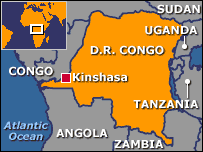 Not
as Ctm. But I was involved as part of a European Peace Organisation in the
Congo two years ago. The war is a purely African one, with Rwanda and
Uganda fighting the Congolese army and supporting local guerillas.
Civilians were suffering because the war lords were armed and supported
these neighbouring countries. So far three million people have died. We
got in touch with the war lords to organize a seminar on the war, and
asked them to provide protection for our convoy and call a truce for 15
days. The seminar brought surprising breakthroughs. One war lord
apologized for the murder of civilians and promised to stop the fighting.
The promise was not kept unfortunately, but our experience proves that
civilians can go into a war zone and stop the fighting at least
temporarily. On our arrival the jubilant civilians, seeing us as
harbingers of peace, swarmed around us in ever growing crowds. If the
United Nations would train people like us, to
intervene in these situations, I’m sure we could make a difference. The
Congo is a huge country which has been completely destroyed by Mobutu who
governed from 1965 till 1998. In the east there is no electricity, no
roads, no sewage treatment plants and no state schools. Despite this, the
people managed to organize themselves in the middle of the rain forest,
building power stations, sewage treatment plants, schools. Self-help
groups emerged of widows, orphans all committed to social issues, and they
continue to build despite the war.
Not
as Ctm. But I was involved as part of a European Peace Organisation in the
Congo two years ago. The war is a purely African one, with Rwanda and
Uganda fighting the Congolese army and supporting local guerillas.
Civilians were suffering because the war lords were armed and supported
these neighbouring countries. So far three million people have died. We
got in touch with the war lords to organize a seminar on the war, and
asked them to provide protection for our convoy and call a truce for 15
days. The seminar brought surprising breakthroughs. One war lord
apologized for the murder of civilians and promised to stop the fighting.
The promise was not kept unfortunately, but our experience proves that
civilians can go into a war zone and stop the fighting at least
temporarily. On our arrival the jubilant civilians, seeing us as
harbingers of peace, swarmed around us in ever growing crowds. If the
United Nations would train people like us, to
intervene in these situations, I’m sure we could make a difference. The
Congo is a huge country which has been completely destroyed by Mobutu who
governed from 1965 till 1998. In the east there is no electricity, no
roads, no sewage treatment plants and no state schools. Despite this, the
people managed to organize themselves in the middle of the rain forest,
building power stations, sewage treatment plants, schools. Self-help
groups emerged of widows, orphans all committed to social issues, and they
continue to build despite the war.
6. How does Fair Trade compare with traditional
trade in Africa?
Six hours
from Nairobi in Kenya in a rural area, farmers use an irrigation system
built by NGOs. In this area, the populations income depends entirely on
agriculture, and they operate according to two systems: Fair Trade
organizations and the traditional system, providing us with an opportunity
to compare the success of the two systems. The farmers operating the
traditional system grow cash crops, sell their crops to the middleman from
Nairobi who pays them at the end of the month according to current market
prices. This means the farmer has no security, because there is always the
danger that the global market might move from Kenya to another part of the
world where the crop can be bought cheaper. Besides, since they are paid
after their crop is sold, they are constrained to borrow money from loan
sharks till they are paid. On a similar plot, farmers’ organizations in
partnership with Fair Trade grow another variety of crops: camomile,
hibiscus, papaya and mangoes. They sell their produce to Meru Herbs, a
Fair Trade association in Kenya which processes their crops, producing
herbal teas in tea bags and jams packed in jars. Ctm in Italy buys the
products, guaranteeing a market for up to two years, the price is fixed by
the association and they are paid 50% of the price in advance, allowing
them to escape the grasp of money lenders. The premium Ctm gives them
above their income, covers maintenance expenses on water irrigation. They
won’t flee to the city slums, where there is a high degradation of life,
to escape poverty, nor will they swell the ranks of African immigrants.
7. How successful have you been in penetrating the
African market?
Fair Trade
has not been as successful in penetrating the African market as it has the
Latin American one and the Asian one. There are 15 organisations in Africa
out of 90 for handicrafts and about 10 out of 50 farming organizations.
One of the reasons is costs. Importing from Africa to Europe is more
expensive. Shipping costs are higher, volume is smaller, and there are
greater logistical problems because the roads are generally bad. Also the
quality of goods especially handicrafts is inferior to Asia and real costs
are higher. As a result in some cases Asians subsidize Africans to keep
prices down.
I am afraid that our partners in Africa are too dependent on Fair Trade
and the north, which is a privileged market. We should be helping them to
access traditional markets more. Mozambique depends on Ctm only in terms
of Fair Trade and we’d like to widen their markets to include other
European states.
8. What needs to be done?
Considering our local fair trade partners, I believe we should strengthen
our cooperation support in order to improve the quality of their products
and their production capacity. In terms of professional skills, an issue
is on planning and logistics: capacity building programs are running to
give those organizations more opportunities to access the market, both
fair trade and traditional.
On a higher level, different think-tanks are proposing opposite approaches
for solving the so-called “development issue for Africa”: some want
African countries to be more involved in the global commercial exchange,
seen as the only viable way to win the scramble for poverty and
malnutrition. And some are proposing the “out of Africa” option, pointing
out that most of the income in rural areas is from local and informal
economical networks…but the meaning of “informal economy” and the role of
the state are still under discussion, and the fair trade movement can
offer a valuable contribution to the debate, thanks to our extensive
experience directly on the field.
Read also
