The following is an extract
from Ken Holmes' recent book "Karmapa",
published in Scotland by Altea Publishing.
More information
on his Website.
The Historical Buddha and His 12 Deeds
Mahayana Buddhism considers that Sakyamuni
had already achieved enlightenment before being born as Prince
Gautama in Lumbini over 2,500 years ago. They see his life here
on Earth as being but one fraction of that enlightenment's consequences—a
necessary drama played out in twelve acts, each of which (including
his "attaining enlightenment" in the eyes of people here) had
a vital role to play in his bringing the timeless message of
universal truth to our world.
Every one of the twelve stages helped in the proper establishment
of his teaching for millenia to come and each had something
to contribute to the envigoration he brought to our planet.
The coming of a teaching Buddha coincides with a key moment
in the destiny of the world and in the complex cycle of reincarnations
of its inhabitants. Enacting the twelve deeds is the way in
which each of the one thousand and two teaching buddhas who
visit our Earth, before its final burn-up by the sun, will reset
in motion the wheel of truth. The noble, exemplary life which
they enact at such a time is known as the supreme emanation
(supreme nirmanakaya).
The twelve deeds are:
 ... to leave the heavens and manifest
on Earth at the most appropriate time, ... to leave the heavens and manifest
on Earth at the most appropriate time,
... to enter the womb of a mother so
as to be born in the most appropriate family for what will follow,
... to be born miraculously,
...
to grow up showing unique physical prowess and mental intelligence,
...to enjoy consorts and the
finest pleasures that worldly life can offer,
...to leave worldliness,
...to practice asceticism more
radically than anyone ever did and then renounce it for its
inadequacy,
...to
go to the place where all the buddhas of this world manifest
enlightenment,
...there to vanquish the negative
energies of the world,
...to show recognition of the Middle Way and attain enlightenment,
...to
teach the universal truths and
...to enter nirvana.
Had Prince Gautama not been a richand handsome prince, not had
more beautiful wives than all other men, not been a better athlete
and scholar and so forth, how could he be credible, later, as
Gautama Buddha, declaring that worldly possessions are not everything?
Had he just been a poor yogi, many might have accused him of
sour grapes about worldly pleasures he had never known. Likewise,
how could he have convinced people of the non-necessity of self-mortification
had he himself not gone without food, sat in the burning Indian
midday sun without drinking and so forth to a degree which surpassed
anything anyone else had ever done?
There is great significance in each aspect of a Buddha's life.
It is not just the final and perfect life of a being who has
been working from purity to purity through hundreds of lives
but the perfect teaching drama; a template for an age to come,
a reference point by which all else can be measured.
Emanations
The teaching emanation of the Buddha as Prince Guatama graced
the world for 84 years. Yet throughout the five thousand year
age illuminated by his enlightenment, he remains constantly
present in other forms, giving teachings to those whose minds
are pure enough and open enough to be aware of them. These can
be emanations appearing in an infinite variety of ways, animate
or inanimate, from time to time, to help human and other beings.
Beyond these there is a constant teaching presence which is
so pure and powerfully direct that only those who have reached
the ten levels of constant absorption in voidness have the subtlety
and strength of mind to be aware of it. Called the sambhogakaya,
it is a state of mental transfiguration no longer sullied by
the confusion of worldly ignorance. In that state, every sight
and sound is charged with deep and joyous meaning. Its experience
consists of thousands of interfaces, each perfect and meaningful,
with the overall universal wisdom of enlightenment. These are
known as pure lands; pure experience.
Although buddhahood and its wisdom can never be realised directly
for what it is until one attains complete enlightenment and
actually becomes it, bodhisattvas experience it indirectly through
the doors of their mind and senses, as visionary states of insight.
Far removed from suffering yet emanating to help those still
suffering, deeply rooted in peace and wisdom, nurtured by this
ever-growing vision of perfection, they enjoy the finest access
to enlightenment. Their way of experiencing enlightenment is
known as sambhogakaya, which means complete access, complete
enjoyment.
Besides the lineages of teaching which go right back to the
time of the nirmanakaya of Sakyamuni, twenty-five centuries
ago in India, there are others which have emerged over the ages.
These stem from his sambhogakaya, as experienced by enlightened
bodhisattva teachers up until the present day. Thus, the buddha
mind brings teachings to the world as and when necessary, to
match its changing needs.
Tilopa was one such enlightened bodhisattva. Having gathered
together and penetrated the meaning of the teachings of more
than one hundred of the most advanced Buddhist gurus of his
day, he gained total enlightenment and became inseparable from
the buddha mind, uttering at that time the famous couplet:
"I, Tilo, have no human guru, My guru is the mighty
Buddha Vajradhara",
Buddha Vajradhara being the aspect of enlightenment from which
flow the teachings of vajrayana.
Tilopa
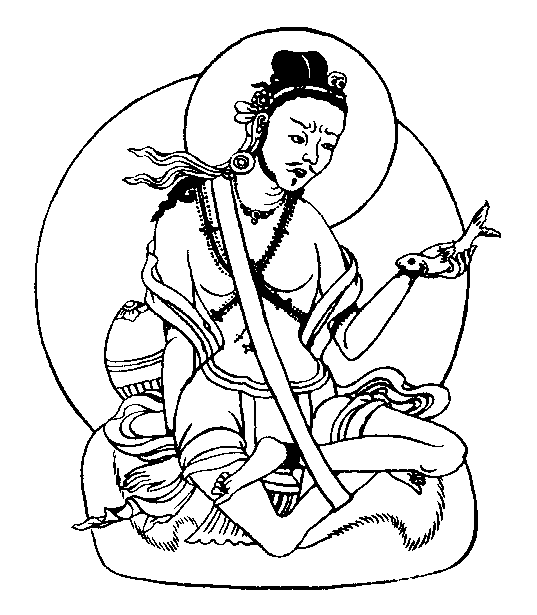
Tilopa
Indian Buddhist biographies may have been a rich oral tradition
while Buddhism was widespread in India. It was not unusual in
those days for people to carry their knowledge in the hearts
and minds, committing volumes to memory. Many abbots were able
to recite more than half the hundred volumes of the Buddha's
recorded teachings by heart. Some even knew them all. Unfortunately
the demise of Buddhism in that land destroyed its oral traditions
there. What remains is very little, preserved thanks to the
writings and subsequent printings of other countries' biographers,
especially Tibetans; a people with a very systematic mentality,
rather different from the romantic and beautifully-complicated
Indian mind which, as its architecture and music betray, delights
in obtuse diversion and the non-concrete.
Tilopa occurs twice among the famous 84 mahasiddhas of Indian
Buddhism—as Tilopa and Tillipa, although some believe these
to have been two separate individuals. The following summary
is based upon the present Tai Situpa's biography of Tilopa, for which
he drew upon the various fragments of biography which have survived
the ages.
There is an interesting parallel between the conception of Tilopa
and that of the present Karmapa. In both cases, the parents
turned to a holy man in their attempts to secure the child they
wanted, had their wishes fulfilled by the birth of a son, born
amid unusual signs, and then turned out to be the parents of
a wonder child, whose life, even from an early age, was to be
guided by the greatest spiritual teachers of his time.
In Tilopa's case, the guidance came from the commanding appearance
of a dakini ("sky-flyer" - female spiritual being), who manifested
at important moments in his life to set him in the right direction.
From the very outset, she made it clear to him that his real
parents were not his worldly ones, but primordial wisdom and
universal voidness:
"...your father is Cakrasamvara and your mother
is Vajravarahi .."
On her advice, he frequented monasteries and gradually took
up a monk's life, eventually becoming an erudite scholar and
an exemplary monk, known as Prajñabhadra. Following a vision,
he discovered a text hidden in the base of a statue in the monastery.
Not understanding its meaning he prayed to his dakini mentor,
who sent him to the illustrious gurus Matangi and Saryapa to
study tantra. Returning some time later to the monastery, he
furthered his classical studies. Another critical encouter with
his celestial dakini teacher initiated him further and definitively
closed the gaps that existed between his theoretical knowledge
and his experiential insight.
Following this, he travelled widely in India, going from guru
to guru until he had assimilated the very quintessence of each
major strand of vajrayana teaching of the day. In particular,
he received from Saryapa the teachings on purification of chakra
and subtle body, best known these days through their Tibetan
name of tummo. From Nagarjuna he received the illusory
body and radiant light teachings; from Lawapa the dream yoga;
from Sukhasiddhi the teachings on life, death and between-life
states (bardo) and consciousness transference; from Indrabhuti
teachings on insight (prajna) as the balancing of energies and
from Matangi the teachings on resurrection of the dead body.
Understanding the many parallels he found in the various traditions,
and realising that they each responded to the needs of different
people at different stages of awakening, he eventually condensed
their essence into four principal streams of teaching. It is
from these, and in these, that we have the true meaning of the
word Kagyu. In Tai Situpa's words:
"Taking avantage of his new-found
freedom, Prajñabhadra practised meditation very intensively,
travelling when necessary to receive the special techniques
and guidance of most of the great teachers of his day: Guhya,
Darika, Dingi and so on. The best of students, he mastered
all their vital teachings and was able to appreciate their
common points and their particularities. The lineages which
he inherited all condense into four streams of transmitted
wisdom. It is from these that the Kagyu tradition derives
its name, for 'Kagyu'
is a short form of the Tibetan
theg pa gsum gy snying don
bka bab kyi chos bzhi'i gdams ngag bar ma ckad pa'i brgyud
pa,
which roughly means the unbroken lineage
of profound and intimate guidance in the four sorts of transmitted
mastery, the heart meaning of the three yanas.
In the above, Ka is short for Ka.pap.zhi.
- which could be loosely rendered as 'four transmissions
of mastery'. Zhi simply mean four. Ka.pap is
a term without any equivalent in English. It means transmission—of
knowledge, skill, insight and teaching ability—in a specific
domain, from master to student, to the point where the student
enters into complete possession of all the master's prowess.
It is the sort of thing that takes place when someone already
gifted in, or deeply predisposed towards, a certain subject
seeks out the best person in that field and learns from them
everything they have to teach. Implicit to this process is
the spontaneous appreciation and rapid assimilation that occurs
when a student has a natural feel for a subject.
The four Kagyu transmissions referred to here
are those of:
 .. great seal - (Tib. phyag.rgya.cken.po Skt. mahamudra)
in this instance 'uncharacterised mahamudra', i.e. without
ritual, form or sophistry,
.. great seal - (Tib. phyag.rgya.cken.po Skt. mahamudra)
in this instance 'uncharacterised mahamudra', i.e. without
ritual, form or sophistry,
.. heat yoga -(Tib. gtum.mo, which literally
means 'angry mother'),
.. lucidity - (Tib. od.gsal
means ' as clear as if illuminated'--sometimes called 'clear
light' in modern translations) this includes dream and between-life
(bardo) yogas
.. union - (Tib. Ias.kyi.phyag.rgya
Skt. karma mudra)
...These four transmissions contain the very
essence of all three levels (yana) of Buddhism. Each contains
the others and therefore each contains everything. As a whole
they are called mahamudra.
If each of the above were not an aspect of
a whole, tu-mo, subtle heat, would simply be a technique
for producing warmth; one would be no more than a human oven.
Radiant lucidity would be just something illuminating, like
torchlight. They are not like that. Subtle heat and lucidity
are very profound practices, richly supported by mahamudra's
insight, mantras, visualisation-stage mahamudra etc. They
are very complete, each being a highlighted aspect of the
same thing.
These four, one of which is intimate knowledge
of mind and the other three skilful areas of technique, have
been transmitted in their original integrity, via a lineage
of perfect masters and perfected students, from the time of
Tilopa until our present day. They form the hub of the present
Kagyu Lineage.
During this period of his life, he acquired the name Tilopa,
which means sesame-grinder, as this
was the secret guise in which he lived externally, while all
the time perfecting his meditation internally. A marvellous
phrase occurs in this part of his biography:
"From this moment on, not one moment
of his life, day or night, was wasted."
Having inherited the Buddhist lineages of his time, Tilopa was
then advised by his guiding dakini to go to the impenetrable
valleys of Orgyen, where he would receive extraordinary transmissions
of teaching. In a veritable épopée, he worked and fought his
way through earthquakes, hallucinations, demon army attacks
and other phenomena and was rewarded by becoming heir to some
very special teachings; the heart teachings of the dakinis.
These included the nine secret dakini teachings and the four
wish-fulfilling-gem teachings.
Then followed his enlightenment. Although he had had many
excellent gurus, including celestial dakinis, his enlightenment
occured through direct fusion with the mind of Sakyamuni's
sambhogakaya. Tilopa experienced this as meeting "the Buddha
Who Holds the Vajra(yana)" (Vajradhara Buddha). The fivefold
transmission of insight that took place then is indescribable.
It ended with Tilopa being indistinguishable from the enlightenment
of all the Buddhas. The remainder of his earthly life was
spent teaching and ensuring that the precious wisdom and lineages
he had inherited were perpetuated by worthy disciples for
the future benefit of humankind.
|