The Depression era mining activity in the Howard would soon grow to spread over four main watercourses; the Maud, Maggie, New, and Louis Creeks. At first mining techniques were primitive and miners would simply fossick with gold pans, small sluice boxes and whatever hand tools were needed to move material through them. Small boulders were broken apart using spalling hammers before being stacked on the stream bank to enable miners to extract gold bearing gravel from the stream bed. As time went by the more easily accessible gold was eventually exhausted and miners adopted new techniques such as hydro mining with high pressure nozzles to wash gold bearing gravel from the banks of creeks. This usually meant bringing water from dams situated many hundreds of metres away using fluming and water races in order to obtain sufficient pressure. Another change was the use of explosives and motorised winches to move large boulders to the stream could be worked down to bedrock.
It was shortly after the outbreak of the First World War that my grandfather, Karl McDowell, first came to the Howard from Karamea with his parents. McDowell the senior became involved with an existing claim, while Karl would fossick in the upper Louis Creek due to the lower reaches being mostly taken up with claims already. On one fossicking trip during 1917 Karl found walls of moss covered stacked stone in the headwaters of the Louis Creek and considered this evidence of very early mining activity, possibly from the mid 1880's, when George Fairweather Moonlight was known to have prospected in the area.
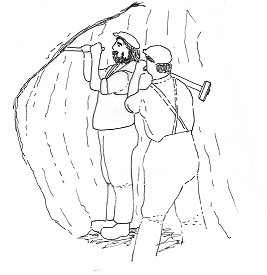
At different times throughout the early 1920's father and son would work a claim together, using just hand tools and a sluice box, although when material was too large to move or process by hand, they would bore holes into rocks using a hand drill and break them apart with explosives.
