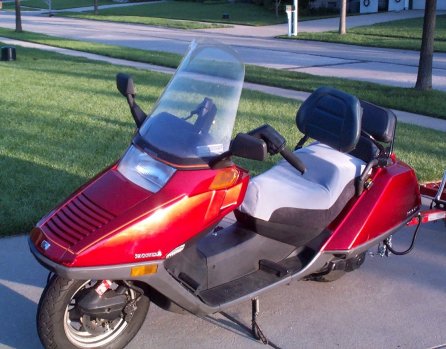
My Helix is a 1987 model with 9500
miles on it. Thanks to some lucky breaks, and a lot of assistance from Scoot
Tours, I have a great scooter that cost me $425. Scoot Tours is a club centered
around the Helix, and can be found at http://www.geocities.com/scoottours.
My interest in the Helix started
via the Internet. I have scoliosis, which is a curved back. Due to my scoliosis,
I cannot extend my arms straight ahead of my body for any length of time. In my
“younger days” I graduated from a Honda 90, to a Honda 175 (2 cylinder), to
a 1972 Honda 550 4 cylinder. I put 45,000 miles on the Honda 550, and then
finally graduated to a 1982 Gold Wing. My Gold Wing saw both coasts, and my wife
and I took our honeymoon on it. Unfortunately, my back was soon limiting me to
30 miles or less rides, even with a back belt. In 1985 I sold the Gold Wing. In
1996, via the Internet, I started to research two wheel vehicles that were
compatible with my back. After a lot of research, I found recumbent (human
powered) bicycles. Three years ago I bought a recumbent bicycle that has the
same wheelbase as a Helix (discussed on another page in this Web site). It has a
mesh seat that is about the same height and width as a lawn chair. In the last
three years, I put 2500 miles on this bicycle. In late 1998, via the Internet, I
discovered feet forward motorcycles (which have a seating position similar to my
recumbent bicycle) via a British Web site. This web site mentioned the Helix,
and that it was sold in America. Upon seeing that it was only a 250cc engine, I
initially rejected it. Further Internet research yielded an article about
someone who ran the Helix in the 1995 Iron Butt Competition (www.ironbutt.com).
In this competition Ed rode a Helix 9361 miles in 11 days! He placed higher than
some Gold Wings! I knew the Helix would work for commuting or highway travel,
and was interested in acquiring one. I told a few friends, and started patiently
looking for a “good deal” and spring.
I found my Helix in a police
impound lot. This was a case of knowing the right person, as any decent vehicle
never makes it from this lot to a public sale. In June 1999, my friend (who
requests to remain anonymous) called me and told me he had a Helix in sad shape.
Was I interested? I met him and saw this dusty Helix that had suffered some
neglect and an accident. It was picked up after being left on a public street
for a month with plates which had expired in 1994. My first reaction was
negative, but I asked him about the cost and title status. He informed me that
it would cost about $100 to acquire, and he could acquire a salvage title for
it. The Helix had a $800 tow and storage bill when I saw it, but he could
acquire it for about $100 because he worked for the tow and storage company
(that’s why you have to know someone). Most of the parts were there, so I knew
it was worth at least that price. I could not check the engine as the drivetain
was enclosed and I could not turn over the engine by hand. The Helix had no
battery or key, and I had no time to take the belt cover off. I told my friend
to start the acquisition process and crossed my fingers.
Acquiring an impounded vehicle is a
long and cumbersome process. It took two months to get the salvage title (the
original owner has a limited time period to claim the vehicle). It took another
couple of weeks to convince the tow lot owner to sell the Helix to my friend,
and not to his buddy who gets most motorcycles to fix up and sell. While
checking out the Helix, I saw two gorgeous Harleys in the same shed that ended
up going back to their owners when the drug charges were dropped, and two sports
bike that had been spray painted with gray paint at random. By the end of
August, my friend had the salvage title (which cannot be licensed). It was now
my job to convert the Salvage title to a licensable title in my name. The first
step is to buy a form at the license bureau. This took $25 and 2 hours in line
to buy the form! I then had to determine if this Helix was stolen (if it was, I
would lose it and be out the $100). I stopped a cop on the street and asked him
to run the license plate that was on the Helix. He gave me some weird looks, but
did it and he told me it was not stolen. My friend then had to get a police
investigator to come out to the lot to check the Helix for stolen parts. He
found none, and filled out the appropriate sections of the form I had purchased.
The next step was to send the form to the state capital. The next roadblock was
determining how much money to send with the form. No dollar amount guidelines
are provided. Salvage dealers must
know how much to send, but I did not. In Missouri, there is one person on one
phone in our capital that answers questions concerning this form. It took three
days of calling to get through. When I finally reached the official, she told me
I should enclose $31 to acquire a title, with a $3 expedite charge if I want
them to process it in 10 days instead of 3 months (who would not expedite this)?
With my application sent, I could finally turn my attention to getting the Helix
running.
In mid-September I finally took
delivery of the Helix. My friends bet me which would happen first: the Helix
would be licensed and running, or Missouri would be covered in snow and the bike
would be grounded. The Helix looked like this when I picked it up:
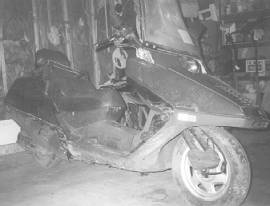
Note the abandoned sticker on the windshield, the damaged
front lights, and passenger backrest. I pity whoever was on this Helix when it
was in a accident. The plates expired in 1994, so I guestimated that the
accident occurred in 1994.
The first goal was to get the motor running and the Helix moving. Thanks
to Scoot Tour’s Maintenance Guide, I purchased the service manual at discount
($25) from Dreyer Honda. I went to Sams and bought the recommended battery.
Unfortunately, I listened to my local Honda dealer’s service department and
tore the whole dash apart getting the keycode. The keycode is the same keycode
as the trunk, and the trunk lock is very easy to remove. The key cost me $6 and
I bought some touch-up paint at the same time. Next I drained the gas from the
tank. The gas lid was off when I received the Helix, and the gas was full of
rust. I used a hand pump to get most of the gas out of the tank. I then removed
the plug on the bottom of the tank. When doing this, please make sure you have a
large area under the tank to collect the gas. The fuel drips onto the shield on
the bottom of the tank, and then drips out all around the tank area on the edges
of the shield! After refilling the tank with fresh fuel, I tried to get the fuel
pump to kick on by manually jumping it via the wire connector and instructions
in the shop manual. I never did get this working. Finally the moment of truth
came – I had new fuel and oil in the bike. I cranked the electric starter and
--- nothing! No-one told me you had to hhold the rear brake pedal in (salvaged
bikes don’t come with owners manuals and the shop manual does not mention
this). By trial and error, I pushed the rear brake and finally had the starter
working. I cranked for awhile and --- nothing! Removing the fuel line from the
carburetor while cranking yielded a mess, so I knew that the fuel filter and
pump were working OK. Cranking the engine by hand (by moving the driven pulley
on the drive belt after checking the condition and width of the belt) indicated
that the engine had compression, and the valves were probably working. Removing
the new spark plug and taping it so the outside was grounded while cranking
showed plenty of spark, so the electrical system appeared OK. The lack of
firing, and lack of gas smell, indicated that I may have carburetor problems.
Smelling and feeling (putting my hand behind) the exhaust confirmed that nothing
but air was getting into the engine.
The next step was to rebuild the carburetor. A friend (actually the
employee of the police impound lot) volunteered to do this, if I removed the
carburetor. After a lot of consultation from the shop manual, I had the
carburetor in my hand. My friend and I determined that both jets were totally
clogged. He cleaned them out, and I put the carburetor back on the bike. A few
cranks later (to get fuel to the carburetor) and --- the Helix engine fired to
life! No work was required to the
valves or any part of the engine. I did buy a gallon of antifreeze and mixed it
with water to replace the 1.5 quarts required to refill the cooling system.
With the engine running, it was time to start working on the body and
upper frame. In Missouri, we have a yearly safety inspection that requires all
lamps, horn, … to work. I had no headlight or turn signals, cracked bodywork,
… My biggest obstacle was the headlight. The bulb worked, but the lens was
cracked and most of the glass was missing. A called to Honda indicated that the
headlight assembly costs $210. Dreyer Honda (?) offers a discount to Scoot Tours
members, but the discounted assembly cost more that I had invested in the Helix.
Ray (found
through Scoot Tours) came to the rescue. Ray saves parts from damaged Helixs and
had a spare headlight assembly that he graciously sold to me for $50. Steve’s
Cycle, Inc. labeled in Scoot Tours as Willie’s Cycle at 1-800-622-9253, sold
me a right mirror for $20 and turn signals for $15 each. With the parts on
order, I started to remove the appropriate body parts. The fairing came off to
access the headlight. The trunk and rear cover was removed to repair the
passenger backrest and upper rear frame. With these parts removed, I now had a
black low rider. Friends and I ran the Helix up and down our street (no real
title at this time) while it looked like this:
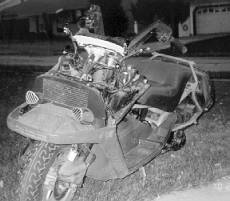
The upper rear frame required a lot of bending and a little
welding. All four mounting holes for the rear red trunk cover were sheered.
Parts of the fairing had broken completely through. To repair the body, I used
Napa Plastic cement which is made for outdoor applications. Similar to epoxy,
the glue is two parts that are mixed and take an hour to setup. This glue is
holding many parts of my Helix together. Many coats of touch up paint, scratch
remover, and wax have greatly improved the body’s appearance. The coating on
the windshield required rubbing compound to remove it and then scratch remover
to remove the scratches induced in the process.
On October 28th, approximately five months after first seeing
it, my Helix was inspected, insured, and licensed. I had $325 invested in the
Helix in purchase, license fees, and parts and I was legal!. The next remaining
problem was the front tire. 80% of the tire was perfect, but one 9 inch section
was dry rotted. I guess that the Helix must have been covered for the four years
since it was licensed, but this one section was exposed. Calls to local Honda
and motorcycle dealers yielded no tire. I called Dunlop (via a e-mail and phone
number on the Internet), and they told me it would take months to get a tire.
Can you imagine this response if you were on the road? Finally I called Niehaus
Cycles from their ad in Scootin. They told me I would have a tire the next day (Niehaus’s
UPS depot is St. Louis). After a little cursing taking the tire off and on
(doing this on the road would be very difficult), and the assistance ($60 tire +
$15 mount more invested) of a local motorcycle shop, I was ready for the
highway. During this time, I was having fuel filter problems. The surface rust
in the gas tank kept clogging fuel filters. After a 50 mile ride, the Helix
stopped idling and started backfiring at low RPMs. I thought it was another fuel
filter problem, but further investigation pointed to the carburetor.
During a second carburetor rebuild, the problem was traced to the idle
mixture screw which had worked its way out and fallen out of the carburetor! By
pure luck, the screw had fallen into the swingarm and was still there 60 miles
later.
It was time to remove the gas tank. The rust in the gas tank had to be fixed. Three fuel filters turned a bright rust color, one at a time. The lower fairing and middle body panels had to be removed. By this time, I have removed every single panel that can be removed from the Helix. The gas tank was removed from the frame. After discussing what to do with many “experts”, the cure was to partially fill the gas tank with small sharp pebbles and kerosene. Then you shake and shake for awhile to scrape off the surface rust in the tank. This method only works if you have surface rst problems and the gas tank itself is not rusted through. Four kerosene flushes later, and lots of shaking to remove pebbles, the tank was clean. In another brilliant move, I spilled ¼ gallon of gas in my car when getting fuel to refill the tank. The smell is still there three months later, but greatly reduced. The shake and shake treatment appears to have worked, as the fuel filter continues to run clear.
To assist my back, I purchased an ex-Gold Wing backrest from Mike (of
Scoot Tours). The backrest was modified to attach to my now custom rear backrest
mounts. Resting against this backrest, having the handlebars turned down, and
putting my feet at the top of the floorboard (above the rear brake pedal) has
really helped my back. Placing my size 13 feet this high on the floorboard
prevents the use of the air damns, which were missing when I acquired the Helix.
I now have a Helix that runs great, looks acceptable, and cost me $425.
I’ve decided not to re-paint this Helix, as the scars are a part of its past.
The next step is to find a way to haul my 6 foot long bicycle on the Helix. Due
to its length, the bike will end up on a trailer. While fixing the rear frame,
we added a “custom” black trailer hitch.
If you have any questions comments, or suggestions on the above, please
contact me at [email protected], or at the next Scootercade. Look for the resurrected Helix
with the battle scars.
Update March 2002
In the last two summers I've added 7000 miles to the Resurrected Helix.
With the exception of one flat tire, the Helix contines to run great!
A minor backfiring problem was traced to the exhaust insulator being
damaged when the back tire was replaced.
Costs to date:
$425 - Acquire the Helix and make it licensable/roadworthy
$300 - Required maintenance at 12,000 miles (belt, tire, brakes, clutch, air filter)
Baring unforseen problems, The Resurrected Helix and I should be at the 2002 Scootercade!
Update October 2004
The Helix now has 24800 miles on it. 15,300 of those miles are mine!
Only failures to date are a back tire air valve core coming loose (flat)
and the driven clutch bolt coming lose (then no power to rear wheel)