| Messier/type: | M44 / open cluster |
| mag/dia/dist: | 3.1 / 1.7 degree / 580 ly |
| constellation: | Cancer |
| date/time/place: | Dec 17, 2000 / 00:45 / bangkok |
| trans'y/seeing/l-poll: | low / fair / high |
| telescope: | newtonian 4.5" f8.8 |
| eyepieces/power: | 25mm / 40x |
| sky atlas page: | 6 |
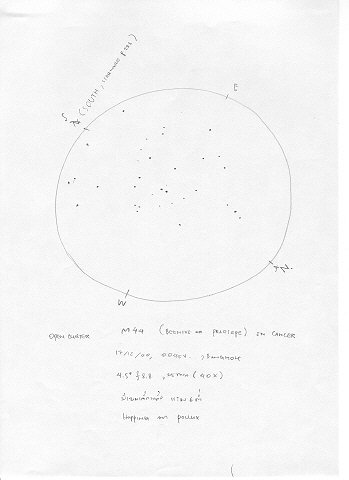
Hopping from Pollux in Gemini, as Cancer has no bright star. Caster & Pollux are quite fit in FOV of finder scope (about 5 degree, FOV = 6 degree). Center at Pollux, star 75 & 83 (mag5 & 5.5) will help to find out correct direction. Star 75 is closer to Pollux more than 83. Pollux-->star 83-->points to M44. You can scan telescope (or binoculars) in this direction about 15 degree from Pollux. For the first time, I hop from star 83 to stars 2,4,13 & 14 in Cancer, then hop to stars 19,24, 28,30 & 32, further hop to stars 43,33 & 47. M44 locates at the center of triangle comprise of stars 43,33 & 47; it can be seen in finder scope. M44 surrounding with three bright stars is very impressive, but need FOV 5 degree, Binoculars is very suitable for this. At eyepiece (25mm,FOV 1.25 Degree), M44 appeared as large cluster, elongated in north-south direction.
Refer to text: 50 stars detached, weak concentration, star max mag6.3, extend 17 ly, age 660 million years.
note: In my sketch, there are 34 stars. But Galileo recorded 36 stars. He used 1 inch refractor. Home