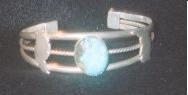
Some of the most beautiful pieces of jewelry in the world have been made with turquoise. Mined heavily in many parts of the world, it can be found in great abundance in our own Southwestern region of the United States
There are a few different forms in which turquoise is found. This occurs when crystals form in the cracks of other rocks. It is mostly too thin to be cut away from the original stone. It can also be found in larger chunks, often with pieces of other rocks mixed in with the turquoise.
Turquoise is also replicated by man-made plastic easily. It is very difficult to tell the difference between these and authentic stones and is often sold for the price of real turquoise. There are also many different minerals, like Chrysocolla, Malachite, and Variscite, that because of their color are mistaken and sold for turquoise.
When looking for a fine grade of turquoise, one should remember the ideal shade is a bright royal blue. However, turquoise can come in a variety of blue shades. Some turquoise is more porous than others, causing it to turn green over time. This is caused by continuous wear and the absorption of skin oils into the stone.
For thousands of years, people from all parts of the world have been fascinated by turquoise. The first example of turquoise jewelry was of a gold and turquoise bracelet on the arm of a mummified Egyptian queen. This piece of jewelry is thought to be 7,000 years old - the oldest example found to date.
Turquoise has been mined in Persia since about that time as well. It was used in Persian jewelry as much as in jewelry of Egyptian royalty. Writings of the area tell of large vases carved from huge pieces of turquoise. One of them had the capacity of 6 gallons.
The Chinese also found use for turquoise. Large quantities were made into beads and traded into Mongolia and Tibet. Because turquoise is easily carved, the Chinese made beautiful carvings from larger pieces. To the Chinese, turquoise is second only to jade.
Probably the most recognized style of turquoise jewelry is found in the southwestern part of the United States. The Southwest is an ideal environment for turquoise, which is a mineral generally found at higher elevations in semiarid regions. Many of the mines in this area have been worked since prehistoric times and produce a large quantity of turquoise.
To the Native Americans, turquoise symbolizes the sky and water. It is also associated with healing and protection. The Navajo, for example, give turquoise bracelets and earrings to newborns to shield them from accidents and disease. Since turquoise is considered a good-luck stone, it had been associated with the hunt. Stone fetishes of bears and mountain lions wrapped with bits of turquoise have been found in prehistoric sites. Navajo sheepherders often carried turquoise fetishes to encourage growth of their flocks.
There are a few different techniques in which Native Americans use to construct turquoise jewelry. One of these is the Zuni technique. The Zuni almost always construct the stone for the piece of jewelry. In other words, they first make the metal into the piece of jewelry. Then, they cut the stones in order to fit into the bezels creating a more precise shape.
Another is the Hopi technique. The Hopi use an overlay method. They cut out a design in a piece of metal and solder it on top of another piece of metal. They like to place emphasis on the design in the metal, using turquoise primarily as an accent.
A third technique is the Navajo technique. This is where the parts of the jewelry are designed around the stone. While the jeweler does not have to worry about cutting the stone, they need to be sure all parts of the piece fit the stone perfectly. This technique can be used to make some very interesting pieces as the stone does not have to be cut into a perfect shape.
It is because of its beauty that people became captivated by turquoise so long ago. Its versatility and classic look has kept it in the jewelry mainstream ever since. In the future, it will continue to be worn, sought after, and a symbol of good luck to many.