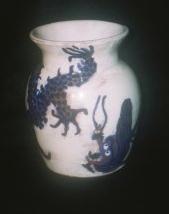
The Chinese have been crafting the finest porcelain and ceramics for the past 4000 years. In china, ceramics show a much greater diversity than any other art form. However, there is a distinct unified style in all forms of Chinese art, especially the pottery. It is a very elegant, simplistic, and classic look that has captured the worlds attention; from the poorest peasant to kings and queens and even the art critics of today.
Most likely the most talked of period in Chinese art history is the Ming Dynasty, which lasted from the 15th to the17th centuries AD. The pottery in this period is beginning to produced in more centralized areas, particularly in the province of Ching-te-Chen. Many of the smaller workshops were beginning to disappear.
The main feature of Ming ceramics is the beautifully painted decoration, either in blue or red underglaze. Pieces made for royalty were of the most perfect materials, while pots made for trade were often made with bad glaze, ill-concealed joints, and poorly finished bases.
The shapes of the Ming period are also very characteristic. Mei-Ping vases with high shoulders and a narrow neck were a popular shape as were wide jars, bulb-shaped vases, gourds, and stemmed cups. Figures of legendary heroes and gods as well as small animal models also became popular.
At the beginning of the 15th century, the decoration style became more fixed. The classic motifs were inspired from designs on the embroidered silks. Lotus leaves, animals, clouds, Taoist symbols, and story illustrations were among the more popular designs.
The use of marks also became popular at this time. These marks were either painted on the base or the edge of the piece and almost always in underglaze blue. These are called �reign marks�, which were chosen by the emperor at his accession, to identify the dynasty. However, it was common to accidentally mark pieces with that of an earlier dynasty making identification somewhat inaccurate.
Blue and white were the most common colors of the Ming Dynasty. Large plates with floral motifs were prominent in the beginning of the 15 century. The reign of Ch�eng Hua (1465-1487) saw the first polychrome pieces. Enamel colors and underglaze blue were used to give the �five -color� technique (wu ts�ai). The reign of Wan Li and the Transitional period were known for the classic style called tou ts�ai. The outlines were traced in a pale blue, contrasting with clear toned enamels.
A well known style from the 15th and 16th centuries is the �three-color� (san ts�ai). This comes from provincial factories making architectural pottery. They made vases with lots of outline, religious figures, and garden scenes. The colors are mostly dark blue, turquoise, aubergine, and white. These colors show the characteristic Ming taste for a polychrome palette, and is very different from the styles of earlier dynasties.
Sadly, Chinese ceramics today are mostly copies of earlier pieces and don�t offer as much artistic value. However, the beauty of Chinese pottery from the past still endures today and is greatly respected in the art world.