| Medieval Sports & Games |
| Introduction |
 |
 |
 |
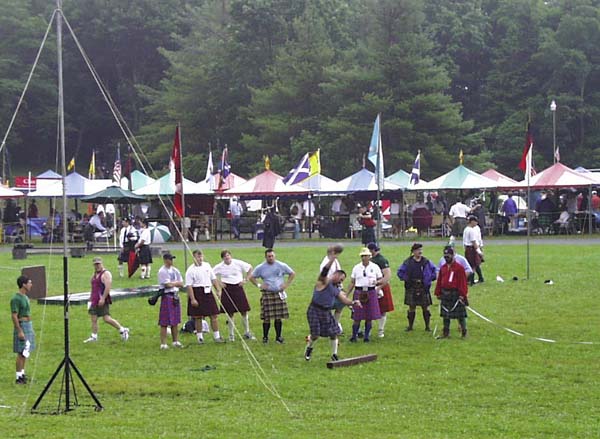 |
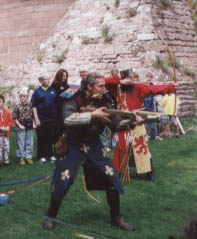
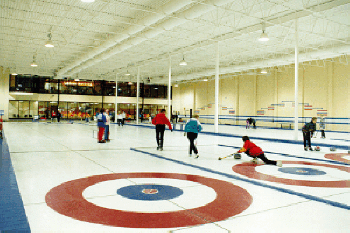
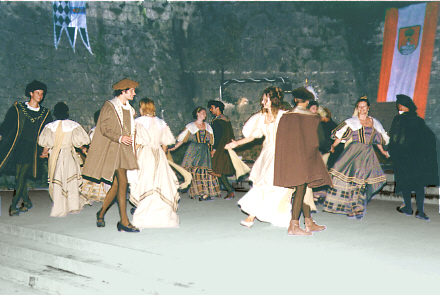
| Many sports and activities that were played in the Middle Ages are still popular today. Such activities include: early field hockey (played by men in Medieval Europe), early curling (the point of which is to move a heavy puck-like object across ice by sweeping a broom in front of is very quickly), shot-put (throwing a small, heavy ball as far as one can), early bowling, early tennis, wrestling, archery, football (played first with a Viking's head -British- then with an inflated pig's bladder) and skiing. Other popular activities included dancing, chess, sledding, ice skating, sleigh rides, and water jousting. |
| Tournaments |
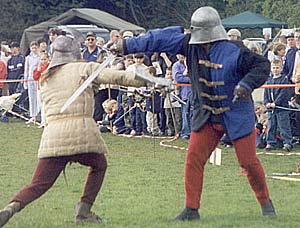
| Tournaments were competitions between two knights at a time.Tournaments formed in the eleventh century in France and were run by local royalty. Tournaments included many events (i.e. jousting, swordfighting or martial arts and wrestling). There was also a second type of tournament called the melee in which two teams of knights would simulate a battle. Similar to flag-football (played now-a-days) each knight would wear a flag and would try to tear off the flag wore by an opponent. Tournaments lasted for nearly six hundred years despite attempts by the Roman Catholic Church to end them. The Church disliked these tournaments because many knights died from injuries sustained during their event(s). They proved to be too popular, however, and the Catholic Church did not have the power to stop them from occuring. |
| Purpose of a Tournament |
| The puropse of a tournament was for knights to stay in good condition for battle. They served as good training and practice because of the variety of events. They also served as entertainment for citizens. |
 |
 |
 |
 |
 |
| Popular Sports |
| The Middle Ages lasted for five-hundred years (between 1000 and 1500 a.d.). During the time of the Roman Empire, people in Europe entertained themselves through watching physical competitions. These competitions evolved into such sports as jousting, wrestling and football as the Middle Ages began. |
 |
|