I know a bank where the wild thyme blows,
Where oxlips and the nodding violet grows,
Quite over-canopied with luscious woodbine,
With sweet musk-roses and with eglantine:
There sleeps Titania sometime of the night,
Lull'd in these flowers with dances and delight;
And there the snake throws her enamell'd skin,
Weed wide enough to wrap a fairy in.
--Oberon, A Midsummer Night's Dream, Act II, Scene I
PUCK: How now, spirit! whither wander you?
Fairy: Over hill, over dale,
Thorough bush, thorough brier,
Over park, over pale,
Thorough flood, thorough fire,
I do wander everywhere,
Swifter than the moon's sphere;
And I serve the fairy queen,
To dew her orbs upon the green.
The cowslips tall her pensioners be:
In their gold coats spots you see;
Those be rubies, fairy favours,
In those freckles live their savours:
I must go seek some dewdrops here
And hang a pearl in every cowslip's ear.
Farewell, thou lob of spirits; I'll be gone:
Our queen and all our elves come here anon.
PUCK: The king doth keep his revels here to-night:
Take heed the queen come not within his sight;
For Oberon is passing fell and wrath,
Because that she as her attendant hath
A lovely boy, stolen from an Indian king;
She never had so sweet a changeling;
And jealous Oberon would have the child
Knight of his train, to trace the forests wild;
But she perforce withholds the loved boy,
Crowns him with flowers and makes him all her joy:
And now they never meet in grove or green,
By fountain clear, or spangled starlight sheen,
But, they do square, that all their elves for fear
Creep into acorn-cups and hide them there.
Fairy: Either I mistake your shape and making quite,
Or else you are that shrewd and knavish sprite
Call'd Robin Goodfellow: are not you he
That frights the maidens of the villagery;
Skim milk, and sometimes labour in the quern
And bootless make the breathless housewife churn;
And sometime make the drink to bear no barm;
Mislead night-wanderers, laughing at their harm?
Those that Hobgoblin call you and sweet Puck,
You do their work, and they shall have good luck:
Are not you he?
PUCK: Thou speak'st aright;
I am that merry wanderer of the night.
I jest to Oberon and make him smile
When I a fat and bean-fed horse beguile,
Neighing in likeness of a filly foal:
And sometime lurk I in a gossip's bowl,
In very likeness of a roasted crab,
And when she drinks, against her lips I bob
And on her wither'd dewlap pour the ale.
The wisest aunt, telling the saddest tale,
Sometime for three-foot stool mistaketh me;
Then slip I from her bum, down topples she,
And 'tailor' cries, and falls into a cough;
And then the whole quire hold their hips and laugh,
And waxen in their mirth and neeze and swear
A merrier hour was never wasted there.
But, room, fairy! here comes Oberon.
A Midsummer Night's Dream, Act II, Scene 1
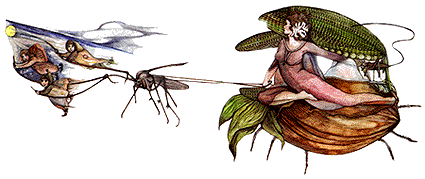
O, then, I see Queen Mab hath been with you.
She is the fairies' midwife, and she comes
In shape no bigger than an agate-stone
On the fore-finger of an alderman,
Drawn with a team of little atomies
Athwart men's noses as they lie asleep;
Her wagon-spokes made of long spiders' legs,
The cover of the wings of grasshoppers,
The traces of the smallest spider's web,
The collars of the moonshine's watery beams,
Her whip of cricket's bone, the lash of film,
Her wagoner a small grey-coated gnat,
Not so big as a round little worm
Prick'd from the lazy finger of a maid;
Her chariot is an empty hazel-nut
Made by the joiner squirrel or old grub,
Time out o' mind the fairies' coachmakers.
And in this state she gallops night by night
Through lovers' brains, and then they dream of love;
O'er courtiers' knees, that dream on court'sies straight,
O'er lawyers' fingers, who straight dream on fees,
O'er ladies ' lips, who straight on kisses dream,
Which oft the angry Mab with blisters plagues,
Because their breaths with sweetmeats tainted are:
Sometime she gallops o'er a courtier's nose,
And then dreams he of smelling out a suit;
And sometime comes she with a tithe-pig's tail
Tickling a parson's nose as a' lies asleep,
Then dreams, he of another benefice:
Sometime she driveth o'er a soldier's neck,
And then dreams he of cutting foreign throats,
Of breaches, ambuscadoes, Spanish blades,
Of healths five-fathom deep; and then anon
Drums in his ear, at which he starts and wakes,
And being thus frighted swears a prayer or two
And sleeps again. This is that very Mab
That plats the manes of horses in the night,
And bakes the elflocks in foul sluttish hairs,
Which once untangled, much misfortune bodes:
This is the hag, when maids lie on their backs,
That presses them and learns them first to bear,
Making them women of good carriage:
This is she--
Mercutio, Romeo and Juliet, Act I, Scene IV
MISTRESS QUICKLY: Fairies, black, grey, green, and white,
You moonshine revellers and shades of night,
You orphan heirs of fixed destiny,
Attend your office and your quality.
Crier Hobgoblin, make the fairy oyes.
PISTOL: Elves, list your names; silence, you airy toys.
Cricket, to Windsor chimneys shalt thou leap:
Where fires thou find'st unraked and hearths unswept,
There pinch the maids as blue as bilberry:
Our radiant queen hates sluts and sluttery.
The Merry Wives of Windsor,, Act V, Scene V
There is an old tale goes that Herne the hunter,
Sometime a keeper here in Windsor forest,
Doth all the winter-time, at still midnight,
Walk round about an oak, with great ragg'd horns;
And there he blasts the tree and takes the cattle
And makes milch-kine yield blood and shakes a chain
In a most hideous and dreadful manner:
You have heard of such a spirit, and well you know
The superstitious idle-headed eld
Received and did deliver to our age
This tale of Herne the hunter for a truth.
Mistress Page, The Merry Wives of Windsor, Act IV, Scene IV
|