 |
 

|
|
|
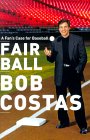
Bob Costas is a fan of baseball. He appears numerous times in Ken Burns'
"Baseball" series. He knows baseball. This book is his attempt to show
what is right about our national pastime, and what is wrong. And where
it went wrong. It also gives good solid arguements on how to fix it.
According to Costas, baseball's problems started in 1993 when the owner's
shook up the leagues to try to generate popularity. This only made it
worse. Baseball was turning into hockey, football, and basketball. The
bulk of the book is spent detailing what should have happened in 1993,
what he would change, and what he would return to it's former self.
The solutions for baseball are roughly split into five catagories. -
1993
- Revenue sharing
- Salary caps
- Realignment
- Wild Card
--On 1993
Baseball thought it had problems. It's popularity had been going down
for several years. Baseketball's had been on the rise. Basketball was
as popular as baseball. That should tell you something. Basketball at
it's highest was only AS popular as baseball in it's lowest. Nevertheless
the owners did something drastic and, according to Costas, borderline
stupid (my words, not his). Among the things that happened were three
divisions per league and wild cards.
--On Revenue sharing
Currently every team gets $15 million for national TV coverage. Gate receipts,
stadium revenue, and local TV money go only to the home team. Therefore,
the Yankees make $58 million, the Cubs $56 million. At the other end,
the Expos make $3 million. The Twins $5 million. You can see by this how
big money teams can attract top talent and be in a position to compete
for championships year after year. Since 1993 all playoff teams have been
in the top ten in revenue. The world champion has been in the top five.
Enter revenue sharing. All teams would get a semi-equal share (60% home
team 40% visiting team) of gate receipts, stadium revenue, and local TV
money. After revenue-sharing is implemented, the Yankees get $54 million,
the Expos get $27 million.
Yes, lesser teams may be taking away some of the successful team's revenue,
but it's for the greater good of the league. More evenly-matched teams.
Everyone has a chance at competing for top talent and the top spot.
|
|
|
|
--On Salary caps
Because there are a handful of players that have yearly incomes in the tens
of millions, only high revenue teams can afford them. The rest can afford
one, maybe two each. A salary ceiling makes top players affordable to all
teams. But, along with a ceiling on salaries, there is also a floor. A minimum
salary that fluctuates with the league's total revenue. These guys will
still make a ton of money. After all, the clubs make a ton of money because
of their talents, they should get their fair share. But the range shouldn't
be $15 million a year vs $300,000. Costas provides a formula for the ceiling
and floor based on the total revenue from the previous year.
--On Realignment
There has been a desire to adjust the leagues and divisions to cut down
on traveling and create rivalries. Houston vs Texas. Oakland vs San Francisco.
New York vs New York. You get the picture. The problem is that baseball
is a very historical sport. More historical than any other. The country
was glued to Mark McGwire as he chased and broke Roger Maris' record.
No one cares about football or basketball records. To this end, rivalries
are built through a history of two good teams consistently competing for
the top spot. City distance doesn't make a rivalry, ecstacy and heartbreak
does.
--On the Wild Card
In a nutshell...having a wild card takes all the competition out of a
pennant race. Look at football, basketball, and hockey. The regular season
is just jockeying for playoff position. Costas sites numerous pennant
races that went down to the wire. At the end of the season, there's a
winner and a loser. Wild card advocates site instances where the wild
card provided a race. In reality, without the wild card the race would
have been there, just not for 2nd and 3rd place. His solution is to keep
the three divisions and let the team with the best record get a reward
for doing so. Home field advantage and a bye into the league finals. His
solution does require moving one team from the NL to the AL in order to
keep an even number of teams in each league. That team is...read the book.
This book gave good insight into the pros and cons of all that has gone
wrong with baseball since 1993. I can't say I'm impressed with Costas'
baseball knowledge. I've always known him to be knowledgeable about baseball.
He being the author was the main reason I read this book.
|




