HW4
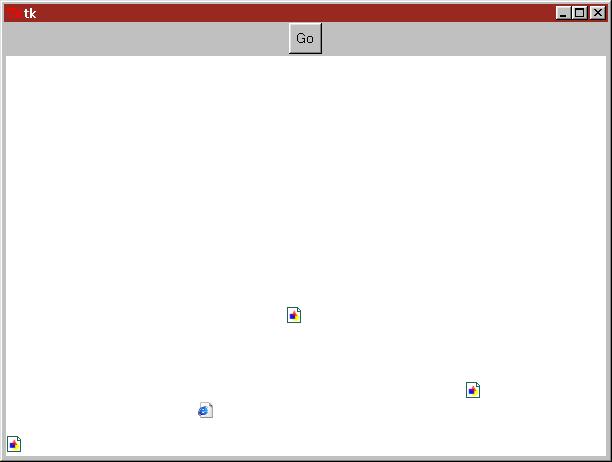
Screen shot of HW 4:
Zipped version of hw4.stl
Code of hw4.stl:
program hw4;               -- SETL interactive interface example 1
	use tkw, random_pak;    -- use the main widget class

    -- ball_data stores all info about the balls:
    -- color, current x & y coords of the center,
    -- x & y coords of the center 1 sec ago, mass.
    -- Based on this data we can compute momentum
    -- and speed (for bouncing).
    var ball_types := {
    					{"red", {-100,-100,-100,-100}, 1.0},
    					{"blue",{-100,-100,-100,-100}, 1.5},
    					{"green", {-100,-100,-100,-100}, 2.0},
    					{"black", {-100,-100,-100,-100}, 5.0}
    				  };
    var colors := ["red", "white", "blue", "black"];
    var canvas_width := 600, canvas_height := 400, diam := 10;
    var gravity := 10.0;
    var elasticity := 0.9; -- a number in 0..1 telling how much of the enegry
    					  -- does the ball looses with every jump off the ground
    var immobility_counter := 0; -- if same coord pattern repeats - ball is immobile, remove it
    var imctr_x:=0, imctr_y:=0; -- coords used in determining immobility
	var ca; -- canvas
	var icons; -- list of icons
	var GLOBAL_DEBUG := 0; -- debug level

	-- use images instead of the balls!
	--MyImage := Tk("image","myball.gif");
   	--MyBall := Canvas("image",MyImage);

    var balls := {}; -- array of ball_data-like items - 1 for each ball on screen

    var Tk,blue_circ,red_circ,num_steps := 0;    -- globalize for use in procedure below
    var rand_handle, rn; -- handle for random integers; rand number
    rand_handle := Start_Random(canvas_width, OM);            -- create a stream of random numbers

    Tk := tkw();                                            -- create the Tk interpreter
    bu := Tk("button","Go"); bu("side") := "top";   -- create a button
    bu{OM} := new_ball;    -- clicking the button starts the animation
	URLIcon := Tk("image","icon_url.gif");
	RMIcon := Tk("image","icon_rm.gif");
	GIFIcon := Tk("image","icon_image.gif");
	icons := [URLIcon, RMIcon, GIFIcon]; -- image of a ball

    -- create a canvas
    ca := Tk("canvas",str(canvas_width)+","+str(canvas_height)); ca("side") := "top"; ca("background"):= "white";
    --blue_circ := ca("oval","-100,-100,-140,-140"); blue_circ("fill") := "blue";   -- insert the circles
    --red_circ := ca("oval","-400,-100,-440,-140"); red_circ("fill") := "red";
    Tk.mainloop();          -- enter the Tk main loop


    -- starts the new series of balsl animation
    procedure new_ball();
    	init_ball(); -- show a ball in random place, gets passed a rnd num in 1..4
    end new_ball;

	-- start the movement of 2 new balls
	procedure init_ball();
		var x1, x2, y1, y2, r := diam, coords1, coords2, color;
		var mass := 0.0;
		var diff, aball;

		-- create random parameters for the new ball
		-- current coords
		x1 := random(rand_handle);       -- 0..600
		--y1 := canvas_height - fix(0.6666 * float(random(rand_handle))); -- 0..400 translated into screen Y coords
		y1 := fix(0.6666 * float(random(rand_handle))); -- 0..400 translated into screen Y coords
		coords1 := str(x1) + "," + str(y1) + "," + str(x1+r) + "," + str(y1+r);
		-- prev coords, should be close by
		diff := random(rand_handle)/30 - 10;               -- makes diff bet -10 and 10
		x2 := x1 + diff;       -- near by
		diff := random(rand_handle)/30 - 10;               -- makes diff bet -10 and 10
		y2 := y1 + diff; -- 0..400
		coords2 := str(x2) + "," + str(y2) + "," + str(x2+r) + "," + str(y2+r);
		color := colors(random(rand_handle)/200 + 1);
		mass := float(random(rand_handle))/60.0;

		-- new ball's index in the tuple of balls
		num_balls := #balls;
		num_balls := num_balls + 1;

		-- set up info for the new ball
		--aball := ca("oval",str(x1) + "," + str(y1) + "," + str(x2) + "," + str(y2));
		--aball("fill") := color;

	 	aball := ca("image",icons(random(rand_handle)/200+1)); -- load random image
   		aball("coords") := str(x1) + "," + str(y1);

        balls(aball) := [color, x1, y1, x2, y2, mass];
		debug(1, str(num_balls) + "Init: ball=" + str(aball) + "; coords: " + str(balls(num_balls)) );
		--ndebug(1, aball);
		--ndebug(1, "; coords: ");
		--debug(1, balls(aball)); -- debug
		animate();
	end init_ball;

    -- advance the animation and return true, or false if finished
    procedure animate();
    	var color, x, y, x0, y0, mass := 0.0; -- ball data
    	var new_x, new_y;
    	var temp_x, temp_y; -- used in swapping coords

     	if #(circles := domain(balls)) = 0 then return; end if;		-- teminate if no cir

    	-- go through all balls on screen, i is current image
    	-- move them according to their velocities and gravity
		for i in circles loop

			[color, x, y, x0, y0, mass] := balls(i);
			debug(1, "Existing coords: (" + str(color) + "," + str(x) + "," +
				str(y) + "," + str(x0) + "," + str(y0) + "," + str(mass) + ")");

			-- delete balls rolled beyond the screen
			if x > canvas_width+diam then balls(i) := OM; i.delete(); continue; end if;
			if x < -diam then balls(i) := OM; i.delete(); continue; end if;

 			-- movement in the gravitational field of the planet
 			-- happens according to the following cooords eqations:
 			-- x(i+1) = 2*x(i) - x(i-1);
 			-- y(i+1) = canvas_height - (2 * y(i) - y(i-1) - a/2), where a is
 			-- deceleration, +10 m/(s*s)

  			-- so, advance position and apply gravity
  			new_x := 2*x - x0;
 			new_y := 2*y - y0 - fix(gravity/2.0);

  			debug(1, "Old: (" + str(x) + "," + str(y) + ")"); -- new coords

   			x0:=x; y0:=y; x:=new_x; y:=new_y;

			debug(1, "; so: (" + str(x) + "," + str(y) + "," + str(x0) + "," + str(y0) + ")");

			-- bounce off boundaries
			-- bottom border: swap y0 and y
			if y < diam then
				ndebug(1, "bottom:");
				temp_y:=y;
				y:=y0;
				y0:=temp_y; -- swapped!
				ndebug(1, "Swapped: (" + str(x) + "," + str(y) + "," + str(x0) + "," + str(y0) + ")");
				y:=fix(float(y0) + float(abs(y-y0))*elasticity); -- make the bounce non-absolutely elastic
				ndebug(1, "upper: " + str(y));
				if y < diam then y0 +:= diam-y; y := diam; end if;
				debug(1, "(" + str(x) + "," + str(y) + "," + str(x0) + "," + str(y0) + ")");
			end if;

			-- right border: swap x0 and x
			if x > (canvas_width-diam) then
				debug(1, "right: ");
				temp_x:=x;
				--x:=x0;
				x:=fix(float(temp_x) - float(abs(temp_x-x0))*elasticity*0.3);
				x0:=temp_x;
				debug(1, "(" + str(x) + "," + str(y) + "," + str(x0) + "," + str(y0) + ")");
			end if;

			-- left border: swap x0 and x
			if x < diam then
				debug(1, "left:(" + str(x) + "," + str(y) + "," + str(x0) + "," + str(y0) + ")");
				temp_x:=x;
				x:=x0;
				x0:=temp_x;
				debug(1, "Swapped:(" + str(x) + "," + str(y) + "," + str(x0) + "," + str(y0) + ")");
				x:=fix(float(x0) + float(abs(x-x0))*elasticity*0.3);
				if x < diam then x0 +:= diam-x; x := diam; end if;
				debug(1, "Adjusted: (" + str(x) + "," + str(y) + "," + str(x0) + "," + str(y0) + ")");
			end if;

			-- immobility conditions:
			-- if current coords are the same for 4 times - immobile
			--debug(1, "imctr coords: (" + str(imctr_x) + "," + str(imctr_y) + "), current coors: (" + str(x) + "," + str(y) + "), imctr=" + str(immobility_counter));
			if imctr_x = x and imctr_y = y then immobility_counter +:= 1; end if;
			if immobility_counter = 4 then immobility_counter := 0; balls(i) := OM; i.delete(); continue; end if;
			if imctr_x /= x or imctr_y /= y then imctr_x := x; imctr_y := y; immobility_counter := 0; end if;

  			debug(1, "Old before collision: (" + str(x0) + "," + str(y0) + ")"); -- new coords

  			-- bounce off others: if centers are within a distance [diam], and
 			-- motion is bringing them together, then
 			-- reflect component of motion along line thru centers
			--for [circ2,[v2_x,v2_y,p2_x,p2_y]] in balls | circ2 /= i loop
			--for [color2,x2,y2,x20,y20,mass2] in balls | circ2 /= i loop
			for i2 in circles | i2 /= i loop
				debug(1, "Ball " + str(i) + " colliding with " + str(i2));
				[color2,x2,y2,x20,y20,mass2] := balls(i2);
				if (diff_x := x - x2) * diff_x + (diff_y := y - y2) * diff_y > diam*diam then continue; end if;

				-- determine new coords of 2 balls after councing against each other
				-- pass new & old coords and mass for this ball and ball2
				[new_x, new_y, new_x2, new_y2] := reflected_coords(float(x),
																   float(y),
																   float(x0),
																   float(y0),
																   mass,
																   float(x2),
																   float(y2),
																   float(x20),
																   float(y20),
																   mass2);

				-- c0onvert float results into int for usage below
				[new_x, new_y, new_x2, new_y2] := [fix(new_x), fix(new_y), fix(new_x2), fix(new_y2)];

				balls(i2) := [color, new_x2, new_y2, x2, y2, mass2];
				[x,y,x0,y0] := [new_x,new_y,x,y]; -- set new & old coords for this ball i
			end loop;

  			debug(1, "Old after collision: (" + str(x0) + "," + str(y0) + ")"); -- new coords

	        balls(i) := [color, x, y, x0, y0, mass];			-- note new circle data

			-- reposition the circle
			-- make sure that all Y coords are transformed into the screen
			-- coords according to the formula:
			-- Y scr = canvas_height - Y
	        --i("coords") :=  str(x - diam) + "," + str(canvas_height - y + diam) + "," + str(x + diam) + "," + str(400 - y - diam);
	        i("coords") :=  str(x) + "," + str(canvas_height - y);
	   	end loop;

		Tk.createtimer(1,animate);
    end animate;

	-- debug methods
	procedure debug(debug_level, msg);
		if debug_level <= GLOBAL_DEBUG then print(msg); end if;
	end debug;

	procedure ndebug(debug_level, msg);
		if debug_level <= GLOBAL_DEBUG then nprint(msg); end if;
	end ndebug;

	procedure reflected_coords(x1,y1,x10,y10,m1,x2,y2,x20,y20,m2);
		var v1, v2;             -- speeds befor ecollision
		var v1_prime, v2_prime; -- speeds after collision
		var ret_x1, ret_y1, retx2, ret_y2; -- return coords of 2 balls
		var A, B, C; -- helper vars, to simplify equations
		var DD; -- discriminant squared

		-- first we calc everything for x axis,
		-- so v1 and v2 are actually projections of
		-- real vector velocities of 2 balls on x axis
		v1 := x1-x10;
		v2 := x2-x20;
		A  := v1 + (m2*v2)/m1;
		B  := -m2/m1;
		C  := m1*v1*v1 + m2*v2*v2;
		DD := 4.0*m1*m1*A*A*B*B - 4.0*(m2 + m1*B*B)*(m1*A*A - C);

		if DD < 0.0 then
			ret_x1 := x1;
			ret_x2 := x2;
		end if; -- discr < 0, return same coords
		if DD = 0.0 then
			v2_prime := -m1*A*B / (m2 + m1*B*B);
			v1_prime := A + B*v2_prime;
			ret_x1 := v1_prime + x10;
			ret_x2 := v2_prime + x20;
		end if;
		if DD > 0.0 then
			-- first root of square equation
			v2_prime := ( -2.0*m1*A*B + sqrt(DD) ) / (2.0*(m2 + m1*B*B));
			v1_prime := A + B*v2_prime;
			ret_x1 := v1_prime + x10;
			ret_x2 := v2_prime + x20;

			-- ignore 2nd root for now
			-- second root of square equation
			--v2_prime := ( -2*m1*A*B - sqrt(DD) ) / (2*(m2 + m1*B*B));
			--v1_prime := A + B*v2_prime;
			-- use the coords that are closer to the original coords
			--if ret_x1 > v1_prime + x10 then ret_x1 := v1_prime + x10; end if;
			--if ret_x2 > v2_prime + x20 then ret_x2 := v2_prime + x20; end if;
		end if;

		-- then we calc everything for y axis,
		-- so v1 and v2 are actually projections of
		-- real vector velocities of 2 balls on y axis
		v1 := y1-y10;
		v2 := y2-y20;
		A  := v1 + (m2*v2)/m1;
		B  := m2/m1;
		C  := m1*v1*v1 + m2*v2*v2;
		DD := 4.0*m1*m1*A*A*B*B - 4.0*(m2 + m1*B*B)*(m1*A*A - C);

		if DD < 0.0 then
			ret_y1 := y1;
			ret_y2 := y2;
		end if; -- discr < 0, return same coords
		if DD = 0.0 then
			v2_prime := -m1*A*B / (m2 + m1*B*B);
			v1_prime := A + B*v2_prime;
			ret_y1 := v1_prime + y10;
			ret_y2 := v2_prime + y20;
		end if;
		if DD > 0.0 then
			-- first root of square equation
			v2_prime := ( -2.0*m1*A*B + sqrt(DD) ) / (2.0*(m2 + m1*B*B));
			v1_prime := A + B*v2_prime;
			ret_y1 := v1_prime + y10;
			ret_y2 := v2_prime + y20;

			-- ignore 2nd root for now
			-- second root of square equation
			--v2_prime := ( -2*m1*A*B - sqrt(DD) ) / (2*(m2 + m1*B*B));
			--v1_prime := A + B*v2_prime;
			-- use the coords that are closer to the original coords
			--if ret_x1 > v1_prime + x10 then ret_x1 := v1_prime + x10; end if;
			--if ret_x2 > v2_prime + x20 then ret_x2 := v2_prime + x20; end if;
		end if;
		return [ret_x1,ret_y1,ret_x2,ret_y2];
	end reflected_coords;

end hw4;
Go back