
Heian Period
The Heian period began in 794 A.D. The capital of Japan was moved to Heiankyo (Kyoto). Prince Kukai (774-885) had traveled to China and had brought back with him a more rigorous form of Buddhism: Shingon (also called "esoteric Buddhism"). Shingon involed the use of mandala (diagrams of the spiritual universe), kongokai (chart of worlds), and taizokai (representation of the realms). The Lotus Sutra was a collection of their beliefs. In order to practice this form of Buddhism, people had to have access to these pictures. Also, Shingon was very popular since it allowed women to reach enlightenment. As a result, a great deal of art was produced. The best example of Shingon work is the Muro-ji temple. This temple houses many images of Shaka, also called the "historic" Buddha. Also housed there was Samatabhadra, the protector of the Lotus Sutra.
The Late Heian period, also called the Fujiwara period, began in 894. The Fujiwara family, the most powerful in Japan, discontinued the practice of sending embassaries to China. It was at this time a new Buddha arose, Amida (Buddha of the Western Paradise). This was called "Pure Land" Buddhism. The best example of Amida can be found within the Hoodo of the Byodoin (Phoenix Hall). On a great platform stands a golden image of Amida. This is not the most impressive work in the temple, however. That would be the door panels that depict the Raigo (descent of Amida to take souls to paradise). These panels are some of the first examples of yamato-e (Japanese style painting). Since Japan had broken ties with China, they were beginning to develop their own art style. Towards the end of the Heian period, a secular form of art developed: the emaki, or hand painted scrolls. These scrolls were used to tell stories. The most popular story used was The Tale Of Genji by Lady Murasaki.
Heian Artwork
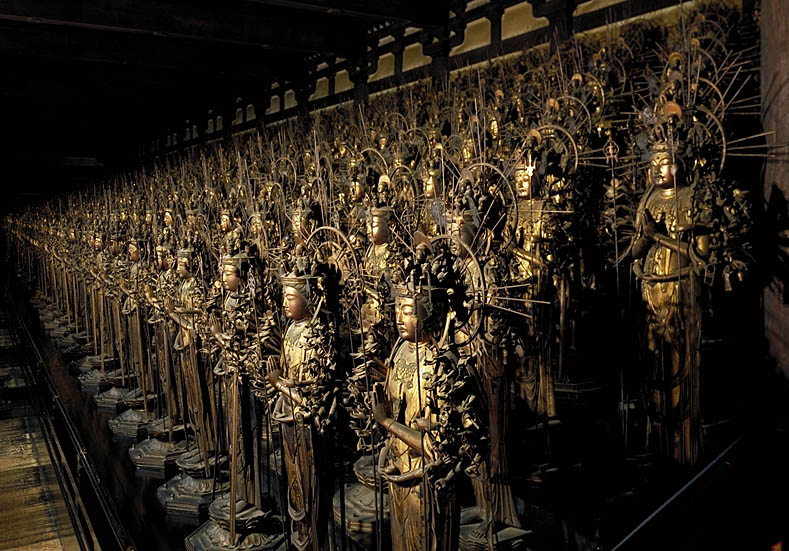
Sahasrabhuja, 1164 A.D.
Standing Thousand-Armed Kannon
note: Kannon is the bodhisattva of compassion
Follow this link to Kyoto National Museum Period art search!

E-mail me at [email protected]