
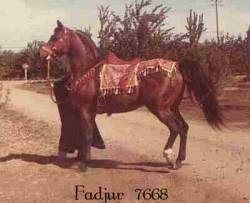
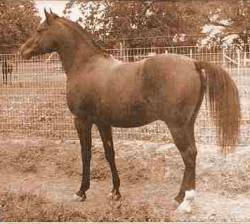
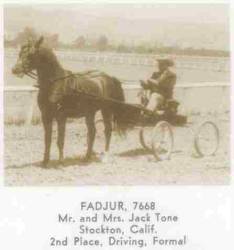
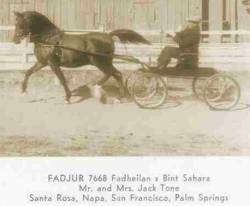
AHR*7668
Bay Stallion 1952 - Bred By Harry Linden
Fadheilan X Bint Sahara
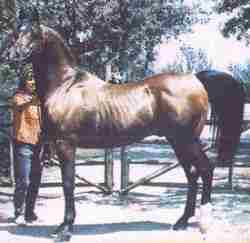
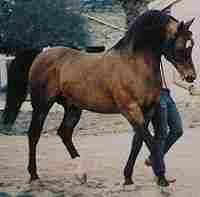
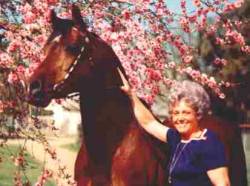
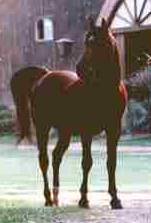
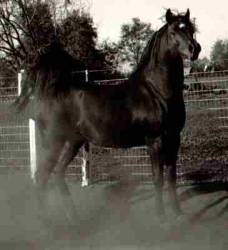
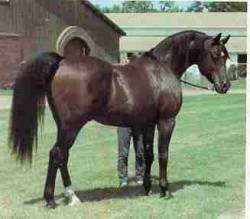
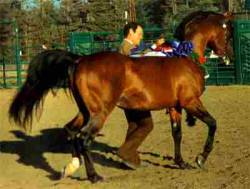
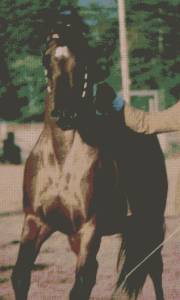
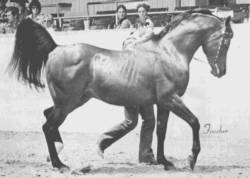
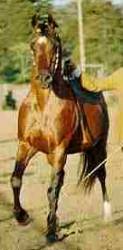
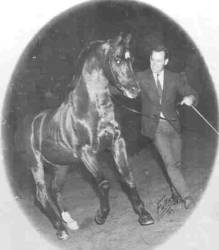
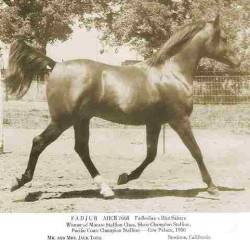
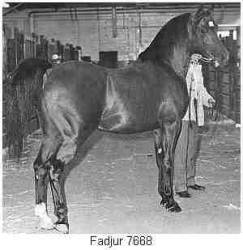
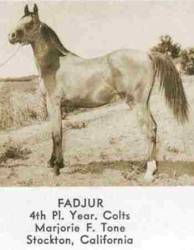
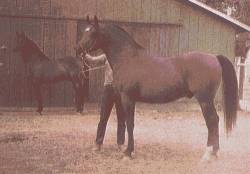
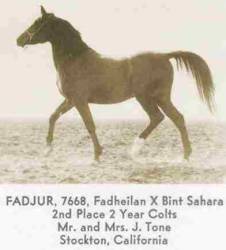
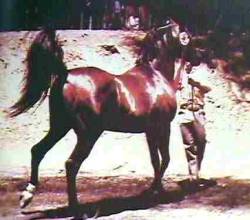
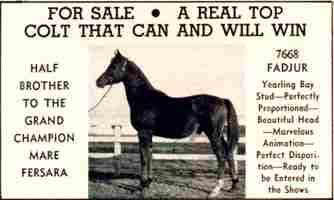
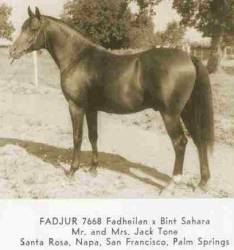
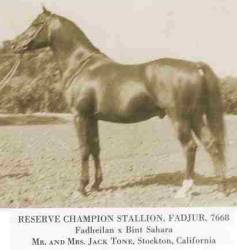
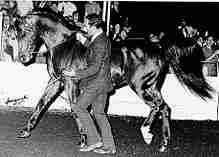

Legendary Show Horse
FADJUR had a show career that is unparalleled and unequaled
by any equine. He was not campaigned as some Arabian
stallions are today...as a popular breeding stallion his primary
duties were focused the breeding barn, and yet with limited
showing (a few times each year) FADJUR managed to chalk
up championships in halter for 19 years in a row,
beginning with a Reserve Championship as a three year old
in 1955 and ending in 1975 when he retired from the show ring
at the age of twenty-three.
His Titles included six US and Canadian Top-Tens;
two US Reserve National Championships -
(the last in 1968 at the age of 16)
and tied in 1963 when he lost to his son IBN FADJUR.
He was a Class A Halter Champion 22 times and placed
first in Halter and Get of Sire classes 71 times,
Pacific Coast Champion 4 times - Region One Champion
Stallion (all of California and Nevada), twice, and
Great Plains Champion Stallion once....
His last big win....at the age of 23 was
the Stallion Championship at Santa Barbara in 1975.
Perhaps because FADJUR was only shown a few times each year,
he never got sour...and the fact that he enjoyed showing off at home
and was encouraged to do so may have contributed to his long and
successful show career. It is interesting to note that the strain of Arabians
that is noted for fire and animation (Hadban Enzeyhi) is prominant in
FADJURS pedigree, being the strain of his sire FADHEILAN through
his paternal granddam *KASZTELANKA.
Whatever the reasons for his success and popularity.....FADJUR was
the ultimate show horse...turning on his fiery presence in the show ring,
and yet gentle and personable and a great companion and friend to his
FADJUR sired 855 registered purebred foals in his lifetime, (and
many part-Arabians, as well) beginning with JATTA and NADJUR
in 1955. His last foal crop, which he sired at the age of 31, came in 1983 and numbered 14 - seven colts and seven fillies. The last - FADJURS GALLANT was born in October of 1983 - seven months after the death of his sire - so it can truely be stated that FADJUR remained fertile to the end. His registered get totalled 417 mares,
303 stallions & 135 geldings (as of Dec. 1996).
He was not dominant as to color....according to registry records
392 of his get were bays, 203 were chestnuts, 222 were greys
and 3 were registered as black.
All of FADJURS get were sired by natural service, and he was
famous for his breeding manners - controlled by voice
command alone!!
Marjory F. Tone first saw FADJUR when he was eight months of age. It was love at first sight. They became an invincible team who has gone down in Arabian horse breeding history. Marjory convinced her loving husband, Jack Tone, that FADJUR should be her stallion. Jack Tone made the call to purchase him for Marge's birthday just two months before he was a year old, and weeks before he was to go to an Arabian horse auction. Frank and Helen McCoy owned Bint Sahara when FADJUR was foaled, and had described him to Marjory when she asked for his recommendation of a stallion who looked like his maternal sister, Fersara.
FADJUR became a very loved and admired member of the Tone family. FADJUR never left the Jack Tone Ranch in Stockton, California, except to venture to a horse show or two per year or to be shown on exhibition. FADJUR's last show at the age of 23 was the prestigious Arabian Horse Association of the San Fernando Valley's annual show in Santa Barbara. FADJUR won the Class A Stallion Halter Championship, judged by B. Paul Husband, and topped off one of the greatest Arabian show horse records of all time.
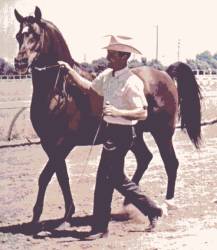
Marjory Tone's guidance over FADJUR's life included giving permission for him to be shown by her son-in-law, Paul Polk, (who had never even seen a horse show class!). Marge trained Paul to handle and show FADJUR in the way she loved to see him: FADJUR proudly showing off to the applause of Tone family and friends.
The pair, FADJUR and Paul Polk, became a show-stopping sight for the next twenty years of their lives. They won the most prestigious Halter Championships available at the time, in the most naturally animated, proudly showing off / having fun fashion! Just as Marge had imagined was possible.
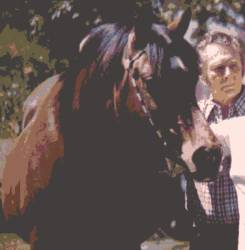
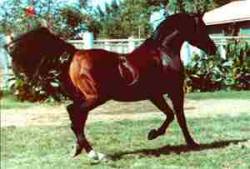
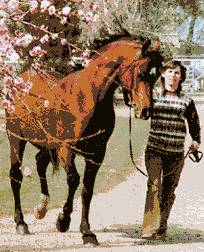
Besides becoming a Legendary Show Horse and Sire, FADJUR -- the fuzzy little weanling colt with the beautiful little face and proud attitude Marge Tone fell in love with -- grew up to be everything she could possibly hope for as an Arabian stallion. He never lost his extreme proudness and the love of life Marge saw as he threw his tail over his back to show off for her that first meeting. Some of the features which made FADJUR stand out in everyone?s memory who saw him were: He was so extremely proud and loved to put on a show for people, whether in hand or free at home, he loved the applause! He would dance and prance, snorting and playing. His neck and tail held high, no matter how many hours the classes lasted nor how hot or cold the weather. He had a unique, unforgettably classic and chiseled head, with huge, dark, wide-set eyes, deeply dished profile, small muzzle, pronounced tear bones, beautiful shapely ears and fine, shiny blood bay coat, with high black points, a big bursting star on his forehead, and a left hind sock. He had an extremely arched neck, arched highly out of his withers, and a high, straight, flag tail carriage. He had beautiful substance and muscling, with big wide hooves and large powerful, flat joints. -- Those who knew FADJUR best know he had the most remarkable character and disposition of kindness, intelligence, understanding and will to please. He was closest to Marge Tone, and seemed to understand every thought and communication she gave him.
For thirty-one years, FADJUR lived as King of the Jack Tone Ranch. His image still reigns over his Kingdom, through his line-bred descendants living there now.
Thinking horsemen the world over who have owned or worked with some FADJUR blooded horse, sooner or later return to seek out another. To re-attain the same passion he instilled in Marjory Tone so many years ago.
In 1999 FADJUR was honored by Western Horseman magazine in their book titled "Legends of the Arabian Breed ".
In 1999 FADJUR was inducted into the Arabian Horse Trust Hall of Fame, for his influence on the Arabian Breed
FADJUR helped his Dam, Bint Sahara and his lifetime mate, Saki, also obtain the honor of being inducted into the Arabian Horse Trust Hall of Fame for their influence on the Arabian Breed. And also to become the Leading Living Dams of Champions during their lifetimes. To this day, FADJUR's descendants earned and hold this mind-boggling title of influence for producing Champion offspring.
FADJUR's granddaughter, Autumn Fire, is the Leading Dam of National Winners today.
FADJUR's great-granddaughter, TW Forteyna, is currently the Leading Living Dam of Champions, and is challenging Autumn Fire as Leading Dam of National Winners.
A survey by Arlene Magid discovered that of the "Leading Living Broodmares" today, THREE of the TOP FIVE producers are descendants of FADJUR.
27 Fadjur daughters have produced National winners -- 4 of them have produced 2 or more!
95 FADJUR daughters have produced champions, crossed with practically every bloodline of the Arabian breed.
12 FADJUR daughters are Aristocrats (producers of 4 or more champions).
FADJUR was the "Leading Living Sire of Champions" up until the time of his passing in 1983.
FADJUR's grandson, Khemosabi was the heir apparent to FADJUR's crown as "Leading Living Sire of Champions", and continues to earn that title to this day.
FADJUR was named a "Living Legend of the Arabian Breed," voted so by the membership of the International Arabian Horse Association
FADJUR was twice voted "Most Popular Stallion in the World," by a vote of subscribers to the Arabian Horse World magazine.
FADJUR was the Leading American Bred sire of Champions
FADJUR was the leading sire of foals registered with the Arabian Horse Registry of America for 10 years
FADJUR sired over 800 Purebred Arabian foals, all by natural cover -- His last foals were sired when he was 30 years of age.
FADJUR was the Leading Sire of Foals Exported to Other Countries
FADJUR descendants have held World Records and National Championships in numerous divisions and disciplines in the United States and Many Other Countries
FADJUR sons hold HALL OF FAME awards in Endurance, and Stock Horse disciplines, as well as producing RECORD TITLED offspring
FADJUR won his first National Title in 1959. He or his descendants have held National Titles every year since!
FADJUR won United States National Halter Stallion Top Ten Champion Awards, five times, SPANNING TEN YEARS!!
FADJUR was Reserve National Champion Halter Stallion twice, EIGHT YEARS APART, 1960 and 1968!! For his last Reserve National Championship, HE WAS 16 YEARS OF AGE! He competed against 60 other Champions in this class, from 5 different countries. FADJUR was National Champion on TWO of the three judges cards and dropped to Reserve by one vote
FADJUR tied for National Champion Halter Stallion a third time. He shared National Champion Position on the judges' cards with his own son Ibn Fadjur, who would become Reserve National Champion Halter Stallion, and FADJUR, Top Ten. His daughter Jurneeka also won two National Performance Titles that year!
FADJUR won a Canadian National Halter Stallion Top Ten Champion Award, his only time shown there, AT AGE 17, and received a standing ovation.
FADJUR was FOUR times Pacific Coast Champion Stallion -- the first at four, the last at nine years of age.
FADJUR was Regional Champion Stallion twice, at fourteen and fifteen years of age!
FADJUR was Great Plains Champion Stallion, at Eighteen years of age!
13 FADJUR sons have sired National winners -- 8 of them have sired 2 or more National winners!
22 FADJUR sons are known to have sired champions (many more are undocumented)
26 FADJUR sons have sired 40 or more foals.
The TWO Arabians who have won the highest number of National Championships both descend from the Fabulous FADJUR: Bar-Fly (FADJUR grandson) in working western classes and Good Thunder (FADJUR great-grandson) in English and Harness classes!
Fadjur was the product of two "cold crosses" his sire Fadheilan being the son of *Fadl whose antecedents were bred in Egypt, and *Kastelanka, who was bred in Poland. Fadjur's dam Bint Sahara was nearly all Crabbet breeding (a combination of desertbred and Egyptian source horses with no close up realtionships to *Fadl) with her tail female line tracing to the Davenport imports...the mare *Wadudda, and the stallions *Hamrah and *Abbeian.
Fadjur's sire Fadheilan was bred by Henry Babson, noted for breeding "straight" Egyptians descended from five Arabians he imported from Egypt in the 30's. He also imported horses from Poland, and in the early days experimented with the Polish Egyptian cross. Fadheilan was sold to Harry Linden of Spokane WA. where he was used for many years as a ranch horse and breeding animal. Fadjur was Fadheilan's most noteable offspring,
but he did sire many good horses in the Pacific Northwest and interestingly enough his daughter Fadeeka, when bred to Fadjur, produced Jurneeka, dam of Khemosabi who took over his grandsire's place at the top of the list of leading sires of Arabians.
At the death of his owner, Fadheilan came to California to live out his years at the Jack Tone Ranch, and at the age of 21 years won the Pacific Coast Champion Stallion Title, an amazing feat for an aged stallion.
Fadjurs dam, the illustrious Bint Sahara produced 18 foals in her lifetime, 11 of which became champions. Considering that among all the Arabian mares only eight have produced 10 or more champions, is a remarkable record indeed. She was bred by John C. Silva in California, and sold to Frank B. McCoy, of McCoy Arabians, noteable foundation breeder. Registry records are sketchy for the early years, but apparently Bint Sahara was sold to Harry Linden after producing three foals including the gorgeous Fersara for the McCoys. Evidently as Fersara matured, McCoy recognized the value of the mare he'd sold, and leased her back in foal with her seventh foal and fourth foal by Fadheilan, thus Fadjur was foaled at the McCoy ranch in 1952.
Bint Sahara went on to produce 11 more foals for the McCoys, but none had a show or production record that could compare to Fadjur.
Fadjur's paternal grandsire *Fadl was imported from Egypt by Henry Babson and was a versatile stallion, being ridden in 100 mile endurance races and used as a polo pony along with his breeding activities. He also won honors in early "breeding" classes.
*Kasztelanka was imported from Poland where she was a moderately successful racehorse before becoming a broodmare.
Another Polish-bred son of *Kasztelanka (Halef) went to the Weil stud in Germany where he became the grandsire of the German import *Sanacht, dam of 12 U.S. champions, so the influence of *Kasztelanka in America through her sons, cannot be denied.
Bint Sahara's notable paternal grandsire Farana, (*Nasik x *Farasin) was bred by W.K. Kellogg from bloodstock imported from Crabbet Park in England. A good source of information on the Kellogg horses is articles and books written by Glady's Brown Edwards, as she was a student at the Kellogg Institute where these horse were bred and knew many of them personally. Of Farana she writes (in her book "The Arabian, War Horse to Show Horse"). "The Sire Line charts show the branches but do not show the broodmare sires, of which Farana has turned out to be one of the best. Admired originally for his catlike speed as an exhibition stockhorse, he was expected to put this trait in his get, which he did. His excellent shoulder and withers, short back, and level croup were among his assets. His neck could definitely been longer, and while his profile was straight (which is perfectly acceptable in the standard) it would look dished when he was in action - his nostrils flaring and big eyes popping as he put every ounce of energy into his work, won several stockhorse championships at the Coronado National Horse Show, he did what was required of him then and was spectacular in sliding stops from a dead run, and he did spins so fast that once in a while he left a his rider still up in the air, also spinning, before and ignominios landing. He was a fast backer, almost trotting backward, as he made his exit - in reverse gear, from the Kellogg arena; and of coarse he backed fast and straight in the process of the stockhorse rituals. If *Nasik had never sired another foal, he would be well remembered because of this sensational worker. Farana performed every Sunday, twice a day, for over ten years along with regular works and other shows. He was never cooled down even on a hot day and panting from his all-out exertion; he was just run into his stall and tied up. It is a wonder he didn't stiffen up or get unsound. Some stockhorse judges condemned him for too-light bone (it was fine, but not tied in nor too light), but he remained clean legged through the years. He was much too stylish - with too-high neck (though the head-carraige was good) and "fancy" high-carried tail to be a proper cow horse, but he did have good enough action at the trot for English performance."
Bint Sahara's paternal granddam was a high percentage Egyptian mare (remembering that all imported Crabbet stock descended from horse bred in Egypt combined with the blood of the Blunt's desert imports), being line bred to *Ghazala 211 who was acquired in Egypt by the Blunts of Crabbet Park in England, and sold to Spencer Borden in the US after producing two fillies (Radia "Ghadia" and Jemla) at Lady Anne Blunt's Sheykh Obeyd stud in Egypt which have bred on. Her family is well represented in America through her two daughters Gulnare and Guemura as well. Her dam Bint Helwa was sent to England and was Crabbet Park's famous "broken legged mare". Her line is well represented the world over,
giving *Ghazala many international connections.
Bint Sahara's maternal grandsire Ribal was bred by W.R. Brown from imported Crabbet stock. His sire *Berk....again quoting Glady's Brown Edwards. Heading this shipment in 1918, was the magnificent stallion *Berk (Seyal x Bukra) who was a champion at halter but known for his bold free moving trotting action, died a year after his importation after siring only four foals in America, tho' well represented in England. Ribal (out of *Rijma) did his bit (to pass on the free moving action). *Berk was also the sire of Rissla, dam of *Rifala whose inbred son *Raffles was also noted for his freemoving square trot.