
AHR*25460/PASB*1694
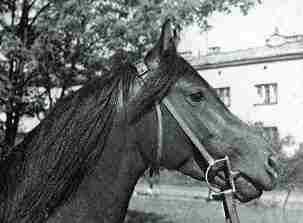
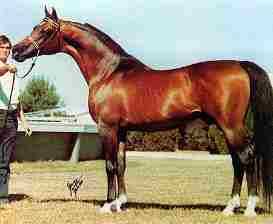
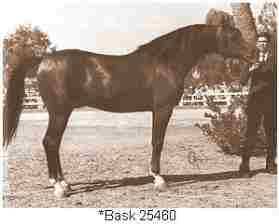
Bay Stallion 1956 - Bred By Albigowa State Stud Farm
Witraz X Balalajka
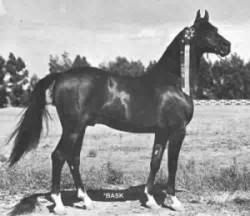
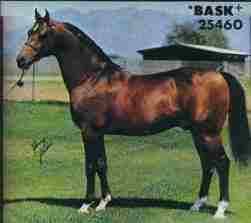
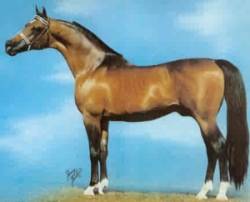
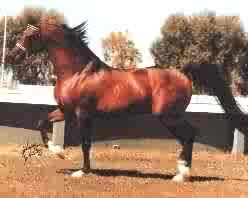
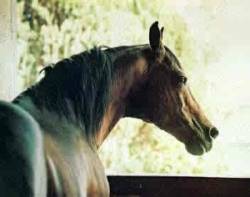

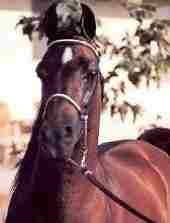
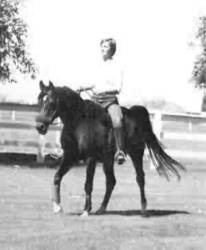
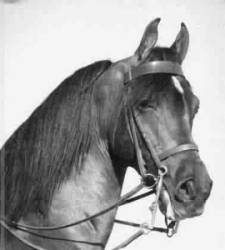
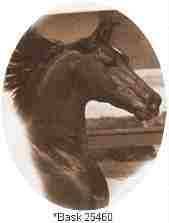
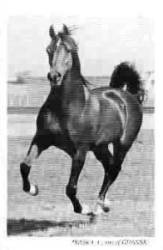
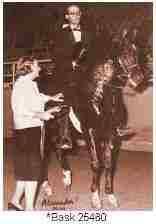
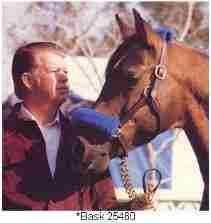
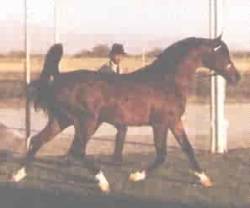
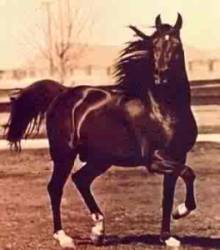
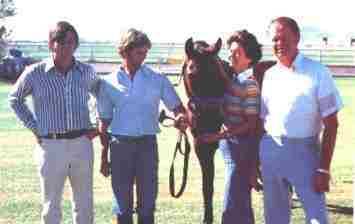
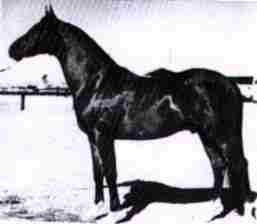
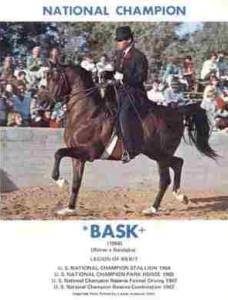
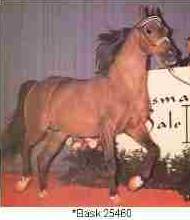
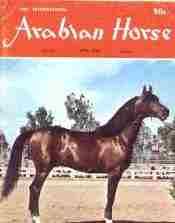
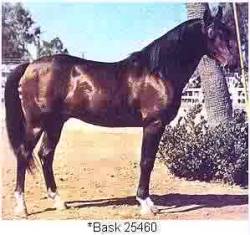
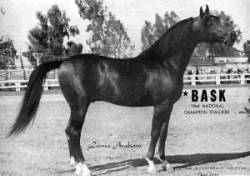
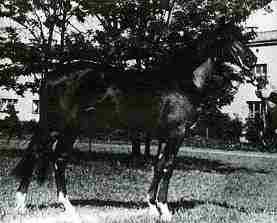
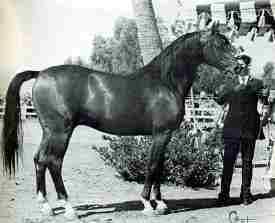
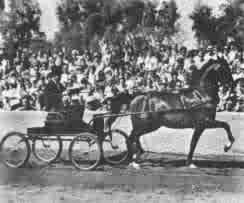
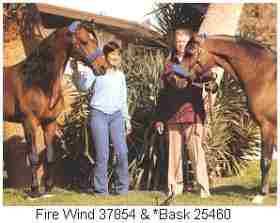
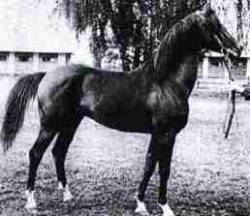

Witraz x Balalajka
*Bask++ was born February 9, 1956 at Albigowa State Stud in Poland. He arrived in an age when Poland was still rebuilding after the devastating effects of World War II and while Arabian breeding as a state-funded project was still being greatly debated in that country. His sire, WITRAZ, (Ofir x Makata) was a bay stallion born in 1938, a war-baby who managed to survive not only the war, but capture by other nations who were ready to take any horse they could catch back to their borders. His dam, the grey BALALAJKA (Amurath-Sahib x *Iwonka III #3937) born in 1941, who, along with her daughter Arfa, were the only remaining survivors of the war from the entire Krasnica Stud breeding program. This sweet and silky-coated mare was considered to be the most valuable of all the beautiful mares at Albigowa Stud after the war.
*Bask's++ show record:
� 1964 Scottsdale Champion Park
� 1964 Scottsdale Champion stallion halter
� 1964 US National Champion Stallion
� 1964 US National Top Ten Park
� 1965 Spokane Reserve Champion Park
� 1965 Birmingham Charity Horse Show, Champion Park
� 1965 US National Champion Park
� 1965 Legion of Merit (++)
� 1966 Scottsdale Champion Park
� 1967 Region 1 Champion Park
� 1967 Region 2 Champion Park
� 1967 US National Reserve Champion Formal Driving
� 1967 US National Reserve Champion Formal Combination
� Sire of 1,050 foals, and 35,514 grand foals!
*Bask++ began his race training in Poland at the age of two. He remained in the racing program for a full four years. Out of 40 races, he placed first eight times, second seven times and was third seven times. While not a top racer, his presence on the track kept him from being sold to a circus, or from going to a less prestigious stud where he might be used to upgrade the local farm horse stock. It was not until he reached the age of six, that he was sent back to stud to be evaluated. Since the Albigowa State Stud had been disbanded, *Bask++ was sent to Janow instead.
That move nearly spelled the end for *Bask++. Janow already had many good sons of Witraz at stud, plus sons of Wielki Szlem, whom the Poles considered to be far better looking than the Witraz offspring. *Bask++ was viewed by the officials as having a large, but pretty head, long legs but a shallow chest and a rather immature air about him. There was no doubt he had plenty of animation and spirit, but was it enough to allow him to continue at the stud as a stallion to be used on purebred mares was the question.
The question, fortunately, never was answered by the Janow officials. Dr. LaCroix and Mr. Howie Kale, with their teenage sons, were the first Americans to visit the Polish studs since the war had arrived to take a look at exporting some of the famed Polish stock for their own breeding programs back home. Dr. LaCroix and his son, Gene, agreed, one look at *Bask++ was all it took. In an effort to hide his choice, Dr. LaCroix returned to his home in Scottsdale after putting *Bask++ as 18th on his list of 20 or so horses that he and others from the USA were interested in purchasing. Since the Poles were more than willing to sell, the deal was quickly completed, although it would be some months before the horses would arrive in the United States. Despite the delays and the anxiety, one thing remained steady in Dr. LaCroix's mind *Bask++ would be arriving.
The Transatlantic trip was made by cargo ship which encountered some of the worst weather imaginable, with 80 foot waves crashing against the ship for days on end. For at least ten days the horses that made the trip (*Naborr included) were neither fed nor watered. Other than a case of colic, *Bask++ came through it fine, although he had lost about 100 pounds. But despite the long journey, he was as charged up and ready for anything as he ever was. After arrival in the United States, quarantine, and a train trip to Scottsdale, *Bask++ finally was home. It was mid-March 1963.
Within days he was being put to mares, and the following year saw *Bask's first foals. The LaCroix's were ecstatic over the quality of those foals.
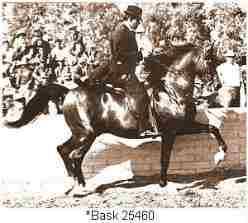
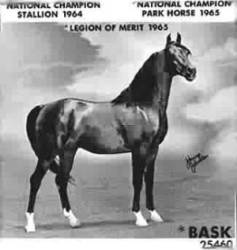
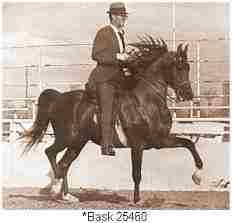
It was 1964 now and *Bask++ was ready to begin his career as a show horse. His first show was, appropriately, the show in Scottsdale. Without trouble, the Polish-bred stallion won not only Champion Stallion honors, but received the Championship in Park (3-gaited), also. These honors earned *Bask++ his picture on the March 1964 issue of Arabian Horse World. Later that year, he was shown at the US Nationals, were he went Top-Ten in Park and received the title of Champion Stallion. It was not until the following year (1965) that *Bask++ won his Championship in Park. He was the first horse to win National Championships in both halter and performance. In only four shows, *Bask++ had qualified for his Legion of Merit.
Continuing his show career into 1966, *Bask++ again won the championship in the Park class there. After that he was trained to drive, and, in 1967, he won Reserve Champion at the US Nationals in both Formal Driving and Formal Combination.
With that list of impressive wins behind him, *Bask++ retired from the show ring and concentrated on the serious business of putting foals on the ground. Of the 1,045 purebred foals that he sired, many were to mares he bred to more than once. In fact, some mares produced five or more foals by *Bask++.
This was the heyday of Arabian breeding, showing and selling. Horses sold for phenomenal prices, and it was well-known that *Bask++ alone was responsible for putting Lasma on the map. His get and grand-get were coveted like precious gems and many people felt they had arived if they owned a *Bask++ son, daughter or grand-get of the famous Polish stallion.
*Bask++ died at home in Scottsdale on July 24, 1979 during the Canadian Nationals. His daughter, Ambra, won the Canadian National Park Horse championship the next day. Her rider, Gene LaCroix said, we did it for *Bask++
*Bask's stall at Lasma remained empty. No other horse could ever take his place.
Chapter .1 - *Bask - From Arabian Legends (with per
IN THE MIDDLE of Poland's worst winter in 100 years, on January 25, 1963, 15 purebred Arabian horses were carefully loaded into wooden crates aboard a ship bound for New York City.
Ignacy Jaworowski, who would one day be the director of Poland's famous Michalow Stud Farm, was responsible for the precious cargo. He was anxious to get underway, as weather delays and a dockworkers' strike in America had postponed the departure for weeks.
Jaworowski knew he guarded some of his country's finest Arabians. And he knew their new American owners were just as concerned for their safety as he was. As the freighter churned through the frigid harbor and out into open water, he checked the hay supply. Then he walked among the stalls and mentally tallied his charges: the mares *Gwozdawa, *Gwadiana, and *Wiganda, and the stallions *Bajram, *Naborr, and *Bask among them. Jaworowski smiled. All would soon be safe in their new homes.
The ship's captain decided to pick up more cargo and spent another week stopping at various European ports. Jaworowski prudently purchased a bit more hay in Le Havre, and the vessel finally sailed westward.
All was well for the first few days. Then, with little warning, a terrible storm hit. For 10 days no forward progress was made. The ship tossed violently in mountainous waves. The crew and horses became sick. It was impossible to eat or drink. *Wiganda aborted her foal. *Bask, usually so animated, stood stoically in his crate. As the trip lengthened, hay supplies ran low.
Finally, 44 days after departure, the nightmare was over. The weary band arrived in New York on March 9, 1963.
They were a sorry lot. All had lost weight. *Bajram's skin was raw and the hair gone from his chest where it had for days rubbed against the crate. *Naborr fared somewhat better, but *Wiganda died just 5 days later from stress and foaling complications.
*Bask was a pitiful sight. He had colicked, lost more than 100 pounds, and his body had taken quite a beating. For the rest of his life, whether in national championship spotlights or the most illustrious breeding shed in the world, *Bask would bear witness to that horrible journey with a thin white scar running along one side of his body. The horse who would so transform the Arabian horse industry in America had almost been lost at sea.
*Bask was, quite simply, the most influential and widely recognized Arabian horse of the 20th century. As an individual, he was quite impressive. But as a sire, he was incomparable.
His offspring became the models by which most Arabian horses were judged, both in halter and performance competition. The chances are slim, at best, that any other stallion will ever even come close to threatening his solid gold sire records. *Bask, as a sire, reigned supreme.
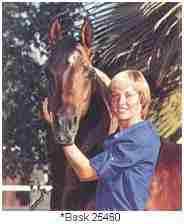
But even the best seldom make it alone. In *Bask's case, the story was shared by Dr. Eugene LaCroix, D.O., and his family, wife Mary Jean, sons Gene and Raymond, and daughter Kathy. They were responsible for *Bask's importation from Poland, his campaign to national championships, and similar campaigns for many of his offspring. Furthermore, the LaCroixes developed innovative marketing strategies the likes of which had never before been seen in the Arabian business, and in some cases, in the entire horse industry.
To begin, it is important to understand the climate in America when *Bask appeared. By the early 1960s, the Arabian horse industry in general had reached a point of relative inertia. With the exception of a handful of exotic Egyptian, Spanish, and Polish imports about that time, the majority of purebred Arabian horses in North America were bred and cross-bred from the same seed stock: mainly Crabbet lines, sprinkled with some Davenport and other assorted old desert pedigrees.
Many horsemen looked on Arabians as rare, cute, little, hot-tempered animals best suited as occasional riding horses or as pretty pasture ornaments for eccentric breeders.
Prices had remained about the same for decades, and the demand for Arabian horses was to some extent limited to fellow breeders and the slow trickle of newcomers. There were a few, such as Bazy Tankersley at Al-Marah Arabians in Maryland, Daniel C. Gainey in Minnesota, Frank McCoy and the Tones in California, and a handful of others, who managed to breed some lovely horses, turn a profit, and successfully promote the breed to others. But that was not the case for the majority.
*Bask was like a catalyst that, when combined with previously inert substances, creates a fiery chemical reaction. Temperatures climb until, seemingly all at once, the mixture explodes with an array of fireworks breathtaking to behold.
Suddenly, or so it seemed, Arabian horses came into their own as beautiful, showy, powerful athletes. As pedigree expert and author Gladys Brown Edwards wrote in 1985 of *Bask's contributions: "The result was real riding-horse conformation with a high-carried elegant neck, a willingness to learn and do, and especially a free and high way of going in classes where action is paramount."
In other words, as writer Lucille Shuler first pointed out, "*Bask horses set new standards by which other Arabians were judged." Registrations and prices rose. By the late 1970s, America was falling head over heels in love with the "new" Arabian horse.
Could another stallion have done the same? Perhaps. Did other stallions and breeders contribute to this phenomenon? Yes, definitely.
Ultimately, however, if only one may claim the title, then The Sire of the 20th Century was *Bask.
Polish Heritage
*Bask was foaled on February 9, 1956, at Albigowa Stud Farm in Poland. Roman Pankiewicz, former director of that farm and highly respected within the Polish Arabian horse breeding community, recalled *Bask's sire, Witraz, and dam, Balalajka, for an article run in the May 1980 issue of Arabian Horse World:
Of all the mares I found on my arrival at Albigowa, I considered Bask's dam, Balalajka, the most valuable," he wrote. "Balalajka was a very well-conformed mare of excellent lines and great beauty, combined with feminine looks and gentleness... however, at that time nothing could foretell her future career."
Balalajka's dam, *Iwonka III, was among those Polish horses taken to the United States after World War II as "spoils of war." She left behind her in Poland only one other foal, Cellist, a 1942 colt by Trypolis who was used mainly to sire Anglo-Arabs in Poland. *Iwonka III does have several lines descending from her in North America, however.
Balalajka's sire, Amurath-Sahib, was an outstanding sire of broodmares and is well-represented in the pedigrees of many of today's U.S. and Canadian champions. Wrote Pankiewicz, "He passed on his clean lines, size, beauty, and type. Every daughter used in breeding left a lasting record."
About *Bask's sire, Witraz, Pankiewicz said: "Balalajka produced her best foals with Witraz, who had a difficult temper and often passed it on to his get. He was the most handsome of contemporary sires, but, unfortunately, he wasn't too popular with our breeders due to his character. But great people are also sometimes a little crazy, aren't they? Witraz, *Bask's sire, was by all means a great horse."
Witraz is often compared to another great Polish stallion of his era, Wielki Szlem. Both were Ofir sons, and both shared a common granddam, Gazella II. Witraz was out of the mare Makata (by Fetysz [by Bakszysz]), who produced only the colts Teheran and Witraz before World War II, when most Polish breeding efforts came to a halt.
Wielki Szlem, on the other hand, was out of Elegantka (by Bakszysz), Poland's most esteemed broodmare prior to the war. He was, according to Pankiewicz, "a small, handsome athlete of very good conformation, general soundness, and substance.
Witraz was more of a dandy, who, because of his charm and beauty, was forgiven some minor incorrectness of conformation. When you looked at him, you didn't have that impression of substance, that's the way it was.
"Wielki Szlem sired many good and very good horses, whereas Witraz sired a number of less impressive horses but also not a few great ones."
Pankiewicz explained that several Wielki Szlem sons were used to extend the Kuhailan Haifi line, but only two of Witraz's sons, Como and Banio, were used and only in a limited manner. Only later was a third son, Celebes, used more often.
"Having the great Ofir in mind, our breeders put more trust in Wielki Szlem, who was more like his father," wrote Pankiewicz. "At Janow (Podlaski Stud Farm), Czort (by Wielki Szlem) was decided to be sufficient representation of the Ofir line and was kept to do the job. For these reasons, the great *Bask was sold and never used in Polish breeding."
Show Career
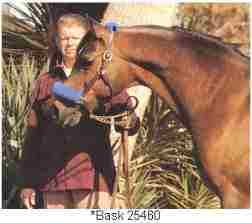
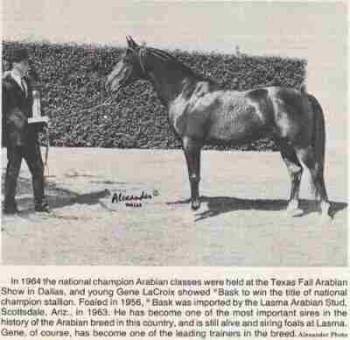
The royal monarch's show ring career was launched in 1964. In February, with 16-year-old Gene leading him, *Bask was named Scottsdale Champion Stallion. Hours later, Jerry Smola rode him to the park championship over 26 entries. He was an instant hit.
The LaCroixes decided not to show him again until the U.S. Nationals in Dallas later in the year. There, with Gene again leading him, *Bask was named U.S. National Champion Stallion. Smola rode him to a Top Ten win in park.
In 1965, the Nationals were in Springfield, Illinois, and *Bask dominated 39 competitors to win the park championship.
"*Bask was always a pleasant, agreeable horse to be around; always tried to get along. But get him in the show ring, and he'd get all blown up and ready for everything and anything," recalled trainer Jerry Smola in Arabian Horse World. "He had the fire and the brilliance, and a tremendous way of going, that made a real show horse.
"When he got all fired up, like he wanted to in a park class, why, he was a hard horse to ride. He liked to set up and go! When he won the national championship, I had a stirrup hanger break, and the ringmaster said, Why don't you just ride him around a time or two without it. The class is almost over.' I couldn't have done it. I had to switch saddles. I would not have tried to ride him around that ring with only one stirrup."
*Bask was now the first Arabian national champion stallion ever to win a national championship under saddle. He also became the first Arabian to achieve his Legion of Merit title in only four shows.
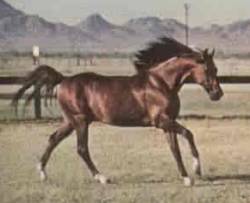
An article soon after in Arabian Horse World described his action as being as light and precise as a ballet dancer's. The free, high-stepping, athletic movement he demonstrated at that show became the legacy he passed to his descendants.
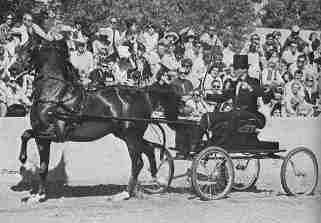
In 1966, *Bask was again Scottsdale Park Champion, this time with young Gene aboard. He then was put into harness and at the 1967 national show in Albuquerque was named U.S. Reserve National Champion in both formal driving and formal combination. With that, *Bask was retired in glory to the breeding shed.
His proven reputation as a beautiful athlete with a bright, trainable mind, all of which was consistently passed on, would bring the best mares in the country to his door. As early as 1964, the top breeders in the country were lined up, including Dan Gainey, Dr. Blake Gammell, R.B. Field, and Leland Mekeel. From the earliest foal crops came future significant sires such as Baske-Tu, Gai-Robert, and Tornado, and the lovely mares Basquina++, Spring Baskette, Gali-Croix, and Dancing Flame++.
From then on, through his final year as a breeding stallion in 1979, nearly everyone in the industry dreamed of or vied for a chance to bring a mare to the court of *Bask. He first stood for $500, which was quite high for the time. By the late 1970s, his stud fee had climbed to $10,000.
Offspring
In all, *Bask sired 1,050 registered Arabians, from which came 196 national winners, 495 Class A champions, and numerous race winners, including National Champion Racehorse Bask-O-Zel.
Furthermore, 292 of his offspring went on to produce or sire national winners themselves.
He sired only one Half-Arabian, *Bask's Warlock, who won three national championships by his fourth birthday. He was out of the Saddlebred mare Strega, herself a national champion.
Space does not permit an in-depth study of *Bask's national-winning offspring. Suffice to say that what makes the list so incredible, in addition to sheer numbers, is that virtually every division offered is represented, from halter and driving to park, English and western pleasure, and working western events.
Overall, his greatest influence has proven to be in the halter and English/park divisions. It can safely be said that, on average since 1980, at least 30 percent of the national halter winners and more than 50 percent of the national English division winners are direct descendants of *Bask. His influence is amazingly strong into the second, third, and even fourth generations.
A partial list of some of the better-known *Bask offspring who were U.S. or Canadian national champions or reserve champions (and only some of their wins!) is included here by division. Many won in more than one division, such as in halter and park.
Park: Mieczych, Ambra, Promotion, Red Tape, Reign On, The Judge, Zodiac Matador, Pro-Fire, EW Natal, First Class, Scarlett Lace, Hallelujah Bask, Cognac, Ibn Prowizja.
English pleasure: Basquina, Basquelle, La Basque, LeBask, TC Expression, FF Summer Storm, Taask, Lite My Fire, Anitaa, Fyre Water, Cease Fire, Sprint, Mark IV Coronation, Raya Royale, Dark Eyes, Genuine, MHR Sterling, Bask De Espana, Hask, Fire Devil, Taask, Basks Last Love.
Hunter pleasure: Crown Royale.
Driving: Promotion, TC Expression, Scarlet Lace, Task, Serinask, Pro-Fire, FF Summer Storm, Cease Fire, Red Tape, Mark IV Coronation, Abaskus, Diamond Bask.
Western/working western: Jask, Cinco Grande, Talabask, Fielon, Famest, Bask Image, Chaz.
Halter stallions/colts: GG Jabask, La Basque, MS Santana, Tornado, Amurath Baikal, Baske-Tu.
Halter mares/fillies: Amurath Bandeira, Bask Melody, Basquina, Basquelle, Dancing Flame, Fame, Fire Music, Mi Fire Dream, Alove Note.
Among *Bask's many sons who are top sires are: Gdansk (ex *Gdynia), Cognac (ex *Gdynia), Tornado (ex *Silwara), Wisdom (ex Wizteria), Serinask (ex Serinne), GG Jabask (ex Jalana), Fire Wind (ex Lakshmi), Cal O Bask (ex Susecion), Negatraz (ex *Negotka), Ariston (ex *Amfibia), Baske-Tu (ex Nafta), Mi Tosk (ex Toi), Mon Ta Basko (ex *Bint Ambara), The Chief Justice (ex Sey Cherie), Port Bask (ex *Portulaka), Safire (ex Caridina), Le Fire (ex Susecion), Zodiac Matador (ex RO Fanciray), Bask Flame (ex Mudira), Pro-Fire (ex *Prowizja), and Promotion (ex *Prowizja).
Statistically, as of this writing, U.S. National Park Champion Zodiac Matador is *Bask's top-siring son of national winners, with 37. GG Jabask, a U.S. Reserve National Champion Stallion, is his top-siring son of Class A or better champions, with 118.
Sadly, two stallions near the top of the list, Wisdom and The Chief Justice, died in a tragic fire on January 31, 1996, while still active breeding stallions. Had they had full careers, they might have become *Bask's best-siring sons, based on their early records.
Determining *Bask's best daughters as broodmares is more difficult, since females naturally have far fewer offspring than males. Furthermore, subjectivity plays more of a role. For example, one mare might have several offspring who are all Class A winners while another has two national-winning offspring and a few "no-shows" out of several foals. Now, who is to objectively say which is the better broodmare?
With that in mind, some of *Bask's best-producing daughters include: Spring Baskette (ex Narteza), Autumn Fire (ex Sparkling Burgundy), Scarlet O'Harra (ex Gai Ferzona), Alove Song (ex *Elkana), Balalinka (ex *Bachantka), Basks Maria (ex Judith-B), HAR Nahray�(ex *Portulaka), MHR Princess Bask (ex Hayley), Baskera (ex *Bandera), Dancing Flame (ex Habina), Masquerade (ex Faseyna), Gwyndalyn (ex *Gwyn), MS Baqueta (ex Bandy), Sha Baska (ex Shalem), New Fashion (ex *Boltonka), TC Charm (ex Khemogina), Shooting Star (ex Lasma Star), Spinning Song (ex Moska), Raya Royale (ex Alouma), Star of Ofir (ex Llana), and Wizteria (ex *Cosmosa).
Autumn Fire is the best-producing *Bask daughter, with nine championship-winning offspring, of which seven are national winners. More importantly, she is the all-time leading dam of national winners in the entire breed.
Gwyndalyn, another leading *Bask daughter, produced eight champions, four of whom are national winners, including U.S. National Champion Stallion Strike (by *Aladdinn).
*BASK++ FAST FACTS:
Born February 9, 1956 at Albigowa State Stud in Poland
Bay, with star and all four fetlocks
Race Record 4/40(8,7,7)
Registered in PASB in Volume 4-5 page 10
Registered in United States as #25460
Imported 1963 by Dr. Gene LaCroix of Lasma, Scottsdale, AZ
1964 Scottsdale Champion Stallion
1964 Scottsdale Champion Park (3-gaited)
1964 US National Champion Stallion
1964 US National Top-Ten Park
1965 Spokane Reserve Champion Park
1965 US National Champion Park
1965 Legion of Merit
1966 Scottsdale Champion Park
1967 US National Reserve Champion Formal Driving
1967 US National Reserve Champion Formal Combination
Stud fee went from $500 in 1963 to $10,000 in 1975
Died July 24,1979
Sire of 1,050 foals.
Sire of 1 Half-Arab
Did not sire any foals in Poland
Sire line to Kuhailan-Haifi desertbred stallion imported to Poland 1931
Dam line to Mlecha, desertbred mare imported to Poland 1845
Strain: Kuhaylan-Dajani
Sire of Wisdom, Red Tape, Crown Royale, MS Santana, Bomarc, Zodiac Matador, Le Bask+, Baske-Tu, Negatraz, Sunn Bask++, Gdansk, Bask-Tez, Fire Flame, Port Bask, Mi Tosk, Fire Melody, Promotion, First Class, Cognac, Tornado, Ariston, Mon Ta Basko, Gwydalyn, Contessa-B+, Hask+ and Barnaby++ to name a very, very few.