Inside this
issue:
About
The Market
For 200 years farmers have
been bringing fresh produce to this outdoor market in downtown Kingston.
Throughout the growing season, market stalls overflow with locally
grown foods. You can find fruits, berries, vegetables, flowers and
bedding plants, maple syrup and honey, eggs, homemade jams, jellies,
pickles and baked goods, sausages, buffalo meat, and trout pate.
Adding to the market’s
appeal are local artisans and craftspeople selling needlepoint and
crochet, tapestry bags, hats, clothing, jewelry, cane chairs, books
bound in metal, toys, homemade fragrant soaps and
woodworking (see profile of Ignac Jerebic on page 2)
The market is a gathering
place where you can chat with vendors, shop at leisure in the open
air, or find a bench in the shade of city hall to "peoplewatch"
. You’re bound to see someone you know!
If you support the idea
of local agriculture we invite you to shop here. You’ll be helping
local farmers stay in business and ensuring the continuation of this
historic market.
Message to Students
We welcome all new and
returning students to Kingston. If you’re on a tight budget, talk
to your market vendors because there are often bargains to be had.
Hours of Operation
The season runs from March
1st to December 31st (from maple syrup to Christmas trees).
We are open Tuesdays, Thursdays and Saturdays from 8:30 a.m. to 6:00
p.m.
For More Information
Visit our website www.geocities.com/kingstonmarket
Pick up our bi-weekly newsletter
from the stalls of Diane and Gonzalo Wilson or
Hank-John and Janet Reinink
We Want to Hear From You
Please speak up and tell
us why you like to shop here. If you have questions we’ll try to answer
them in future newsletters. Drop off your letters with Titia Posthuma
or Hank-John Reinink or email Donna James [email protected]
Share
Your Pumpkin Pleasures!
Thanksgiving will soon
be here and we’re searching for fabulous pumpkin recipes (they don’t
have to be pies!). So look out your favourites and drop them off at
the market with any vendor selling pumpkins. Please include your name
and telephone number. We’ll print the chosen recipe(s) in our Thanksgiving
edition of Market News.
No prizes offered – just fifteen minutes
of fame!
PROFILE
OF IGNAC JEREBIC
"A woodworker
never throws out stuff", said Iggy as he showed me his collection
of assorted woods from all over the world. Brazilian and Indian rosewood,
ebony from Africa, cocobolo, kingwood, purple heart and yellow heart
from Central and South America. These exotic woods, along with maple,
oak, cherry and pine are carved into gift items that Iggy Jerebic
sells at his stall in the Kingston Public Market.
His most popular invention
is the famous toothpick dispenser made from hardwood with a pine center.
"It’s appealing, people are getting fed up with plastic. They
like the natural colour and texture of wood," he said. Iggy has
sold more than 3,000 of these dispensers since he first set up shop
at the market four years ago. He began by making wooden toys for children
and this led him into designing animal puzzles made out of twelve
different woods. Adults are now collecting these puzzles to display
on coffee tables.
Iggy loves the look
and feel of wood. He showed me a chunk of oak that has fungus working
through its veins. The dark fungus makes a pattern like waves on sand.
"The rot is just on the outside. You have to catch it before
it goes too deep," he said.
Iggy has a knack for
spotting the unusual and following it through. His button ear-rings
started out as a joke but soon turned into a good seller. The idea
came to him when he saw a whole wall of buttons at Fabricland. He
noticed that some of them would make really nice-ear-rings. He bought
them, attached backings, and laid them out on a stand. They started
selling immediately. "They are light and unique. Women say you
can see silver and gold everywhere, but few colours. Women come by
with new outfits to match up with ear-rings," he explained with
a smile.
During the slower winter
months, Iggy spends long hours in his workshop building up stock for
the next season. Located in the garage of his suburban home, the workshop
is neat and well-organized. It’s also remarkably dust-free. Iggy explains
that dust is a real killer for woodworkers. He attaches vacuum tubes
to his machinery to suck away dust and he always wears a mask because
fine particles linger in the air. These particles can cause severe
allergies and are deadly over time. Noise is another occupational
hazard and Iggy protects his hearing with ear defenders.
By the end of the winter
Iggy is ready to emerge from his workshop and hang out at the market,
greeting customers and breathing in the fresh air. "I look forward
to getting out in the Spring. At the market you make friends. Certain
regular customers you talk to."
This market life is
a second career for Iggy who retired early from the military. He grew
up in Montreal and joined the forces at the age of 19. Trained in
electronics, he was posted to Kingston for seven years and then had
two tours in Germany. He and his wife Mary enjoyed their time in Germany.
"We’re both from European backgrounds and we fit in well."
But Iggy believes you are better off with roots and he wanted to stay
in one place while his children were growing up. Kingston seemed like
a good place to settle. "It was a good decision to join the forces,"
he said. He paused for a moment and smiled: "And a better decision
to leave."
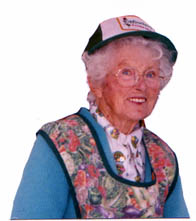 |
In Memory
of Doris Thomson
|
The corner stall at Brock
and King Streets was adorned with flowers last Saturday. The bright
bouquets of sunflowers and snapdragons were brought by friends of
Doris Thomson, longtime market vendor, who died on September 9th
at the age of 91. Doris had been coming to market for 66 years
and continued to work here in the weeks before her death. "I
just know I want to do it until I’m old," she had said to Titia
Posthuma in the Spring. "She was indomitable", said Titia.
"Humble and well-respected by all the vendors".
Throughout the day, people
gathered quietly in the sunshine to reminisce and say their farewells.
Family members had recreated her stall and placed pictures of Doris
on the table along with a memory box for friends to "share their
stories about Nana" for a family memory album. Her old green
truck was parked behind the stall and hanging on its open doors were
her familiar blue winter coat and yellow tuque. "Smiles are Free!"
said a wooden sign nailed to the truck. Customers and friends wrote
their names and messages in the remembrance book and lingered for
a while to take in the scene. It was a simple and moving memorial.
"She was so special to us", said grand-daughter, Tanya Abrams.
"And we found out just how special she was to other people too".
Commemorative
Market Bag
Made of 100% cotton, this
sturdy and stylish bag features the market logo commemorating our
200th anniversary: 1801-2001. It’s an over-the-shoulder
bag with ample room to hold a 3 litre basket as well as piles of fresh
fruits and vegetables on top. Environmentally-friendly and attractively
designed in cream and black, it’s yours for $8.00.
Note: Proceeds from
sales support ongoing activities of the Kingston Public Market Vendors’
Association, including the production of this newsletter.
What’s
In Season: Apples
Bill Howes is a
local apple grower who sells to market vendors. Until five years ago
he had a stall at the market which was famous for his aunt’s home
baked apple pies. "They were so good they sold out every week
and my aunt gave all the money to her church." Bill said it’s
more difficult to be a vendor now because grocery stores bring in
large volumes and it’s difficult to compete with them. "But our
customers are loyal. They understand we have to charge a little more
and they don’t mind because they know it’s fresh." He says the
Kingston Market is a great tourist attraction and the city could extend
the season by partially enclosing it, as was done in Belleville.
Jim Hughes ships
a variety of apples to Kingston including a heritage variety known
as the Cox Orange Pippin. This apple originated in 1850 in Buckinghamshire,
England. While there is a good selection of locally grown varieties,
Jim commented that the overall crop will be down this year because
of the drought. He had to irrigate his orchards by pumping water from
the lake. He was also hurt by the closing earlier this year of the
apple storage facility in Picton. Growers no longer have a central
place to store for themselves or to sell to packers. Jim now has to
ship his apples to Whitby to be packed, and so his transportation
costs are up.
Frank Stevenson has a fruit
and vegetable stall at the market and grows some of the apples he
sells. In addition to the closing of the apple storage facility,
Frank talked about the closing of the Little Bluff Cider Pressing
Company in Prince Edward County. Fifteen growers used that facility.
It closed in 2000 due to issues of potential liability related to
tougher government regulations. "Cider has come under tougher
guidelines. As a result, there will be less cider on the market this
year."
A Guide to the Growing Season
Frank Stevenson said
it’s important to buy apples in their season. He noticed that some
Canadians have developed a taste for a tart apple and people often
buy Macs, for example, before they are sweet. He agreed to provide
a rough guide to the growing season (see below). Please note that
varieties will ripen earlier this year because of the hot summer.
Summer Apples
Late July
July Reds; Quinte; Yellow Transparent (also
known as Harvester Apple)
August
Vista Bella; Jerseymac; Paulared; Tydemanred;
Melba
Early September
Green Macs; Cortland; Summer Reds
Winter Apples
Mid September
McIntosh (Mac); Empire; Spartan; Gala;
Early October:
Tolman Sweet*; Golden Russett*; Northern
Spy; Idared; Gala: Red & Golden Delicious; Mitsu; Crispin
* Tolman Sweet & Golden Russett
are heritage varieties.
Buying &
Storing Apples
Look for firm apples, free
of wrinkles and bruises. Remove any fruit that are overripe or have
soft spots because they give off ethylene gas causing nearby apples
to ripen too quickly and spoil. Trim and use for pies or applesauce.
Store small amounts in
a plastic bag in the refrigerator where they will keep for up to one
month.
Larger quantities should
be kept in a cool, dark, well-ventilated place such as a garage or
fruit cellar. Cover loosely with plastic to keep humidity in the apple
container.
Preparing Apples
For a nutritious, high-fibre
low fat snack, rinse, buff and eat as is.
Apples have many other
uses: baked with cinnamon and brown sugar; sliced and dried (Pennsylvania-Dutch
schnitz); simmered into a sauce; turned into pies, dumplings,
cobblers, crumbles & brown bettys; incorporated in salads; and
made into a spicy sherbet (starting with a rich, thick applesauce.)
To freeze for pie fillings
and sauces, sprinkle 1 L (4 cups) of peeled, sliced apples with 1
mL (1/4 tsp) of ascorbic acid powder and 25 mL (1/4 cup) of cold water.
Turn gently to coat fruit on all sides. Toss with 25 mL (1/4 cup)
granulated sugar. Pack, label and freeze for up to one year.
Before using, frozen apple
slices should be thawed for one hour or so.
Source: Ontario Ministry
of Agriculture, Food & Rural Affairs;Queen’s Printer for Ontario,
2001
Watch for the
next Market News!
October 6th,
2001
Thanksgiving
Weekend