Inside this
issue:
About This
Newsletter
Welcome to the third edition
of Kingston Market News. This newsletter will be published every second
Saturday until late Fall and you can pick up a free copy at the Market.
Regular columns will feature information on what food is in season
and how to prepare it; profiles of market growers and artisans; interviews
with vendors on current topics and trends; and stories about the history
of the Market and Market Square. For example, did you know that Kingston
is the oldest Farmers' Market in Ontario? At the Market’s 200th
anniversary festivities on July 14, 2001, Hank-John Reinink, chair
of the Kingston Public Market Vendors’ Association (KPMVA), said:
"The Kingston
market exists essentially as it did two centuries ago, providing a
venue where local producers can meet with local citizens in an atmosphere
of commerce and community, a gathering place where neighbours can
visit while shopping for one’s daily sustenance, be it nutritional
or artistic."
The idea for a newsletter
has been talked about for some time and the Vendors’ Association
produced two editions this Spring before the growing season
got too busy. Thanks to the financial support provided by Farmers’
Markets Ontario, we are now able to carry on with the assistance of
Donna James who will produce the newsletter bi-weekly until late Fall.
There will be one edition each in November and December and then we’ll
be dormant until Spring, 2002.
We hope you enjoy reading
Kingston Market News. We ‘d like to hear from you and print your letters
to the editor. Please drop them off at the Market with Titia Posthuma
or Hank-John Reinink, or contact Donna James at [email protected].
What’s In Season:
Peaches
Betty Berghout agreed to
answer some questions about peaches. You can usually find Betty in
the third row near Brock Street.
Q. What variety
of peach is currently available?
A. The Red Haven
Peach is available now and will be for the next few weeks. Then the
Loring variety comes into season. They’re both excellent freestone
peaches.
Q. What kind of
peach is good for canning?
A. Freestone peaches
are best. They are easier to work with because the peach comes away
from the stone. The clingstone is the earliest variety and it’s available
for the first two weeks of peach season. As the name suggests, it
doesn’t come away from the stone so easily.
Q. How is the quality
of this year’s peaches?
A. The peaches have been excellent
because of the warm temperatures in Spring and early Summer. Most
of our peaches come from the Niagara region. Chez Piggy buys a lot
of peaches for their popular Peach Almond Pie. Check out the recipe
in the Chez Piggy Cookbook.
How To Can Peaches
Use firm, ripe fruit. Scald
to remove skins. Halve peaches. Pack in jars, cover with boiling medium
syrup and process at once for 20 minutes in a boiling-water bath.
The Joy of Cooking.
FALL
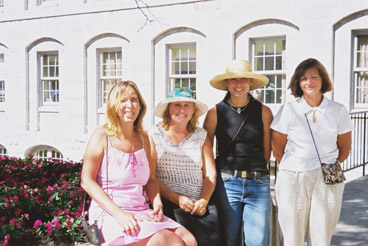
CLOTHING AT THE MARKET
Now that September’s here,
come visit the Kingston Public Market to see new fall clothing lines
featuring kids wear and women’s fashions. The photos below identify
some of our clothing vendors and future newsletters will profile more
of our artisans and craftspeople.
|
|
|
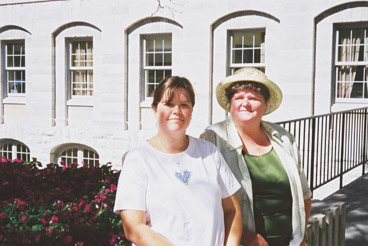
Donna Davison and
Melanie Davison Myers, a mother / daughter team that
makes Children’s Wear
|
|
|
(from left to right)
Francine Dassylva, women’s
fashions and accessories;
Margie Potter, colourful
corduroys and fun overalls in kids wear;
Kelly Matton, Corinne Farber’s
tapestry & leather handbags & and hats;
Candy Welch, tapestry handbags
and women’s clothing;
Lynda Prescod (not shown
in picture) colourful kids wear.
|
|
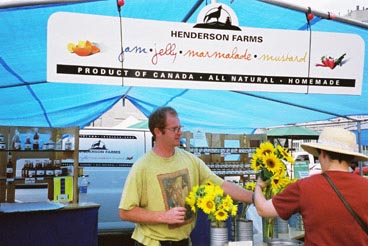
PROFILE OF ROBERT HENDERSON
|
|
"We call it a sticky business,"
Robert said with a laugh. "Jam, jelly, marmalade and maple syrup."
In addition to his prize-winning line of gourmet foods, regular customers
at the Kingston Public Market know Robert Henderson for his sunflowers
and chair restoration that involves traditional crafts of caning,
rushing and splint. A vibrant man with red hair and warm brown eyes
framed by amber glasses, Robert is filled with energy that he pours
into every aspect of his growing business.
Adapting to change is a
constant in Robert’s life. He grew up on Wolfe Island where his parents
and grandparents operated a dairy farm. Eventually the family turned
to market gardening and Robert now operates the family farm and has
been selling his produce at the Kingston Public Market for fourteen
years. "The market is a fun place to be. It’s where I started,"
he explains. A regular customer once asked if he made pepper jelly
and that launched him into a quest for recipes that resulted in his
Hot Jalapeno Pepper and Sweet Red Pepper jellies. He scours old cookbooks
for recipes and consults family members. His Pumpkin Marmalade recipe
came from Great Aunt Marie Chouinard from the Bas St-Laurent (Lower
St. Lawrence) Region of Quebec. The pumpkin used to make this marmalade
is called "potiron gros jaune" (strong yellow
pumpkin). It’s an organic heritage
seed variety, popular in France in the late 1700's. This fine-grained
pumpkin replaces the large quantities of sugar required in most recipes
and it makes for a refreshing, tart flavour. Robert says that Pumpkin
Marmalade is a fall tradition and it goes well with toast, croissants
or hot buns.
All the jams, jellies,
marmalades and mustards are homemade in open kettles in small batches.
Some ingredients are grown on Wolfe Island and some are purchased
locally. Robert has won awards for his Pear Jam, Wild Dandelion Wine
Jelly and Maple Syrup at the Canadian Fine Food Show at Toronto’s
Royal Agricultural Winter Fair. The demand for his products has spread
from the Kingston Public Market to Quebec and British Columbia. "It’s
a gourmet product made in limited editions," he says. Even the
jar labels are eye-catching and colourful, thanks to a cousin in Ottawa
who is a graphic designer.
Robert has a brother and
sister who help out at the market when they can. With the seasonal
nature of farming, Robert developed a sideline for the winter months.
"In high school I took a furniture refinishing course and restored
some old chairs for my mother. The instructor showed me how to cane
and it turned out really nice and so I did a few chairs for relatives.
Later I taught myself rushing and splint – rushing and splint are
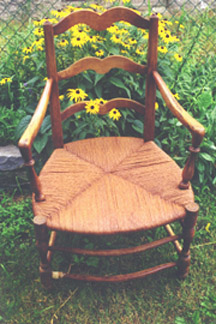
the older traditional methods." Robert does antique chairs as
well as new ones. "It’s a lost art," he said. The photo
below shows a rush chair that dates from the 1700’s. This type of
chair is displayed at the historic fort in Louisbourg, Nova Scotia.
 |
 |
|
During high school at QECVI,
Robert developed an interest in bees, "another sticky business".
He kept an observation hive indoors as well as ten hives outside.
"Ten hives are just a hobby. Some of my neighbours had five hundred."
After high school, Robert went to Guelph University to study horticulture
and then he worked in Leamington growing roses and chrysanthemums.
He returned to Wolfe Island to grow and sell peas, beans, cucumbers,
squash, lettuce and pumpkins. I ask what led him into jams, jellies
and marmalade and Robert replies quite simply that "the deer
population is a problem on the Island and they love the lettuce. I’m
a nature lover and organic farmer and I didn’t want to shoot the deer
and so I got more into the jams over the past two years."
As I prepare to leave,
Robert is packing boxes with jams and jellies to deliver to stores
in Ottawa that afternoon. He will return to three days of intensive
jam-making to prepare for three craft shows in September: the Signatures
Craft Show in Ottawa, the Vegetarian Food Show in Toronto and the
Cabbagetown Art and Crafts Show also in Toronto. Meanwhile, you can
see him at the Kingston Public Market most Tuesdays, Thursdays and
Saturdays.
HOT TOPICS:
FARMERS TALK ABOUT DROUGHT
Last year there was too
much rain and this year not enough. Agricultural lands in eastern
Ontario received only 11 millimetres of rain in July, 2001 compared
to 118 millimetres in 2000.
"It’s been two bad
years," said Larry Baker. "But it’s worse for the
growers." Larry was protected somewhat from the impact of the
drought because he grows flowers and bedding plants in greenhouses.
He buys the rest of his produce from local growers: apples from Adolphustown
and tomatoes from Picton. If the quality isn’t there, he simply doesn’t
buy.
It’s a different situation
for the growers. Dianne Wilson sells fresh and dried flowers,
mostly lilies and cosmos, and honey. She said that honey production
is down by two-thirds this year but the quality might be richer because
it’s drier and might crystallize finer. "We also got amber honey
this year which we don’t normally get. " There were fewer flowers
and the cosmos were shorter. There would have been no lilies except
for the fact that the whole family of five children went out with
hoses to water. "It started to rain while we were watering but
it didn’t sink in. I kicked the earth and it was still dry. Basically
it doubled our work, but one of the benefits was less weeds!"
Robert Henderson
(featured on page 2) commented that a lot of seeds simply didn’t germinate
this year. His sunflowers were reduced by half and the ones that did
grow were much smaller than usual. His fruit and pumpkin crops were
also cut in half.
Frank Stevenson has a farm on South
Bay in Prince Edward County. He has a small orchard with plums and
pears and also grows vegetables, raspberries and blackberries. "Production
has been hurt this year," he said, "Not just because of
the drought but also the extreme heat. The seeds are grown for a particular
climate, a northern climate, and this year we got sun scald on our
tomatoes and peppers."
Frank was philosophical
about the weather, "The drought and heat are no more drastic
than other events. You have to expect that. The biggest problem is
that locally grown produce has no premium in the market place. We
have to sell at the same price as food that comes from outside. The
drought is insignificant compared to this."
Frank said that people
are trained to shop based on price alone, with no thought to supporting
the local grower who can provide fresh produce. "There has to
be a cultural change," he said. "If a premium is placed
on locally grown products then we can compete with supermarkets. Right
now we have a sceptical public looking for the best price." Frank
said that many regular customers at the market are extremely loyal
and dedicated to supporting their local growers. "Sometimes I
think they’re as rare as hen’s teeth. I just wish there were more
of them."
DID YOU KNOW?
In June 1999, Farmers' Markets Ontario
Provincial Economic Impact Study was released. Results were impressive:
- over 90% of shoppers come to the Farmers'
Markets for the fresh produce;
- over 25,000 people work in our sector;
- there are about 1 million shoppers a
year;
- annual sales at all Farmers' Markets
across Ontario exceed $500 million.
- our impact on Ontario's economy is over
$1.5 billion.