| THE HISTORY OF THE NEW RIVER |
 |
 |
| At the end of the 16th century, London was a thriving, bustling centre of trade and commerce. The population had increased enormously to about 180,000 and now faced an acute shortage of clean drinking water. The River Thames and its tributaries which had made London such a suitable place for a port and city were badly polluted. In Elizabeth I's time, London had no sewerage system separate from its water supply. Since the 13th and 14th centuries, various monarchs and parliaments had tried to stop people throwing dung, garbage and entrails into ditches, rivers and streams but to little effect. Pollution and the general careless disposal of waste made London evil-smelling and unhealthy. Many people got their water from open water courses. Some depended upon water-bearers to bring their supply from the river in barrel-like containers. Other people, often the more wealthy, obtained their water from shallow wells that tapped the ground water and, in a few cases, water was piped to different parts of the city. However, even these sources were soon contaminated. In Elizabeth I's reign, the Corporation of London sought ways of alleviating the problem of the shortage of clean water. By 1570, the City Corporation had obtained an Act of Parliament to cut a channel to bring water from Middlesex or Hertfordshire. |
 |
| In 1580, a man named Russell suggested building a channel from the River Colne at Uxbridge to Holborn in North London. Nothing came of his proposal but, at the turn of the century, Edmund Colthurst, a former army captain, made plans to bring water from springs near Hertford in a channel to Islington. This was to become the New River. There were some very skilled engineers and surveyors who were capable of constructing channels with great precision. The priciple behind proposals to bring water from the Colne or from Hertfordshire was that it could reach London entirely through gravity. That Colthurst and his contemporaries should be so confident in their ability to build to this precision indicates a high level of expertise. Although much of the credit for the project is normally attributed to Colthurst, it is generally believed that the technical expert behind the project was Edward Wright, a mathematician, navigator and map-maker. The New River was to become the longest channel carrying drinking water in Britain and, even now , it is one of the longest remaining stretches in Europe. |
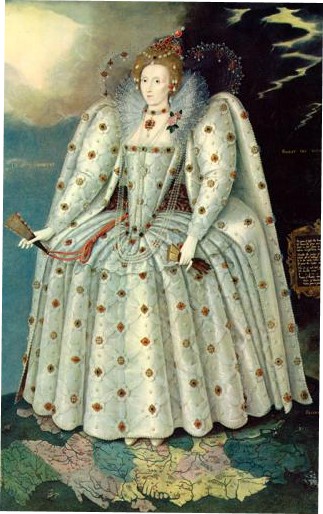
| Elizabeth I |
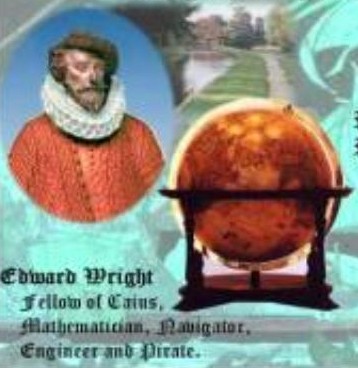 |
| Edward Wright |
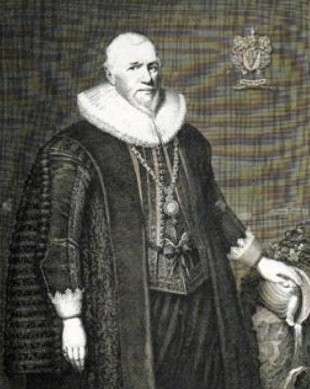
| Edmund Colthurst put forward his plans around 1600 and got the backing of the Corporation of London in 1602. However, Queen Elizabeth I was concerned that, as water flowed from the springs to the nearby River Lea, the navigation there might suffer. A commission was set up to investigate, but the Queen died before Colthurst could be given a licence to start the work. In 1604, Elizabeth's successor, James I, did give Colthurst permission to go ahead provided that he made the river no more than 6 feet wide and finished it within 7 years. The next year, Edmund Colthurst completed 3 miles at a cost of �200 and then applied to the Corporation for funding. The City Council declined to put up further finance and discussions on who should fund the New River project dragged on from 1605 - 1608. Finally, in 1609, the Council accepted an offer from Hugh Myddleton to complete the work in 4 years. The Council's change of mind may have been because they felt that Myddleton, an MP, banker and merchant adventurer had greater resources than Colthurst. What the latter thought of it does not seem to be recorded, but there is little doubt that the 2 men worked together for several years, up to and after the New River's completion. |
 |
| Sir Hugh Myddleton |
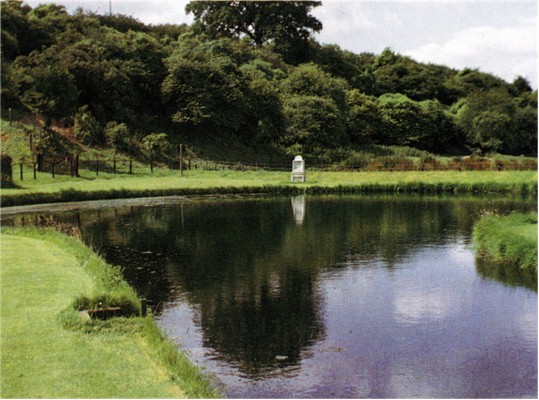
| Myddleton started the work on the New River at Chadwell Spring, where a monument gives the date of opening as 1608, although permission for the New River was only apparently granted in 1609. Colthurst was the overseer and Edward Wright had the task of surveying and directing the course of the New River. The New River was ceremoniously opened on the 29th September 1613 by the Lord Mayor of London, Sir John Swinnerton, in the presence of the Lord Mayor elect, Sir Thomas Myddleton, Hugh's brother. The ceremony took place at the New River's terminus, the Round Pond at New River Head, Stoke Newington. |
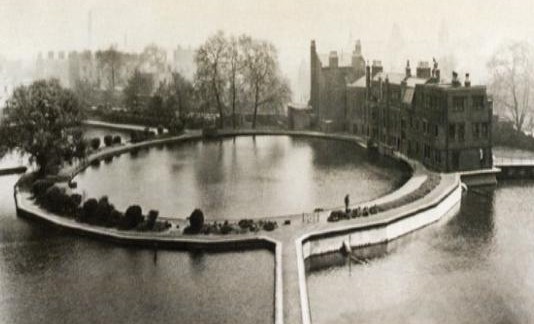 |
| The Round Pond in Stoke Newington in 1914 |
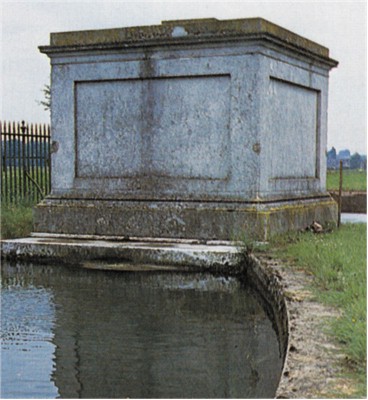
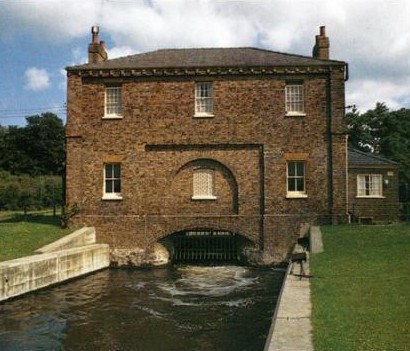
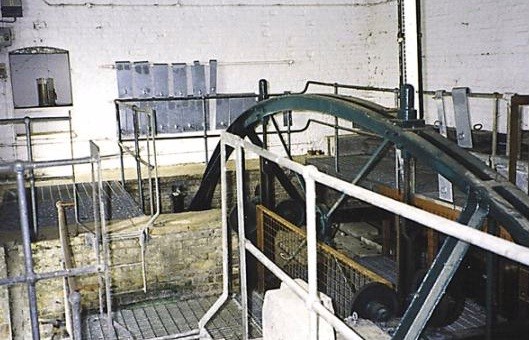
| Within 50 years, the supply of water was no longer sufficient and an Act of 1660 authorised the New River Company to extract water from the River Lea. This was achieved by laying pipes between the two rivers. However, there were complaints from mill-owners and bargemen, who feared a drop in water levels would affect their livelihood. An Act of Parliament in 1738 attempted to settle the disputes by limiting the amount of water extracted from the Lea. A timber gauge was built in the Lea to measure the flow and this was replaced in 1770 by the Marble Gauge which is still in place next to White House Sluice, but no longer in use. Later the flow was regulated by means of a wooden balance engine, which spanned the channel. It consisted of a pivoted beam with a sluice gate at one end and a float at the other. As the level of the Lee changed, the float would rise or fall and cause the sluice gate to fall or rise by a corresponding amount, thus maintaining a constant and measured flow of water. In the New Gauge building, built on the bank of the River Lea in 1856, the intake from the Lea passes over a horizontal metal plate held at a constant distance below the surface. The flow can be further regulated by adding or removing vertical plates to adjust the width of the channel. |
 |
 |
 |
| Marble Gauge |
| New Gauge |
| Inside New Gauge with the Metal Plates on the Wall |