Japanese Imperial Family
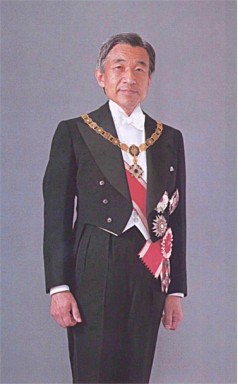
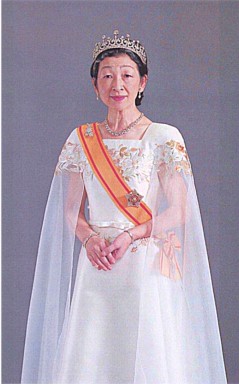
Emperor AKIHITO (125th) & Empress MICHIKO
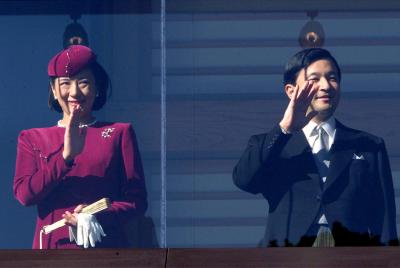
The Crown Prince and Princess of Japan
Naruhito & Masako
His Imperial Majesty AKIHITO, the 125th Emperor of Japan, Grand Cordon of the Supreme Order of the Chrysanthemum, Order of the Rising Sun, Order of the Sacred Treasure, KG (Great Britain), Grand Cross of the Order of. St. Olav (Norway), the elder son of the late Emperor Sh�wa (Hirohito) and Empress Kojun (Nagako), was born on 23 December 1933 at the Imperial Palace in Tokyo. Originally titled Tsugo-no-miya (Prince Tsugo) he entered the boy's elementary department of the Gakushuin in April 1940, advancing in the following years to the secondary and senior courses of the same school. In late 1944, both he and his younger brother, Prince Yoshi (now titled Prince Hitachi) were evacuated to Nikko, to escape the American bombing of Tokyo. Between 1947 and 1950, Mrs. Elizabeth Grey-Vining tutored Prince Tsugo, along with his brother, Prince Yoshi (now titled Prince Hitachi), and his sisters, Princesses Taka and Suga (now Mrs. Ikeda Takamsa and Mrs. Shimazu Hisanaga), in English. Prince Tsugo was formally invested as crown prince and received the Grand Cordon of the Supreme Order of the Chrysanthemum on 10 November 1951. On 2 June 1953, he represented Japan at the coronation of Queen Elizabeth II of the United Kingdom. During the same visit, King Haakon VII of Norway invested the Crown Prince with the Grand Cross of the Order of St. Olav. Crown Prince Akihito entered the Department of Politics and Economics at Gakushuin University in April 1952, but left the university in April 1954 before graduating. He later attended the university as an auditor for a further two years. The Crown Prince served as honorary president or patron of the Third Asian Games (1958), the International Sports Games for the Disabled (1964), the Eleventh Pacific Science Conference (1966), the Universiades in Tokyo (1967) and in Kobe (1985), the Japan World Exposition in Osaka (1970), The International Skill Contest for the Disabled (1981), and the Second International Conference on Indo-Pacific Fishes (1986). For his research on the taxonomy of the gobiid fish, he became a member of the Linnean Society of London in 1980; he became an honorary member of this society in 1986. As crown prince, the present emperor acted in matters of state on behalf of Emperor Showa, in accordance with the 1947 Constitution, during his visits abroad and from the time the emperor became seriously ill in September 1987. On the death of Emperor Showa, 7 January 1989, he ascended the throne. The government named new era Heisei, which means the "achievement of peace." The Enthronement Ceremony (Sokui Rei Seiden no Gi) took place in Tokyo on 12 November 1990. The Emperor, an expert on the taxonomy of gobiid fishes, has published at least twenty-six papers on the subject in the journal of the Ichthyological Society of Japan. The Emperor is also a research associate of the Australian Museum and since 1992 an honorary member of the Zoological Society of London. As Crown Prince and Crown Princess, Their Imperial Majesties made official visits to Afghanistan, Argentina, Australia, Belgium, Brazil, Bulgaria, Denmark, Ethiopia, Finland, India, Indonesia, Iran, Ireland, Jordan, Kenya, Malaysia, Mexico, Nepal, the Netherlands, New Zealand, Norway, Pakistan, Paraguay, Peru, the Philippines, Romania, Saudi Arabia, Senegal, Singapore, Spain, Sri Lanka, Sweden, Tanzania, Thailand, the United Kingdom, the United States, the former Yugoslavia, Zaire (now the Democratic Republic of Congo), and Zambia. As Emperor and Empress, Their Imperial Majesties have paid state visits to Indonesia, Malaysia and Thailand (1991), the Peoples' Republic of China (1992), Belgium, Germany and Italy (1992), the Holy See and the European Union (1993), the United States and Brazil (1994), the United Kingdom and Denmark (1998). During his 1998 state visit to the United Kingdom, HM Queen Elizabeth II invested the Emperor with the Most Noble Order of the Garter.