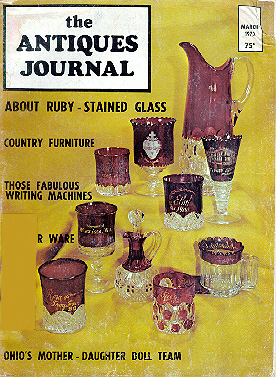
Flashed? Stained? Here Is The Answer!"Occasionally an error that creeps into the nomenclature of the antiques world becomes so deeply embedded from use that it probably will never be corrected." This quote refers to the incorrectness of calling ruby-stained glass...ruby flashed glass. I read this quote in an article called "Identifying Ruby-stained Glass" from the March 1973 edition of the Antiques Journal. I couldn't believe my eyes. That is exactly how I feel 26 years later. Funny how this was someone else's pet peeve before it became mine. How right Bill Poses, the author of that article, was when he made that statement years ago. Here I am in the 1990's trying to set it right. My collecting began around 1990 and I was told that King's Crown was flashed and that is how I referred to it. Not long into 1991 I was told by another collector that it was not flashed but stained. I knew I had to do some research, because I didn't want to appear unknowledgeable while trying to collect King's Crown. I looked into my Heacock Volume 7 and there was the only paragraph I found talking about it. I thought it described the difference well. In laymen's terms, flashed means a layer of colored glass on a clear item and stained mean a layer of color on the clear item. This made perfect sense to me. The ruby on King's Crown is easily scratched; therefore, there isn't a layer of glass to protect it. It is stained. I came up with much resistance in referring to King's Crown as stained. Since I only had the Heacock paragraph to back me up I didn't push it. Then came my wonderful "Ruby~Stained Pattern Glass" by Barret. He, too, described the difference between flashed and stained well agreeing with Heacock. Now I have "the Antique Journal" article telling me exactly what flashed and stained glass is, but also telling me to give it up the error will probably never be corrected. So, for those of you visiting my page let me educate you on the difference. Clear glass painted with a coat of red paint fired on for permanency is called "stained." This method was done because it was very cheap. This is how King's Crown was decorated. For flashed glass either a coating of red glass was put over clear glass or red glass was dipped into molten clear glass. Then the glass was worked into an item creating a thin layer of red glass either over or under the clear glass. This was also done as a cheap method of creating ruby glass. Twice now I have referred to creating cheap ruby glass. Why were manufacturers concerned with cheapness ... conservation of gold! Check back for the next feature on the King's Crown Collection Page, where I'll describe how gold was used in the creation of ruby glass. The Many Colors of King's Crown | King's Crown Leads | King's Crown Vocabulary My Favorite References | King's Crown House of Shame | The Goblet Chronicles Let's Talk King's Crown | View the King's Crown Guestbook | Have You Lost Your Mind Join the King's Crown Trade Forum | View the King's Crown Trade Forum King's Crown Care and Feeding | King's Crown Featured Articles |