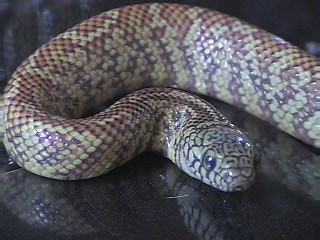
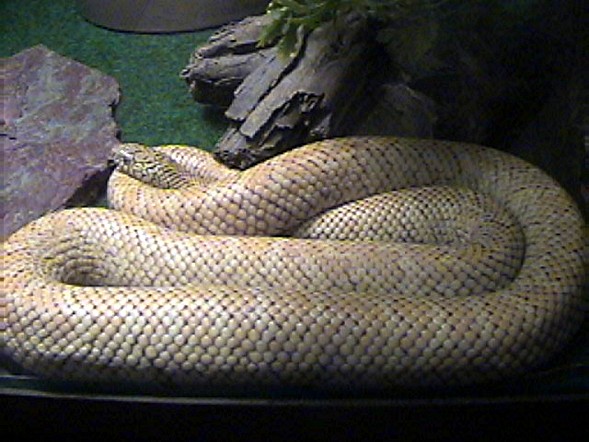
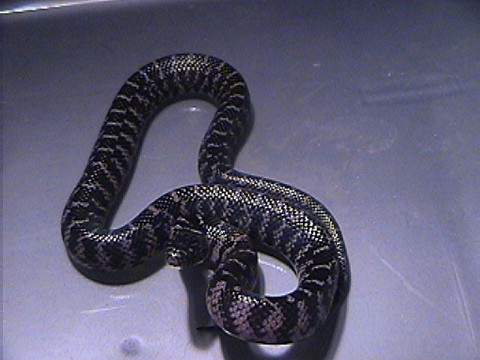
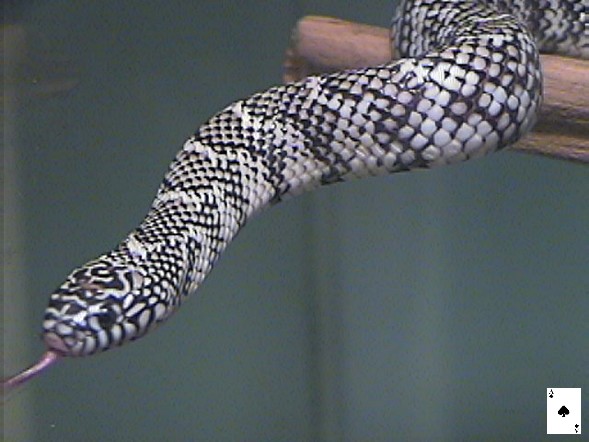
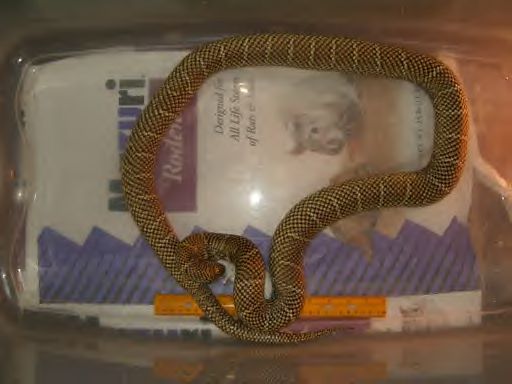
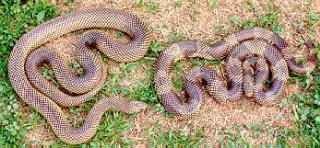
Blanchard (1919)- The Florida Kingsnake was first described in 1919 by Frank Blanchard. One month later, T. Barbour described the South Florida Kingsnake, Lampropeltis getula brooksi. In a later study of the getula complex, Blaney (1977) found that Barbour's specimen was only slightly lighter form of Blanchard's Florida Kingsnake, with barely noticable dorsal bands compared to Blanchard's specimen. He concluded that they were the same snake with varying pattern intensity. Being Blanchard first described the form as L.g. floridana, and Barbour later described it as L.g. brooksi, the name brooksi was eliminated and L.g. floridana retained. Though many in the Herpetocultural community still use the name "brooksi" to describe them.
The Florida Kingsnake is known to intergrade with the Eastern Kingsnake in central Florida. This intergrade is known as the "peninsular intergrade". It is known by having a darker dorsal pattern than the Florida Kingsnake. It's also THOUGHT to intergrade, through a disjunct population, in the Florida panhandle. These intergrades are known as Apalachicola Kings, Blotched Kings, and "goini" after their formally recognized scientific classification. Bruce Means and Ken Krysko (2001) have put forth a study concluding a central population of patternless, near patternless, and striped Apalachicola Kings as being an undescribed species of getula, with the surrounding population formally known as "goini" being intergrades between them and the Eastern Kingsnake. These conclusions have yet to be accepted by the scientific community.
Florida Kingsnake are known to be veracious feeders. Typically taking pinky mice as a first meal very readily.
Some specimens can be a handfull while handling, with others being some of the calmest snakes you could want.Typically, keeping a Florida King well fed will tend to calm them down quite a bit. |