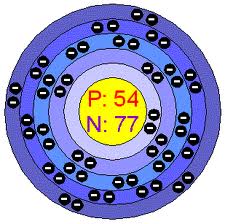
The Element Xenon


54XeXenon131.293
Atomic Number: 54
Atomic Weight: 131.293
Melting Point: 161.36 K (-111.79°C or -169.22°F)
Boiling Point: 165.03 K (-108.12°C or -162.62°F)
Density: 0.005887 grams per cubic centimeter
Phase at Room Temperature: Gas
Element Classification: Non-metal
Period Number: 5    Group Number: 18    Group Name: Noble Gas
What's in a name? From the Greek word for stranger, xenon.

Say what? Xenon is pronounced as ZEE-non.

History and Uses:

Xenon was discovered by Sir William Ramsay, a Scottish chemist, and Morris M. Travers, an English chemist, on July 12, 1898, shortly after their discovery of the elements krypton and neon. Like krypton and neon, xenon was discovered through the study of liquefied air. The earth's atmosphere is about 0.0000087% xenon.

Xenon produces a brilliant white flash of light when it is excited electrically and is widely used in strobe lights. The light emitted from xenon lamps is also used to kill bacteria and to power ruby lasers.

Due to its high atomic weight, xenon ions were used as a fuel in an experimental ion engine aboard the space probe Deep Space 1.

Once thought to be completely inert, xenon will form compounds, usually with fluorine, oxygen and platinum. XePtF6, XeF2, XeF4, XeF6 and XeO4 are some of the xenon compounds that have been formed.

Estimated Crustal Abundance: 3×10⁻⁵ milligrams per kilogram

Estimated Oceanic Abundance: 5×10⁻⁵ milligrams per liter

Number of Stable Isotopes: 6   (View all isotope data)

Ionization Energy: 12.130 eV

Oxidation States: 0