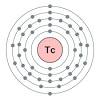
The Element Technetium


43TcTechnetium98
Atomic Number: 43
Atomic Weight: 98
Melting Point: 2430 K (2157°C or 3915°F)
Boiling Point: 4538 K (4265°C or 7709°F)
Density: 11 grams per cubic centimeter
Phase at Room Temperature: Solid
Element Classification: Metal
Period Number: 5    Group Number: 7    Group Name: none
Radioactive and Artificially Produced
What's in a name? From the Greek word for artificial, technetos.

Say what? Technetium is pronounced as tek-NEE-she-em.

History and Uses:

Technetium was the first artificially produced element. It was isolated by Carlo Perrier and Emilio Segrè in 1937. Technetium was created by bombarding molybdenum atoms with deuterons that had been accelerated by a device called a cyclotron.

Today, technetium is produced by bombarding molybdenum-98 with neutrons. Molybdenum-98 becomes molybdenum-99 when it captures a neutron. Molybdenum-99, with a half-life of 65.94 hours, decays into technetium-99 through beta decay. While technetium has never been found to occur naturally on earth, its spectral lines have been observed in S-, M- and N-type stars.

Technetium's most stable isotope, technetium-98, has a half-life of about 4,200,000 years. It decays into ruthenium-98 through beta decay.

Small amounts of technetium can retard the corrosion of steel, although this protection can only be applied to closed systems due to technetium's radioactivity. Technetium can also be used as a medical tracer and to calibrate particle detectors.

Estimated Crustal Abundance: Not Applicable

Estimated Oceanic Abundance: Not Applicable

Number of Stable Isotopes: 0   (View all isotope data)

Ionization Energy: 7.28 eV

Oxidation States: +7, +6, +4