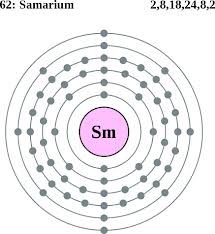
The Element Samarium

62SmSamarium150.36
Atomic Number: 62
Atomic Weight: 150.36
Melting Point: 1347 K (1074°C or 1965°F)
Boiling Point: 2067 K (1794°C or 3261°F)
Density: 7.52 grams per cubic centimeter
Phase at Room Temperature: Solid
Element Classification: Metal
Period Number: 6    Group Number: none    Group Name: Lanthanide
What's in a name? Named for the mineral samarskite.

Say what? Samarium is pronounced as seh-MER-ee-em.

History and Uses:

Samarium was observed spectroscopically by Jean Charles Galissard de Marignac, a Swiss chemist, in a material known as dydimia in 1853. Paul-Émile Lecoq de Boisbaudran, a French chemist, was the first to isolate samarium from the mineral samarskite ((Y, Ce, U, Fe)3(Nb, Ta, Ti)5O16) in 1879. Today, samarium is primarily obtained through an ion exchange process from monazite sand ((Ce, La, Th, Nd, Y)PO4), a material rich in rare earth elements that can contain as much as 2.8% samarium.

Samarium is one of the rare earth elements used to make carbon arc lights which are used in the motion picture industry for studio lighting and projector lights. Samarium also makes up about 1% of Misch metal, a material that is used to make flints for lighters.

Samarium forms a compound with cobalt (SmCo5) which is a powerful permanent magnet with the highest resistance to demagnetization of any material known. Samarium oxide (Sm2O3) is added to glass to absorb infrared radiation and acts as a catalyst for the dehydration and dehydrogenation of ethanol (C2H6O).

Estimated Crustal Abundance: 7.05 milligrams per kilogram

Estimated Oceanic Abundance: 4.5×10⁻⁷ milligrams per liter

Number of Stable Isotopes: 5   (View all isotope data)

Ionization Energy: 5.644 eV

Oxidation States: +3, +2