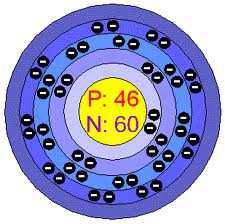
The Element Palladium


46PdPalladium106.42
Atomic Number: 46
Atomic Weight: 106.42
Melting Point: 1828.05 K (1554.9°C or 2830.8°F)
Boiling Point: 3236 K (2963°C or 5365°F)
Density: 12.0 grams per cubic centimeter
Phase at Room Temperature: Solid
Element Classification: Metal
Period Number: 5    Group Number: 10    Group Name: none
What's in a name? Named for the asteroid Pallas and the Greek goddess of wisdom.

Say what? Palladium is pronounced as peh-LAY-dee-em.

History and Uses:

Palladium was discovered by William Hyde Wollaston, an English chemist, in 1803 while analyzing samples of platinum ore that were obtained from South America. Although it is a rare element, palladium tends to occur along with deposits of platinum, nickel, copper, silver and gold and is recovered as a byproduct of mining these other metals.

Palladium is used to make springs for watches, surgical instruments, electrical contacts and dental fillings and crowns. Finely divided palladium acts as a catalyst and is used in hydrogenation and dehydrogenation processes. Palladium at room temperature can absorb up to 900 times its own volume of hydrogen. Hydrogen will easily pass through heated palladium, a property that allows for the easy purification of hydrogen. Palladium alloys are used to make jewelry and, when alloyed with gold, forms a material known as white gold.

Palladium dichloride (PdCl2), a palladium compound, can absorb large amounts of carbon monoxide (CO) gas and is used in carbon monoxide detectors.

Estimated Crustal Abundance: 1.5×10⁻² milligrams per kilogram

Estimated Oceanic Abundance: Not Applicable

Number of Stable Isotopes: 6   (View all isotope data)

Ionization Energy: 8.337 eV

Oxidation States: +3,