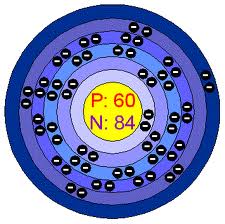
The Element Neodymium


60NdNeodymium144.242
Atomic Number: 60
Atomic Weight: 144.242
Melting Point: 1294 K (1021°C or 1870°F)
Boiling Point: 3347 K (3074°C or 5565°F)
Density: 7.01 grams per cubic centimeter
Phase at Room Temperature: Solid
Element Classification: Metal
Period Number: 6    Group Number: none    Group Name: Lanthanide
What's in a name? Named from the Greek words neos and didymos, which together mean "new twin."

Say what? Neodymium is pronounced as nee-eh-DIM-ee-em.

History and Uses:

Neodymium was discovered by Carl F. Auer von Welsbach, a German chemist, in 1885. He separated neodymium, as well as the element praseodymium, from a material known as didymium. Today, neodymium is primarily obtained from through an ion exchange process monazite sand ((Ce, La, Th, Nd, Y)PO4), a material rich in rare earth elements.

Neodymium makes up about 18% of Misch metal, a material that is used to make flints for lighters. Neodymium is also a component of didymium glass, which is used to make certain types of welder's and glass blower's goggles. Neodymium is added to glass to remove the green color caused by iron contaminants. It can also be added to glass to create violet, red or gray colors. Some types of glass containing neodymium are used by astronomers to calibrate devices called spectrometers and other types are used to create artificial rubies for lasers. Some neodymium salts are used to color enamels and glazes.

Estimated Crustal Abundance: 4.15×101 milligrams per kilogram

Estimated Oceanic Abundance: 2.8×10⁻⁶ milligrams per liter

Number of Stable Isotopes: 5   (View all isotope data)

Ionization Energy: 5.525 eV

Oxidation States: +3