How to Stay Toasty Warm
The Iowa winter is about to come upon us again this year. How do we
prepare for it? This page will give all a little help in preparing for
it. Some may say “ I know all their is to know about
keeping warm in Iowa.” Great, but as the old saying goes you are never
too old to learn. So please read on and maybe you will learn some new tricks
to keeping safe and warm.
My training comes from the military. We were taught by the Norwegian
army prior to going to the Alps for training. I also have lived in cold
climates most of my life. So I know something about
survival in the cold.
The first word in cold survival is COLD. This word is very important.
It is a word to teach your kids. What it stands for is :
C= Clean
O= Overheat
L= Layers
D = Dry
CLEAN- When preparing to go out to the store or to go hunting or even to go out for a snowball fight it is important to be sure to keep the body clean. The pores in the skin transfer heat and help regulate the body heat. If they are full of dirt they just don’t work right.
Overheat = If you are going out and you plan on any type of work remember not to overheat your body. This will lead you to sweat and then the sweat will evaporate. The evaporation will cause you to have what is called Hypothermia, or a lowering of the body temperature. This can be deadly. Take it easy.
Layers- Dress in layers so that if you find yourself overheating you can take of some clothing and allow yourself to cool down slowly. Then as you cool off you have clothing to put on as you get cooler. This works for getting in and out of the cars and going to the stores. The other advantage to dressing in layers is that between each layer of clothing is a trapped layer of air. The air buffers the cold air of the outside and the warm air created by your body.
Dry- Keep your clothing dry. Wet clothes do not allow your body to breath and reduce the air pockets. This will have a chilling effect on you.
Some other information about clothing. You lose 80% of your heat through
your head so a hat is very important. Mittens are better than gloves, the
fingers keep each other warm. Nylon panty
hose are great under thermal underwear. They produce a great air pocket
and are comfortable. Men you can ask you wife to go get them, but Real
Men will buy them for themselves. Wool will keep you warm even if you are
wet. When picking socks for a long walk start with a pair of nylon socks
and then add a pair of wool socks. The nylon socks will allow your feet
to sweat and allow the sweat to go through to the wool socks which will
“keep you warm even when wet.”.
FIRST AID:
So the school bully has taken your child’s mittens and he walked home
with out them. Now his hands are cold. Let this site help you assess the
problem.
The first common problem in cold areas is HYPOTHERMIA: This occurs
when a person’s body temperature drops to between 95 degrees and 77 degrees
F. It can occur when air temperatures are above freezing. To prevent hypothermia,
avoid actions that cause rapid or uncontrolled loss of body heat. Signs
of hypothermia are sluggish movement, reduced coordination, and impaired
judgment. If the persons body core temp drops below 77 degrees, death is
almost certain. Please not that just because a person falls into freezing
water and is down for 20 or 30 minutes does not mean he is dead. The body
goes into a case of Divers Reflex. This is where all the blood is drawn
into the core and the head of the body to keep these areas alive at the
expensive of the limbs. If you find yourself in this situation begin CPR
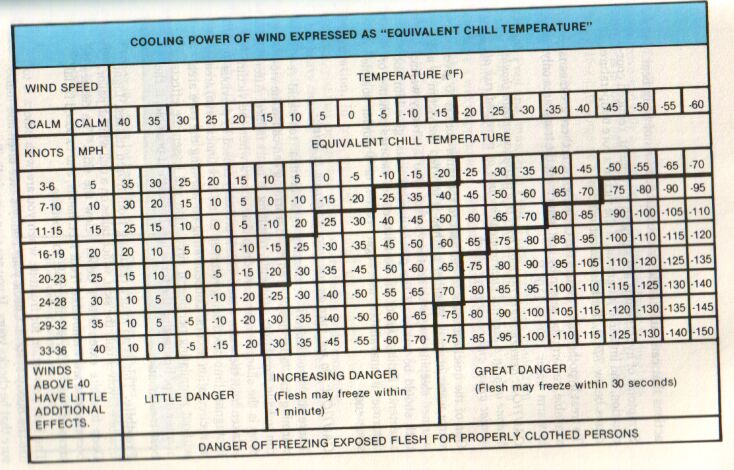
and keep doing it tell EMS arrives. See Figure 1 below for a wind chill
chart.
FROSTBITE = This is an injury resulting from frozen tissues. Light frostbite
(or frostnip as we call it here) involves only the skin, which takes on
a dull whitish pallor. Deep frostbite extends
to a depth below the skin. The tissues become solid and immovable.
How solid? Go to your freezer and get out that hamburger that was put in
there last week and use it for a gage.
The feet, hands, and facial areas are particularly vulnerable to frost
bite. The best prevention for frostbite is to use the buddy system. Mom
and kids can do it. Look at each others skin for white or waxy color areas,
Blacks or dark skin people will have gray color skin. A loss of feeling
in the hands or feet is an indication of frostbite. Look at figure 2 below
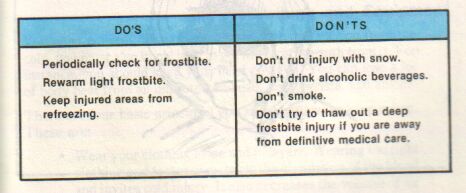
for some do’s and don’ts of frost
bite. To rewarm a minor case of frostbite try the following tricks:
1 For the face. Have the person with the cold facial areas put their
face inside your coat. It will only take about 2 minutes for a light case
of frostbite.
2. For the hands. Have the person with the cold hands put them under
their arm pits.
3. For the feet, if you are stuck out in the cold, put your cold feet
on your buddies stomach under the coat.
4. If you can go home and they do not have a serious case of frostbite,
(it does not feel like 2 lbs of frozen hamburger. And they still have movement.)
then rewarm in water at 100 degrees F to 110
degrees F. DO NOT ALLOW THE AREA TO REFREEZE!!!!
DEHYDRATION = We only think of this in the summer but it is a real problem
in the winter. Because of the cool temperature we don’t feel the need to
drink more fluids like we do in the summer. WRONG. You need just as much
fluids in the winter as you do the summer. Hint: Watch your urine. If it
is a dark yellow you need
more fluid intake. NOT BOOZE.
COLD DIURESIS = This is an increased output of urine caused by exposure to cold. It also decreases the body fluids, which must be replaced. See the paragraph above.
SNOW BLINDNESS = This is caused by the reflection of ultraviolet rays of the sun on a snow-covered area. The symptoms of snow blindness are the feeling of grit in the eyes, pain in and over the eyes that increases with movement, eyes watering and becoming red, and a headache, which intensifies with continued exposure to light. To treat this bandage the eyes tell the symptoms disappear. To prevent it wear sunglasses.
OK, I know some of you are going to laugh about this one but I have to mention it for all the outdoors people.
CONSTIPATION = We know what it is. People tend to hold everything in rather than face the elements. That is why they become constipated, also dehydration will contribute to this problem. Solution: go when you have to go, you will not die with your but in the wind, and drink allot of fluids.
Now for you out of towners who are new to this environment. We have
a condition called WHITE OUT. This is where everything around you is white
so you can’t see the road or even 10 feet in front of you. It is caused
by high winds blowing the snow around. If you are in a auto, stop. turn
on your hazard lights and prepare
too sit it out.
How do I prepare my care for survival in the winter?
Some people say “I don’t need to, I am only going 10 miles to work.”
There is a story about a rancher who left his house to go check on his
livestock in a barn 200 feet from his house. There was a blizzard going
on. He was found dead 400 ft from his house facing the wrong direction.
Here are a few things that you can get ahead of time just to be prepared:
1. A flashlight. Turn 1 battery around and you will not have a problem
with it accidentally coming on.
2. Freeze dried food. You can get it at almost anywhere. If you have
a problem finding some E-mail me and I will help you. Take enough for 2
days.
3. Waterproof matches. You can make your own by coating regular matches
with fingernail polish. It don’t mater what color.
4. A sleeping bag if you are alone, 2 if you have a family. And put
a change of clothing in the bag for each person.
5.A small shovel. This will help you keep the exhaust on the car open
so you can run the engine for about 20 minutes every hour.
6. A can of sterol or candles. Both are great for starting a fire.
Don’t burn the sterol in the car as it gives of poisonous fumes.
That should be enough to get you through a car stalling on the highway.
Now for some do’s and don’ts.
Do stay with the car. It is easier to find than a body.
Don’t leave a car to walk to somewhere unless you can see it.
Do keep the snow from covering the car completely, keep an air hole
open and if possible tie your colored clothing on the highest point of
the car.
Keep a cell phone on hand in case of emergency.
Do listen to the weather before you leave and believe them. They are
real good at forecasting bad snow.
It is better to take a day of from work than to be stuck in snow for
2 days.