The Golden Section
4/25/99
The Golden Section has been around since time began. With it’s counterpart, the Fibonacci sequence, it can be found in almost every aspect of nature, civilization, and the arts. The Golden Section consists of two interchangeable numbers depending on how they have been applied. They are ±1.6180339887... and ±0.6180339887... . To first get to the Golden Section, we must look at the Fibonacci sequence. It is a simple recursive formula that adds it’s previous number in the sequence;
1,1,2,3,5,8,13,21,34,55,89,144,233,etc….
If you divide each number by it’s last, you get the Golden Ratio:
1/1=1, 2/1=2, 3/2=1.5, 5/3=1.666…, 8/5=1.6, 13/8=1.625, 21/13=1.61538.
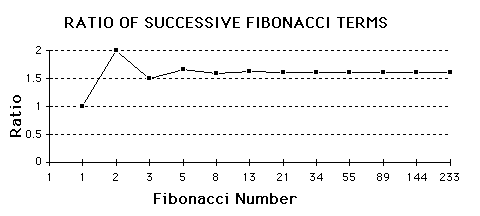
If we look at these quotients plotted on a graph, we see something interesting;
After the 5th or so term, the quotients balance out to a rough representation of the Golden Section, but in this case the Golden Ratio.
Another way the Golden Section can be represented visually is something known as the Golden Cut;
D a A a’ C b B
The entire line is l. If we let AB be divided into two parts by C, then also let the lengths AC and CB be a and b respectively. If l:a’ is equal to a’:b, then C is the Golden Section. Another cut would be in line DB. a’ is the Golden Section because;
Da’:a’B=DB:a’B.
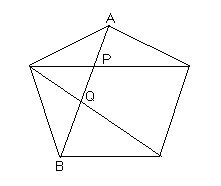
Another good visual of the Golden Ratio is the Diagonals in a pentagon:
Here are some Golden Ratios within the shape;
AQ:AB = AP:AQ
Q = Golden Section FOR |PB, |AB
AND OTHERS…

All this brings us to the "Spira Mirabilis". The Logarithmic Spiral is evident in Nature, and is very closely related to the Fibonacci sequence. The logarithmic spiral;
In the rectangle ABCD: AB:BC = Ø (Golden Section).
Cut off the square AEDF. Then the remaining rectangle EBCF is a Golden Rectangle. If then the square EBGH is cut, then the remaining HGCF is another Golden Rectangle, and so on and so forth.
History
The Golden Section has been applied to in Greek Architecture and art, including Phidias’ sculptures, the Parthenon, among other things.
<-Parthenon
The Greeks seemed to be fascinated with the Golden Ratio, and included it in many aspects of their life. The Acropolis, probably the best known of Greek buildings employs the Golden Ratio in architecture, times too numerous to mention. We know the Greeks used the Golden Ratio on purpose, but we will find out later that some occurrences may be completely arbitrary.
In the 13th century Leonardo of Pisa discovered the Fibonacci sequence, a sequence of numbers that occur in nature in so many aspects. They are also surprisingly tied directly to the Golden Section as we found earlier.
Some pictures that tie into the nature aspect of the Fibonacci sequence are the seeds on a sunflower. Starting from the center of the seed head, spiral out in two directions, (e.g. left & right), counting number of seeds in each row will yield two consecutive numbers in the Fibonacci sequence. For example, if you had 55 rows in one direction, then you will get 89 rows in the other direction. Another example would be 233 rows versus 144 rows.
The Fibonacci sequence also shows up in most growth structures in healthy plants:
On the right is marked the number of growth cycles, that the plant undergoes, and you’ll notice some interesting things if you count the number of branches each growth cycle. The number of branches follows the Fibonacci sequence per cycle. Knowing that when the Fibonacci sequence is divided by itself (mentioned before) and we come up with the Golden Ratio, it’s safe to say that nature definitely reflects this mathematical phenomenon.
The Applied Golden Section
One area of art that the Golden Section happens frequently in is music. In this application the ratio is used for aesthetic purposes. Instances of the Golden Section in music can be a change in tempo, the highest note in a melodic line, a dynamic swell, and many more too numerous to mention. A good example of the Golden Section applied formal music structure is the 2nd movement of the 1st Mozart piano sonata K.330. Composed in 1783, the second half of the movement is 14 measures long. At the ninth measure of this section, one period ends, and another one begins. If you multiply the eight measures of the first period you get (approx.) the number five. In the fifth measure of the period the second part of the melody begins. The same thing happens in the second period. One wonders if Mozart planned this, or he was just sympathetic to mathematical beauty.
Another example in music is Beethoven’s 5th Symphony. In the first movement the theme opens the piece clearly. (this is the famous ‘da-da-da dum!’). The theme is heard throughout the movement, and uses a similar ending each time. A modulation which does not change until we get to the Golden Section in measure 372, which is also the beginning of the ‘Coda’. A coda is the large closing section of a piece. What’s interesting about the Golden Section of this piece, and what makes it a Golden Section, is that the theme is played clearly like always, but a different modulation is used but this time, not to end the phrase. Instead Beethoven takes us on a little ride as he stretches out the motivic idea, and makes an aesthetic section.
Lastly in J.S.Bach’s chorales one generally finds that at the Golden Section of these short pieces a high not is played, and not played again for the duration of the chorale. Bach was well known for being a mathematician in his compositions, but were things like this planned?
Although the Golden Ratio has been around since time began, it can also be found in such things as television shows. Closely related to theater and literature, the section can be compared rather easily, however, since television shows are generally shorter than a play or a novel, their Golden Section is easier to pick out. Let’s take the sitcom. In one half-hour our attention deficit is dragged through an opening, plot development, a point when the actions of characters have reached dynamic forte, bringing on the climax, and finally dénouement. The point when the dynamics of the character reach their height is usually the point of the Golden Ratio. For instance if a character is going through a change in personality that his or her buddies can’t take, then this is usually the point of the Golden Section, the point just before the climax.
In the movies the same thing happens. In the cliché movie the Golden Section would be the point when things first start looking down for the main characters. The main character’s wife has left him, he’s been fired, and any other thing to bring darkness on his cause. For instance in Wayne’s World when Garth has left his best friend Wayne (the main character), he’s out of money, his girlfriend’s left him for the antagonist, and his public access TV show is about to be dropped.
An example of the Golden Section in literature is from Kurt Vonnegut’s Breakfast of Champions. In the opening part of the book, two separate characters are both preparing for the same moment in time. They finally meet in moment of dark humor, which happens in the late vicinity of the Golden Section.
The Golden Ratio makes it into our everyday lives in so many ways that we barely notice. If you find yourself running around you might see something and think, "that looks nice," chances are that that’s the Golden Section at work. These are some things that I noticed in everyday life:
The most prominent thing was a doorway. It fascinated me when I measured the height and width of my bathroom door. It measured 33" across, and 83" high.
83*0.62 = 51.46
83 – 51.46 = 31.54, (approx. 33!)
This kind of modern day architectural math may be intentional, or it just might be the eye of the builder, telling him what is aesthetic and what is not.
I also had to try this on a window, of course. But this time, instead of applying the Golden Section to the height, and finding the width, I had to add up the height and width of the window, and then apply the Golden Section to the answer:
54 + 41 = 95
95 * 0.62 = 58.9
The number 58.9 comes close to 54, the height of the window. This means that if you pivot the top of the window up on one side, you will end up with the pivot being the Golden Section.
Cars are another modern day application of the Golden Ratio.
The following two pictures are of a Saturn and a Porsche. It’ funny to see how the makers of these two cars might have taken the Golden Ratio into account in designing cars. I drew lines down both the horizontal and vertical Golden Sections. Along each line you see something happening in the body.


I noticed, as you can see in the Saturn on the right, that with most cars if you draw a line down the center of the ‘cab’ part, then you end up in the Golden Section of the entire length of the car. When this is applied to the Porsche you come to the highest part of the car. This is an aesthetic technique in art that I mentioned before also occurs frequently in music. In both cars however, the horizontal line divides window from body.
In summary, the Golden Section accompanied with the Fibonacci sequence shows up almost everywhere. It effects our ways of looking at things, and occurs innately in us. Take for instance the way one might organize a clean desk. You don’t center things exactly, they’re always to one side, most likely over 62% of an area! The Golden Section is an important part of architecture, math, music, design, and nature, both old and new.
Here are two references I used: Fibonacci numbers... and The Golden Section...