 |
|
|
|
|
|
|
|
|
|
|
|
|
|
|
|
|
|
|
|
|
|
|
|
|
|
|
|
|
|
|
|
|
|
|
|
|
|
|
| Hip hop Culture |
|
|
| From Wikipedia, the free encyclopedia |
|
|
|
 |
|
|
|
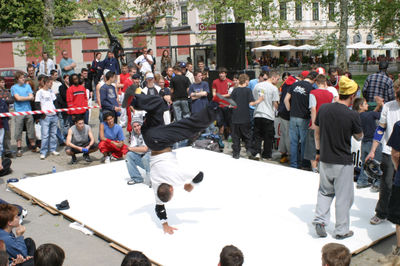
Breakdancer in Ljubljana, Slovenia. |
|
|
|
|
| Hip Hop is a cultural movement that began among Latinos, Puerto Ricans and African American communities in the South Bronx in the early 1970s. Portions of the culture began spreading into the mainstream during the early 1980s, and by the 1990s, hip hop culture had spread all over the world. The movement is said to have begun with the work of DJ Kool Herc, while competing DJ Afrika Bambaataa is often credited with having invented the term "hip hop" to describe the culture. |
|
|
| The four main aspects, or "elements", of hip hop culture are MCing (rapping), DJing, graffiti, and b-boying (known to the mainstream as breakdancing). Most consider knowledge or droppin' science as the fifth element while some consider beatboxing. Others might add political activism, hip hop fashion, hip hop slang, double dutching (an urban form of rope skipping), or other elements as important facets of hip hop. In mainstream spheres, the term "hip hop" typically refers only to hip hop music (or rap music), the music produced by the MCing and DJing aspects of hip hop culture. |
|
|
| Originating from socially marginalized groups, the hip hop culture is spontaneously nonconformist in relation to the western system of values and esthetics. |
|
|
| Influences |
|
|
|
 |
|
|
|
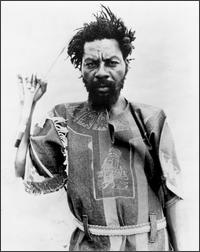
U-Roy |
|
|
|
|
| The various factors that influenced hip hop culture are complex and numerous. Although the majority of influences can be traced to African culture, the multicultural society of New York City resulted in diverse musical influences finding their way into hip hop music. |
|
|
| Elements of the style and techniques of rapping originate with the griots of West Africa; traveling singers and poets had musical styles that contained elements of what would later evolve into hip hop music. Some griot traditions came to the United States, the UK and the Caribbean with the passage of African slaves to the New World. Other notable influences are the spoken word sections of records by soul and funk musicians such as James Brown, Isaac Hayes and Gil Scott-Heron. |
|
|
| One of the many influences for both hip hop culture and music is the Jamaicanstyle called dub, which arose as a sub-genre of Reggae in the 1960s. Dub music saw producers such as King Tubby creating instrumental versions of popular reggae records for the purpose of clubs and Sound systems; they had discovered that dancers often responded better to the extended, isolated beats of the records, often featuring intense percussion and heavy bass lines. Soon, the MCs that hosted the dances began speaking over the instrumental records, and the skills of MCs such as U-Roy, Dr. Alimantado and Dillinger saw them become popular performers in their own right. This tradition continues in contemporary Dancehall music. In 1967, Jamaican immigrants brought dub to New York City and began playing it at parties in community centers, roller rinks and on the streets. |
|
|
| Another significant influence is blues music, particularly its call and response aspect. Blues artists as early as Robert Johnson often mixed in some rhythmic "speaking" in addition to their singing. This survived into the tradition of "toasting", another aspect of the oral tradition intrinsic to hip hop music. This became most pronounced in the tradition of MC battles, begun in the early 1980s. |
|
|
| Origins |
|
|
| DJ Kool Herc, a Jamaican immigrant, was one of the most popular DJs in New York during the 1970s, and played at many neighborhood block parties in the Bronx. After his first gig at 1520 Sedgwick Ave. in the Bronx in 1973, Herc quickly switched from using reggae records to funk, rock music and disco, as he found that the New York audience did not particularly like reggae. Herc and other DJs found that dancers often preferred the percussive breaks of the records, and began extending them using an audio mixer and two records. Within a highly competitive atmosphere, Herc's friends and competitors quickly developed other mixing techniques in order to keep audiences excited. |
|
|
| As in Jamaica, these events were often hosted by a performer who spoke while the music played; these were originally called MCs (Masters of Ceremonies) and, later, rappers. Early rappers focused on introducing themselves, the DJ and others in the audience, although they quickly progressed to including improvisation and a simple four-count beat, along with a simple chorus. Later MCs added more complex and often humorous lyrics, and incorporated sexual themes. Although it had yet to be recorded, hip hop music steadily grew in popularity, and by the end of the 1970s was beginning to become a major artistic force which had spread throughout the United States. During the 1980s and 1990s, hip hop gradually became mainstream in the United States, a transition usually considered to have been completed in 1992. By the end of the decade, the culture had spread worldwide. |
|
|
| Hip hop music |
|
|
| Hip Hop music, distinguishable by its emphasis on rhythm and frequent inclusion of rapping, arose from the mixing of Jamaican and American music by the immigrant DJ Kool Herc in his block parties which started as early as 1970. Rapping is the hip hop equivalent of the toasting which could be found in Jamaican dub music at the same time. Herc would play the funk records that his audience demanded, but he invented the hip hop beat by isolating the "breaks" (the part in the song with only drums) from the rest of the song. While an entire culture grew out of this music, the music itself developed with years, leading to a golden age from 1986 to 1993. |
|
|
| MCing |
|
|
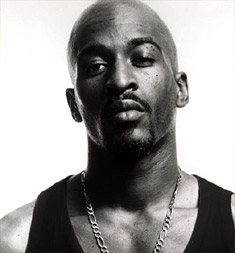
| The most visible role in hip hop culture today is that of the MC�??the master of ceremonies. The MC entertains the crowd with their rapping (the rhythmic delivery of rhymes). With its roots in Jamaican toasting, rapping has developed significantly since its introduction to hip hop culture by Kool DJ Herc and DJ Hollywood in the early '70s. Rapping and MCing have developed throughout the years, due to the achievements of pioneers such as Coke La Rock, Melle Mel, Kool Moe Dee, Schooly D, Ice-T, Run-D.M.C., Beastie Boys and Rakim. |
|
|
| One of the most important aspects of MCing is the concept of the MC battle. Battling is when two MCs engage in a rapping competition against each other, a practice dating back to hip hop's earliest years. The purpose of battling is for each MC to try to diminish their opponent's lyrical skills, subject matter, or even personal qualities; and also to gain the favor of the crowd or audience. The level of crowd impression with a particular lyricist is determined by various forms of lyrical delivery, skill, insults and their ability to "move the crowd". The crowd's reactions determine the victor, thus giving the triumphant lyricist recognition. |
|
|
 |
|
| Rakim, an important rap pioneer. |
|
|
|
| Typically battles occur in various underground hip hop clubs and events, although "battling" may occur in settings as informal as a street corner. Battles are sometimes arranged as contests possibly including panel judges and/or prizes. More well-known battle MCs may go public with a battle on the radio or produce a "diss" record and call out their potential opponent. These public battles are often viewed as publicity events used to gain exposure and acquire more fans. |
|
|
| While less common than Rap battles (in which only MCs participate), DJ battles, Breakin' battles, and Beatboxing battles are also conducted. As in rap battling, audience response and participation (and, occasionally, panel judging) are used as the metric by which a victor is selected. |
|
|
| DJing |
|
|
| While hip hop did not invent DJing, it has extended its boundaries and techniques. The first hip hop DJ was Kool DJ Herc, who created hip hop through the isolation of "breaks" (the parts of albums that focused solely on the beat). In addition to developing Herc's techniques, DJs Grandmaster Flash, Grand Wizard Theodore, and Grandmaster Caz made further innovations with the introduction of scratching. |
|
|
| Traditionally, a DJ will use two turntables simultaneously. These are connected to a DJ mixer, an amplifier, speakers, and various other pieces of electronic music equipment. The DJ will then perform various tricks between the two albums currently in rotation using the above listed methods. The result is a unique sound created by the seemingly combined sound of two separate songs into one song. A DJ should not be confused with a producer of a music track (though there is considerable overlap between the two roles). |
|
|
| In the early years of hip hop, the DJs were the stars, but their limelight has been taken by MCs since 1978, thanks largely to Melle Mel of Grandmaster Flash's crew, the Furious Five. However, a number of DJs have gained stardom nonetheless in recent years. Famous DJs include Grandmaster Flash, Mr. Magic, DJ Jazzy Jeff, DJ Scratch from EPMD, DJ Premier from Gang Starr, DJ Scott La Rock from Boogie Down Productions, DJ Pete Rock of Pete Rock & CL Smooth, DJ Muggs from Cypress Hill, Jam Master Jay from Run-DMC, Eric B., Funkmaster Flex, Tony Touch, DJ Clue,DJ Focus, DJ Q-Bert. The underground movement of turntablism has also emerged to focus on the skills of the DJ. |
|
|
| Beatboxing |
|
|
| Beatboxing, invented by Doug E. Fresh, considered by many to be the "fifth element" of hip hop, is the vocal percussion of hip hop culture. It is primarily concerned with the art of creating beats, rhythms, and melodies using the human mouth. The term 'beatboxing' is derived from the mimicry of the first generation of drum machines, then known as beatboxes. |
|
|
| The art form enjoyed a strong presence in the '80s with artists like the Fat Boys and Biz Markie showing their beatboxing skills. Beatboxing declined in popularity along with breakdancing in the late '80s, and almost slipped even deeper than the underground. Beatboxing has been enjoying a resurgence since the late '90s, marked by the release of "Make the Music 2000." by Rahzel of The Roots (known for even singing while beatboxing) The Internet has greatly aided the rebirth of modern beatboxing�??on a global level never seen before�??with thousands of beatboxers from over a dozen countries interacting on the UK's Humanbeatbox.com. |
|
|
| Beatboxing has also recently branched beyond its traditional scope (mimicry of "beat boxes" to create hip hop beats) to several new stand alone forms. It is now widely practiced as a form of human Drum and Bass, a style of heavy electronic music. The range of sounds that can be reproduced by the human vocal cords is staggering to many unfamiliar with this musical practice. |
|
|
|
Graffiti art |
|
|
 |
|
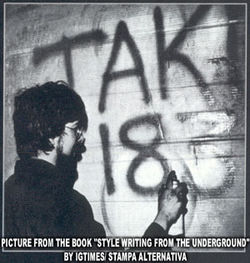
| Graffiti art |
|
|
|
| An age old practice, graffiti holds special significance as one of the elements of hip hop culture. Graffiti as an urban art form has existed since at least the 1950s, but began developing in earnest in the late 1960s, and flourished during the 1970s. |
|
|
| Graffiti in hip hop began as a way of "tagging" for one's crew/gang, and developed during the 1970s on the subways of New York, and later expanded to the city walls themselves. This movement from trains to walls was encouraged by the efforts of New York's Metropolitan Transportation Authority to eradicate graffiti on their property (the M.T.A. officially declared the transit graffiti-free in 1989). |
|
|
| The first forms of subway graffiti were quick spray-painted or marker signatures ("tags"), which quickly evolved into large elaborate calligraphy, complete with color effects, shading, and more. As time went by, graffiti artistically developed and began to greatly define the aesthetic of urban areas. Many hip hop crews have made a name for themselves through their graffiti such as Afrika Bambaataa's Black Spades. By 1976, graffiti artists like Lee Quinones began painting entire murals using advanced techniques. |
|
|
| The book Subway Art (New York: Henry Holt & Co, 1984) and the TV program Style Wars (first shown on the PBS channel in 1984) were among the first ways the mainstream public were introduced to graffiti. Quickly, the rest of the globe imitated and adapted hip hop graffiti. Today, there are also strong scenes in Europe, South America, Australia and Japan. |
|
|
| Graffiti has long been villainized by those in authority, and is associated with gangs, violence, drug culture and street crime. In most jurisdictions, creating graffiti art on public property without permission is a criminal offense punishable by fines and incarceration. |
|
|
|
B-Boying |
|
|
| Breakdancing, also known as breaking, b-boying, or B-girling by its practitioners and followers, is a dynamic style of dance. The term "B-boy" originates from the dancers at DJ Kool Herc's parties, who saved their best dance moves for the break section of the song, getting in front of the audience to dance in a distinctive, frenetic style. Hence the "B" stands for break-boy (or girl). According to the documentary film The Freshest Kids, a history of the b-boy; DJ Kool Herc describes the b in b-boy as short for breaking which at the time was slang for "going off" also one of the original names for the dance. However early on the dance was known as the "boiong" (the sound a spring makes). Breaking was briefly was documented for release to a world wide audience for the first time in Style Wars, and was later given a little more focus in the fictional film Beat Street. It was then documented properly in the critically acclaimed documentary feature film; The Freshest Kids, a history of the b-boy. (released in 2002). |
|
|
| B-boying is one of the major elements of hip hop culture, commonly associated with, but distinct from, "popping," "locking," "hitting," "ticking," "boogaloo," and other funk styles that evolved independently during the late 1960's in California. It was common during the 1980s to see a group of people with a radio on a playground, basketball court, or sidewalk performing a breakdancing show for a large audience. |
|
|
| While breaking in its current form began in the South Bronx alongside the other elements of hip hop, it is similar in style to the Capoeira form of dancing/martial arts, which was developed by enslaved Africans of Brazil. This is however a coincidence, breaking actually developed from the initiation rituals of Latino biker gangs from the late '60s, consisting of a prospect running a gauntlet, in which he woud face the whole gang, in short one on one (likely physical) battles. By the early '70s, the blows were removed, and replaced instead by pantomimes of the same moves, and instead acceptance into the gang depended on how well a prospect performed and was able to "burn", or repel burns from the others. A "burn" is when you humiliate your opponent. The name of the first B-Boy crew was The Zulu Kings. |
|
|
| "Hip-hop" as a form of dance is becoming more popular. Hip hop dance comes from breakdancing, but does not consist wholly of breakdancing moves. Unlike most other forms of dance, which are often at least moderately structured, hip hop dance has few (if any) limitations on positions or steps. |
|
|
| The entire history of b-boying has been documented in an outstanding, entertaining and inspiring film entitled; The Freshest Kids, a history of the b-boy. The film was produced and directed by Israel and was released in 2002 by Image Entertainment. The film chronicles the birth of b-boying and traces its evolution up until present day. The film features many early pioneers including Kool Herc, Afrika Bambaataa, Grandmaster Caz, The Nigga Twinz, The Bronx Boys, The Rock Steady Crew, New York City Breakers and a crop of today's most important b-boys such as Stylelements and also features members of the Electric Boogaloos and the important L.A. based Air Force Crew. |
|
|
| Other elements |
|
|
| During the early years of hip hop, double dutching existed as a minor element that had a following mostly made up of teenage girls. Double Dutch is a rope skipping game that involves two ropes, two persons to turn the ropes, and two more persons in the middle jumping the ropes. While the game is played, the persons turning the ropes would recite urban rhymes, giving the game some correlation to the art of MCing. Double dutching fell out of favor as a part of hip hop as the culture became more male-centric during the late 1970s and early 1980s, although the game is still a popular activity on its own in many American communities. |
|
|
| As it grew and developed into a multi million dollar industry, the scope of hip hop culture grew beyond the boundaries of its traditional four elements. KRS-ONE, a rapper from the golden age of hip hop, names nine elements of hip hop culture: the traditional four and beatboxing, plus street fashion, street language, street knowledge, and street entrepreneurism. He also suggests that hip hop is a cultural movement the word itself had to reflect this. He spells it Hiphop (one word, capital "h") and this is reflected in his Temple of Hiphop. KRS-One's philosphy of slightly more progressive in some ways compared to his contemporaries and isn't necessarily right nor wrong, however he is one of strongest leaders championing hip hop's (Hiphop's) place in the world. |
|
|
|
 |
|
|
|
 |
|
|
| References |
|
|
|
(1999) Light, Alan, ed. The VIBE History of Hip-Hop. New York: Three Rivers Press. |
|
|
|
Rap.about.com Hip hop culture resource
Davey D's Hip-Hop Corner
Homepage for XXL Magazine, the leading publication dedicated to hip hop music and culture
Homepage for KRS-ONE's Temple of HipHop
The Next An Impression of Hip Hop Expression A web based resource that looks at Hip Hop as a Global Movement, with a particular focus on Aotearoa NZ and Indigenous Hip Hop.
Hip Hop Linguistics |
|
|
| Retrieved from "http://en.wikipedia.org/wiki/Hip_hop_culture" |
|
|
All text is available under the terms of the GNU Free Documentation License. (See Copyrights for details.)
Wikipedia® is a registered trademark of the Wikimedia Foundation, Inc. |
|