Soft, yellow and white,
beautiful in my sight
My
fate has been revealed
in
this Turkish daisy field
Who's wrong and who's right
and
who'll win this fight
It's neither here nor there,
daisies are everywhere
And
soon enough I'll cross the daisy field
I'm
afraid but my heart won't yield
As
night turn to day
There's just time to say,
goodbye
Darlin', don't cry for me,
this is what has to be
Although my fate is sealed,
I'm
in this daisy field
Don't think of the pain
what's lost or what's gained
Don't think of these guns of steel,
just me in this daisy field

And
soon enough I'll cross the daisy field
I'm
afraid but my heart won't yield
As
night turns to day
There's just time to say, goodbye

And
soon enough I'll cross the daisy field
I'm
afraid but my heart won't yield
As
night turns to day
There's just time to say...
Goodbye

The
Daisy Field
Walker&Long
|
ANZAC Day, 25th April, is the most important date in Australia's calendar. Across the length and breadth of Australia her people turn out to salute, honour and pay their respects to the fallen and to the surviving servicemen who willingly offered their lives to the service of their country.
If you should ever travel across Australia you will pass through a myriad
of regional towns, cities and suburbs that at the time of the Great War
were merely small villages of perhaps only a few thousand people or less.
A conspicuous feature of all these typically Australian settlements is the
local Cenotaph. Dedicated to the men who gave their lives in the Great War
For Civilization. Upon these monuments the names of the fallen are
inscribed. Most bear too many names for such small towns and districts and
there was barely a family or person in Australia whom, by war's end in
November 1918 were not affected. The lists of names are often tragic for
in many small towns and districts multiple inscriptions of the same name
appear on the same monument, only the initials are different - The term
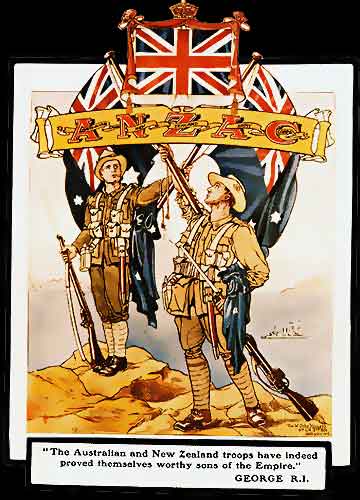
ANZAC embodies the true spirit of our nation.
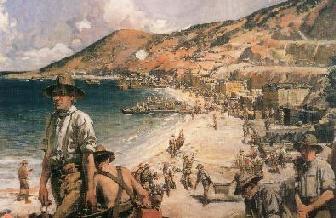
The (acronyn) name ANZAC became famous with the landing of the Australian
& New Zealand Army Corps on the Gallipoli Peninsula at the
Dardanelles, Turkey, on 25 April 1915. It has since become synonymous with
the determination and spirit of our armed forces. The significance of the
day, and the acronym, in Australia’s heritage is probably best stated by
Dr. C. W. Bean in the following excerpt from his official Australian
history of World War One:
"It was not merely that 7600 Australians and nearly 2500 New Zealanders had been killed or mortally wounded there, and 24,000 more (19,000 Australians and 5,000 New Zealanders) had been wounded, while fewer than 100 were prisoners. But the standards set by the first companies at the first call - by the stretcher-bearers, the medical officers, the staff, the company leaders, the privates, the defaulters on the water barges, the Light Horse at The Nek - this was already part of the tradition not only of ANZAC but of the Australian and New Zealand peoples. By dawn on 20 December, ANZAC had faded into a dim blue line lost amid other hills on the horizon as the ships took their human freight to Imbros, Lemnos and Egypt. But ANZAC stood, and still stands, for reckless valour in a good cause, for enterprise, resourcefulness, fidelity, comradeship and endurance that will never own defeat". more info on
ANZAC at: http://www.gunplot.net/
 |