


October 8, 2004
Jinja, Uganda
I now have an African name, Wafula which means "Rain," since I arrived to my last village stop in the rainy season. When it got to the point where I was being introduced as Urine Out-Out, I too realized it was time to truly acclimate. And I kinda like the simplicity of it, much to my mother's chagrin I'm sure.
The last month-and-a-half has been filled with discovery and sadness. With trips to three more villages, I've seen much need. And sadly, Samuel passed away five days after I left the orphanage. I prefer to think that Samuel's tremendous and courageous spirit could no longer be contained by his body, but his death hit me harder than expected. I noticed a fast decline in him but didn't want to believe it was actually time. In his last days, he was truly ready to go and wanted to die, as he confided to one volunteer while asking her to rub his chest to help alleviate his horrible cough. Shortly thereafter, he extended his left arm to the ceiling and took his last breath. We all know that he is much better off, and we actually wondered at times why God would still keep him alive when he was so sick. Then we realized that maybe Samuel was the one touching and helping us instead of the other way around. We will miss him terribly, and I dread returning to the orphanage and seeing his empty chair and empty bed, wishing more than anything to see him sitting cross-legged on that bed waiting for someone to bring him a book, a game, or a laptop with another DVD. His cottage mates were troopers until the end. I was so impressed to watch them care for Samuel, ready to do anything they could to help him. (I can remember running the other way and calling my mother if any of my siblings were getting sick.) I couldn't make it back for the burial but was told that his cottage mates prayed, sang, carried his casket and were the last to leave his gravesite as they cried and sang some more, not wanting to say goodbye to their "brother" and not wanting to believe the horrible affect that AIDS has had on all of them. Special thanks to friends who sent Samuel gifts during his illness which brought much needed smiles to his face.
And some more sad news, quite unexpectedly, Mary, another child at the orphanage, passed away earlier in the week and is being buried over the weekend.
In case any of you are wondering, the kids rose to the occasion in their performance of The Wizard of Oz, in front of a packed lawn during the anniversary celebration of the orphanage. Lucy Kibaki, the First Lady of Kenya, attended the celebration in the early part of the day, so naturally we were all a bit nervous as a couple of the dress rehearsals left a lot to be desired, especially when the three Dorothys, led by Priscilla, almost refused to wear their costumes. But we got them to agree that their blue-and-white-checkered school uniforms were undoubtedly perfect for the part. And we had three of the same dress! To be truthful, they still hate us, because they loved the costume for the Good Witch and even the black dress on the Wicked Witch was kinda cute. Anyway, everybody managed to pull through with only some minor mistakes that made them look all the more charming and Over The Rainbow has been permanently added to their song repertoire. The volunteers also performed a choreographed routine for the audience to a Swahili song. We tried to have rhythm, but needless to say, all 93 kids were bent over hysterically laughing at us, not seeming to care who was in the audience. At one point, we were actually singing "Me Wanna No No" instead of the real Swahili phrase figuring that nobody would ever know the difference. I must say that during the rehearsal and with everything else we had going on, I thought it was a very smart strategy as learning Swahili at that point was the furthest thing from our minds.
The AIDS virus hit hard in the three villages I visited, and the current percent of those infected ranges from 25-50%. All programs were started and run by self-sacrificing, smart villagers who were moved to action and continue to provide immense hope to those desperately in need. The programs were extremely active and well-managed which has led to sustainable improvements. Unfortunately though, access to antiretrovirals is still a major issue.
Mama Na Dada is a program that seeks to empower women and girls through self-sustaining projects in a village that lies on Lake Victoria. AIDS spread rapidly in this area due in large part to the migrant fisherman. Women-run businesses like goat-keeping, bee-keeping, Tye Dye, and tailoring have been funded by Mama Na Dada. They also run support groups and provide home-based care to those that are suffering with the illness. I met Catherine, a 29-year-old happy-go-lucky widow in poor health. Her house had collapsed and was rebuilt by Mama Na Dada. Then there was Clarise, a 30-year-old mother of three who could barely move and was somewhat in denial about her condition. As is common in the villages, we prayed as we entered and exited the house. She was being cared for by her mother and was most worried about the education and care of her children and whether her mother would be strong enough to care for them. Her mother was also concerned having given up everything to care for her daughter and grandchildren. Clarise requested and will receive a wheelchair from Mama Na Dada so she can move around without the help of her mother and get outside to see the sun. Mama Na Dada also operates a recreation center and it was great to see all the village women come and play netball, a combination of basketball and rugby. The program director whose husband grew up in the village, chose to lead Mama Na Dada full-time for no pay instead of working as an Attorney. She was so pleased to watch the women come and play as she said the women get married and have children so young and so rarely have fun in their lives. The women beat the teen girls and won't let them forget it anytime soon! They also run a Stay Alive Youth Group for the girls in the village. Although very conservative in nature, the women elders all got together and decided to teach the young girls about sex and how to avoid AIDS. One elder told me that she tells the young girls to abstain but if they can't, they must protect themselves. The elder women were torn in disseminating this information, but they all lost children to AIDS and believed that their whole village would eventually die if they didn't take action. And it's working. In talking to some of the orphan girls, they know the dangers and are not about to easily trust anybody.
Self-sacrifice and community were again the major themes in Rabuor, a picturesque village reminiscent of a movie set. There are 3000 people in the village and 500 passed away in the last five years. Loyce Mbewa, when returning to her native home, was so stunned at the number of people that had died that together with her family, she began to devote much of her time to the Rabuor Village Project that intelligently takes a business-like approach to assistance. The villagers view every visitor as a gift, and they were gathered and singing as I arrived. (Usually with friends and family I get "What took you so long?") This sentiment was of course partially offset later in the day when a little girl started screaming, hiding her eyes, and running away from me because she had never seen a mzungu (white man) before. It was hilarious.
The Project involves the whole community in raising funds to care for the orphans in the village. They started a nursery school for the younger orphans with a class of over 100 pupils and have been so successful that the nursery school is above the standard of the kindergarten class in the government-run primary school. The pupils are also fed during the day as many of their caretakers cannot afford proper meals for them. The group is also involved in self-sustaining projects like the installation and maintenance of a new well whereby every villager must pay a small amount for each bucket of water. They also acquired five bulls that are being used to plow a community garden that will feed the orphans, and the bulls can be rented for private use. Other programs include poultry and dairy farming with proceeds going to orphan care.
In the village, I met Caxton, a brave 14-year-old boy who has been caring for himself and his two siblings alone since his parents died four years ago. When asked how it felt to be the head of the household at ten years old, he replied that it was hard but now he is used to it. He still finds it difficult to attend school, do the household chores, and at the same time look for food for his brother and sister. Unfortunately, children living on their own is not uncommon. While visiting with Caxton, we saw a young woman panting and convulsing in shock at the news of the death of her three-year-old nephew. Then we visited Shelly, an 81-year-old grandmother who had just spent two months in the hospital due to age-related health problems. She lost three of her seven children and their spouses and is struggling to care for seven grandchildren. When asked how she coped with all the death in her family, she responded that she had to be admitted to the hospital out of shock. Something Shelly didn't lose though was her sweetness and enjoyable sense of humor. I asked if her husband was still alive and she said he was sleeping in the back and then pointed to his grave.
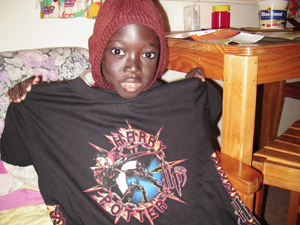
Rest in Peace
Feb. 15, 1994-Sept. 21, 2004
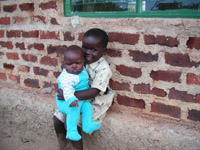
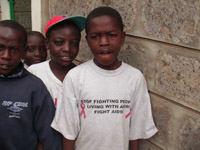
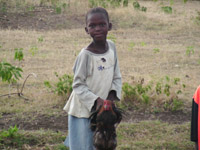
Joshua, the Program Director knows everyone and is willing to help anybody with his farming knowledge and business acumen. There are still four deaths a week in the area, and Joshua has devoted his life to helping people at least have food no matter how AIDS has affected them. I met groups of farmers that are being helped by the program. Apparently much knowledge was lost during the British colonization, and Joshua and his crew are forming groups of farmers that wish to learn steadfast techniques so that no piece of any farm remains idle at any time. They teach crop rotation, terracing and tree planting for soil and water conservation, the establishment and maintenance of tree nurseries, ways to improve soil fertility, and income diversification by raising cows, goats, and other animals. The farmers were so proud of their accomplishments that they all wanted me to visit their farms. Joshua and I figured that we must have walked over 25 miles in two days.
I also met with the widows, a vivacious group of recent businesswomen who can apply and receive loans through Common Ground for such businesses as farming, poultry raising, kiosk operation, tailoring, and brick building. Many of these women rejected wife inheritance, a traditional custom whereby the widow is taken on as the second, third, or fourth wife of the deceased man's brother. Strong and determined to not let that happen, they had the courage to take a risk and start a business in order to raise their family on their own. I visited several of their homesteads where they were so excited to show me what they were doing. None would let me leave their house without a gift so if anybody needs pumpkins, guavas, pineapples, or bananas, please let me know. And these ladies knew something about marketing. Grace who operates a tailoring business wouldn't let me take a picture until she set up her sewing machine on the porch, hung up her best creations, and then proceeded to put a measuring tape around her neck and pretend to sew. She became a widow at 32 and was left with three toddlers. Her husband's family put pressure on her to come live with them, but she decided to start a business and was able to build a new home with her income. The group has meetings twice a month at which time they make payments on their loan, and the camaraderie among the women is inspiring as they sing, dance, and greet each other with high-fives and laughter.
So now I'm on a mini-getaway in Uganda having just gone white water rafting on the Nile. There is a kayaking competition, so I am fitting right in typing on a laptop. Before I totally ruin any chance of meeting new friends, I will sign off. This completes my website journal. I hope you enjoyed it.
Tomorrow I will be making my way back to Kenya for my last week of volunteering at the orphanage and after that begins the travel part of my journey with plans to meet friends in Egypt, Morocco, South Africa, and Tanzania.
This last month-and-a-half was the hardest in terms of keeping up my spirits up in the face of so much sadness. But I wouldn't hesitate to do it again. Due to the amazing faith, perseverance, and personality of the African people, I will remember the life more than the death, the laughter more than the tears, the singing and dancing more than the debilitating illness, and the hope more than the pain. I already miss the happy faces that became such an important and inspiring part of my life but thank them for touching me with their love, courage, and grace. They will remain forever special, always in my heart and never off my mind.