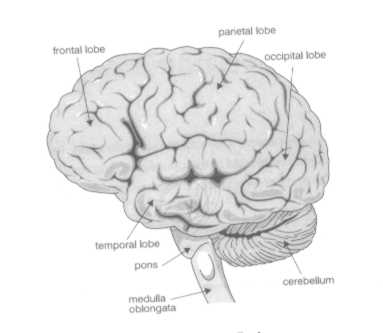
Brain Tumours
Brain cancers account for 15% of pediatric cancers. Since the brain controls learning, memory, senses (hearing, visual, smell, taste, touch), emotions, muscles, organs, and blood vessels, the presentation of symptoms varies accordingly.
Treatment of pediatric brain cancers is more complex than is the treatment of some of the other cancers. Surgery to remove the tumor is not always possible because it may be inaccessible or because surgery would damage parts of the brain necessary for the functioning of the mind and/or body. Inoperable areas of the brain include: brain stem, thalamus, motor area, and deep areas of gray matter. Even a benign tumor in the brain can be life threatening. Another reason malignant brain tumors can be difficult to treat is because a blood-brain barrier exists which prevents some chemicals from entering the brain and reaching the tumor. Therefore, the prognosis depends not only on the type, grade, and size of the tumor, but on its location in the brain.
Brain Tumours are the most common Tumours of childhood and can appear at any age: about 300 children are affected each year in the U.K. Brain Tumours do not usually spread to other parts of the body, but can cause problems by invading the normal brain tissue that surrounds them.
What are Brain Tumours ?
Brain Tumours can develop in the different types of cells found in the brain. The cause of Brain Tumours is unknown.
The two types of brain Tumours that effect children are Gliomas and Medulloblastoma. Gliomas develop in the supporting cells of the brain( which hold the nerve cells in place ) and can be subdivided into two main types in children; Astrocytomas and Ependymomas .
What is an Astrocytoma ?
An Astrocytoma is a brain tumour made up of astrocytes. An Astrocyte is one type of brain Glial cell, and is shaped like a star. Glial cells are the most numerous calls in the brain. Their major function is to provide support, both physical and nutritional to the information carrying cells of the brain, the neurons. Abnormally multiplying astrocytes which form a mass within the brain are an Astrocytoma.
Astrocytomas, even the most aggressive, do not metastasize through the blood and lymphatic systems. In this sense they differ from cancers that arise in other organs in the body. Although Astrocytomas can behave in a "malignant" manner they should really be differentiated from true cancers that occur elsewhere in the body because these brain Glial Tumours do not metastasize.
Astrocytoma. Astrocytomas arise from brain cells which form part of the supportive system of the brain, in particular, cells called "astrocytes" for their star shaped appearance. These tumors are usually slow growing and many are considered "curable". Astrocytomas are often cystic, in which case they are particularly easy to remove completely.
Anaplastic (or high grade) astrocytomas
Also called grade III astrocytomas, anaplastic astrocytomas grow more rapidly than lower grade astrocytomas and contain cells with malignant traits. Surgery followed by radiation, and often chemotherapy, is used to treat anaplastic astrocytomas. There are many clinical trials looking into new treatments for anaplastic astrocytomas.
High-grade or malignant astrocytoma (anaplastic astrocytoma, glioblastoma multiforme) may occur anywhere above the tentorium. Malignant astrocytoma is often locally invasive and extensive.Spread via the subarachnoid space may occur. Metastasis outside of the central nervous system has been reported but is extremely rare. There is no generally recognized staging system. Biologic markers, such as p53 overexpression and mutation status, may be useful predictors of outcome in patients with malignant gliomas.Although malignant astrocytoma carries a generally poor prognosis in younger patients, those with anaplastic astrocytoma and those in whom a gross total resection is possible may fare better.
Kieran's Tumour is Situated
in the Right Temporal Lobe
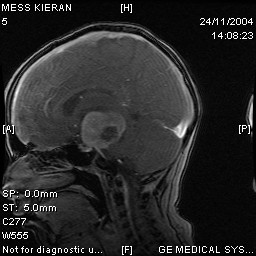
Above is a detailed MRI scan of Kieran's Brain. You can clearly see the remaining Tumor mass in the middle of the image.The MRI was taken on 24.11.04 just before his discharge from the Southern General and will act as a benchmark for the future.
