Part 1: What's your frequency? (Or, Audio Physics 101)
Sound frequency, or pitch, is measured in Hertz (Hz) or cycles/second. Human hearing on average ranges from a low of 20 Hz to a high of about 20 kHz -- approximately 10 octaves (20 Hz to 40 Hz is one octave, 40 to 80 is another). Sound volume, or more accurately Sound Pressure Level, (SPL) is measured in deciBells, or dB. Interestingly enough, electronic signal strength is also sometimes measured in dB.
I don't know if you ever took a math course that covered logarithms, but dB is a logarithmic scale. Here's the math: 10*log(P2/P1)=dB, where P1, and P2 are different power levels. So, say you have a signal that drops from 5.0 Watts to 2.5 Watts. The power has been halved. The deciBell drop will be approximately -3 dB: log(2.5/5) = -.301 Likewise, if you double the power, you get a +3 dB increase. This principle of +/-3 dB is used all over the place in audio specifications.
Another catch phrase used all the time is "reference level". There are two big uses for this term. One use is for setting the volume of a system to a reference level, and making sure all the speakers in the system are balanced to that level. The other use is in describing the frequency response of a speaker or amplifier (we'll stick to the speaker case though).
When you want to gauge the frequency response of a speaker, you send a sine-wave sweep tone through it, and measure its output. Ideally, you want a speaker that is capable of being just as loud at 20 Hz, as it is at 20kHz, and everywhere in between. A sine-wave sweep tone is a signal that starts very low (e.g. 0 Hz) and slowly and smoothly sweeps upwards in frequency at a constant volume (dB level). A speaker is said to have a "flat response" if the volume it outputs from the input sine-wave sweep is the same volume all the way across the spectrum from 20 - 20,000 Hz.
A perfect flat response of course, is rarely, if ever the case. Since a speaker cone is a physical object vibrating at various frequencies, it is going to have a "natural frequency" at which it vibrates the easiest. It will also vibrate very easily at any integer multiple of that natural frequency (these multiples are sometimes called the object's vibrational "modes"). For example, if a speaker cone has a natural frequency of 200 Hz, it will have modes at 400, 600, 800, 1 kHz, and so on. So, for a given dB input sine signal, the speaker will vibrate slightly louder at its modes, and loudest at is 1st mode, or natural frequency. The challenge of the speaker designer is to minimize these peaks; to strive for a "flat response."
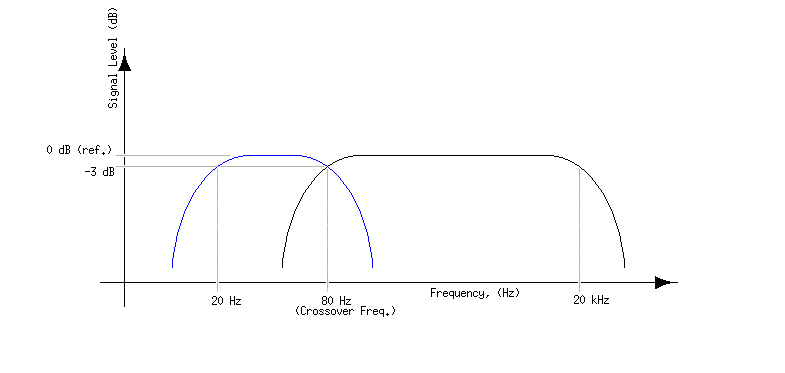
The best frequency response of a speaker, plotted on an X, log(Y) graph, looks like a plateau: flat across the middle (constant Y value) with a steady slope dropping off at each end. The drop-off points will ideally be located around 20Hz, and drop off toward zero, and again at 20,000 Hz, dropping off toward zero, or even negative (see reference level below) dB on the Y-axis, and toward some higher frequency on the X-axis. Below is a sketch of typical subwoofer + satellite speaker frequency response. The sub's response is in blue, and the speaker's is in black.
Now to tie some of this stuff together: Usually a speaker is said to have a flat response, if the flat part of the plateau is within +/- 3 dB (told you it was used a lot) of a perfectly flat line. Now what does this mean? Well from the math, it means that the strength of the signal never drops or increases by more than a factor of 2 (remember 3 dB <=> 2*power) from the REFERENCE level. In this case, the reference level is usually just assigned a value of 0 dB, not because there is no volume, but because it makes looking at the graph easier, since you can then easily see + dB variations and -dB variations. If you were standing in the room where the speaker was being tested reference level would really probably be about 75 dB (which is usually the reference level to which speakers are balanced in a home system.)
You may have noticed that most speakers have more than one driver cone. Usually they have two, sometimes three, but rarely only one. The drivers usually consist of a tweeter (high frequencies) a mid-range (guess) and a woofer (low frequencies). 3- and 2-driver speakers are called 3-way and 2-way speakers, if they have a proper crossover (more on that later) between the drivers. Speakers are designed this way, because small drivers (1" or so in diameter) are closer to flat only across the high frequencies (say 1500 Hz and up), whereas medium sized drivers (3-5") are flat at mid-range frequencies (100 - 1500 Hz, for example) but can't vibrate fast enough to reproduce higher frequencies, and large drivers (6-20" or larger) are pretty flat across the low frequencies (20 - 100 Hz). This way, a speaker designer can combine several drivers together to achieve a very flat response, all the way from 20 Hz up to 20 kHz. To do this properly, a crossover network is used between each set of drivers.
A crossover network is a combination of a Low Pass Filter (LPF) and a High Pass Filter (HPF). These are electrical circuits that do pretty much just exactly what they sound like. An LPF allows any signals with frequencies less than a certain value, to pass through, but it "blocks" any frequencies higher than that value from passing through the circuit. An HPF is the opposite; it passes high frequencies and "blocks" lower frequencies. So, with a crossover between the tweeter and the mid-range with a cutoff frequency (Fc) of say, 1000 Hz, all frequencies above 1000 Hz will be sent to the tweeter, and all frequencies below 1 kHz will go to the mid-range driver. Except of course, those frequencies that are below the cutoff frequency for the crossover between the mid and the woofer, will be sent to the woofer.
Okay, now to go back to the concepts of 3 dB, and the plateau with sloped sides. LPF's and HPF's are not "brick walls" when it comes to filtering frequencies. If you take a driver that has a flat response from say, 100 Hz to 1500 Hz, and place an HPF with an Fc of 500 Hz in the signal, the output of the driver will now have a "plateau" with drop off slopes at 500 Hz and 1500 Hz. In other words, an LPF or an HPF gives a gradual drop off to the signal strength, not a sharp, instant cliff effect. Sometimes, an LPF is placed in a speaker to ensure that it has a smooth decline in its response at the low end, because often times a driver can have very erratic behavior below its intended low end, so you just filter out anything that's too low.
So anyway, the Fc of an LPF or an HPF, or a crossover for that matter, is defined as the point at which the signal is attenuated by -3 dB. This is a critical point. The reason, is because if you combine two signals, one attenuated 3 dB with an LPF at 100 Hz (for example), and one attenuated 3 dB with an HPF at 100 Hz, and combine them, you get a perfectly flat response (assuming the drop off slopes are the same). Why does this happen? Recall the math: A signal which is attenuated 3dB from reference, is at 1/2 the power level of reference (Pr). Add another signal that is attenuated 3 dB, and you get 1/2 Pr + 1/2 Pr = Pr. Pretty cool, huh?
So, what does this all have to do with bass management? I'm getting there… or at least I'm trying to anyway!
Part 2: Low frequencies are non-directional (or, where the heck is that bass?)
Okay, the title says it all… Low frequencies are non-directional. What does that mean? Well, it means that the human ear/brain combo can't discern the direction from which a very low frequency comes, when inside a relatively small room (movie theater and smaller). The reason for this has to do with the fact that low frequencies have very long wavelengths, on the order of 20 feet for a 50 Hz audio sine wave (shorter for higher frequencies, longer for lower frequencies). For the ear to hear the tone, it has to receive one full wavelength. Since most rooms don't have dimensions greater than 20 feet or so, by the time your ear has received one full wavelength of the sound wave, it has bounced off a wall or two before reaching you. So, you can't really tell whether it came from the bass driver, or the wall behind you, or the ceiling for that matter. What's great is that this is good news for speakers and their buyers.
You see, to create low frequency sounds, you need a big driver, and you need to move a lot of air with that driver. For this reason, it takes a lot of power to produce low frequency sound -- a LOT of power. So, to make a speaker that has good response at the low frequencies, and everywhere else, can be very expensive, and these "full range" speakers can also drain a lot of power from your amplifier/receiver. Well, this wasn't too much of a concern in the days of 2-channel stereo, because consumers only needed to buy 2 speakers, and their amps only needed to drive two channels. However, with surround sound, came 5 speakers to drive, and the necessary power to drive them. So some smart person (actually, the first satellite/subwoofer combo available to consumers was made by M&K Sound, who still make some of the best speakers on the market) came up with the idea of using a subwoofer and smaller speakers. Since bass is non directional, we can send all the low frequencies from each speaker to the subwoofer, and just play them all from the sub, thereby allowing us to use smaller, less expensive speakers (ones that don't handle bass too well) for the 5 main channels. Even though all the bass will be emanating from one location (the subwoofer) the listener won’t be able to tell. It will seem as though the sound is coming from where it is supposed to, namely the main speakers. Also, if you give the subwoofer its own power amplifier, you then free up a huge amount of power for your main power amps, so they can better drive the main speakers. Additionally, you can custom design the power amp for the subwoofer, so that it is specialized for amplifying low frequencies, with minimal distortion.
Now, in case you hadn’t guessed yet, the key to all this sat/sub stuff is the non-directionality of low frequencies. (DUH!) The problem is, at what point does bass become non-directional? The folks at THX have determined that this critical point is right around 80 Hz. They are probably right, too, for most Home Theater applications. However, the larger the room, the lower this critical frequency is. Remember, the wavelength of the sound has to be longer than the largest dimension of the room for it to be truly non-directional. This isn’t a hard and fast rule, because lots of complicated factors like room shape, the materials (wood, carpet, brick, drywall) that make up the room, and several other things, also come into play. So, like I said, the THX dudes are probably right. In fact, some people think they even came in a bit low (Yamaha and Sony are two companies that come to mind).
Believe it or not, this all ties into the first part. Because in order to re-direct the low frequency sounds from the main speakers to the subwoofer, guess what’s used? A crossover circuit is used, of course, where the low frequencies, below a certain Fc, from each of the 5 main channels, get sent to the subwoofer, and everything else goes to the speakers as normal.
Now here’s where this all affects what kind of speakers you want to buy. A lot of this depends on two things: what kind of processor (receiver) you have (i.e. what is the Fc for the bass?) and how much money can you spend? (As always!) If money is no object, then buying full range speakers all the way around is a great option. However, that extra money could be put instead towards a set of 5 speakers that REALLY kick butt down to about 70 or 80 Hz, and towards a really pumping subwoofer, to fill out the bottom end. As far as the receiver/processor goes, there are several different setups available.
On the high end, there are very expensive processors with very flexible bass management. They have variable, or adjustable, crossovers, so that you can custom tailor the crossover frequency to your individual speakers. For example, say you have full range speakers in front, but your rear and center speakers go down to 48 Hz. With a very good processor, you could individually set the crossover for each speaker to the exact frequency where the speaker is at its –3 dB point. On the other end of the financial spectrum, you have receivers. Now, receivers span a huge range of quality as far as their processing prowess, and the quality of their power amplifiers. One thing almost all receivers have in common, however, is that the bass management is somewhat inflexible, in that the crossover frequency is not variable. In most receivers, Fc is set, usually at 80 (e.g. Denon and any THX certified receiver) or 90 Hz (e.g. Yamaha, and many Sonys). In some, the Fc is even higher, like 100 or 120 Hz. This is more common with lower quality, mass-market receivers that will likely be paired with lower quality speakers. There are a very few high end receivers that have multiple Fc’s as opposed to a variable Fc. In this case, you would have your choice of setting the Fc at 50, 80, or 110 Hz for example, depending on the speakers you had, but Fc wouldn’t be continuously variable.
So, with receivers that have a fixed Fc, you only have two choices for each speaker: Run the speaker full range, (usually called the "large speaker" setting) or use the crossover for that channel, and send all the low frequencies for that channel to the sub (this is usually called the "small speaker" setting). So, for those people that have speakers that perform well down to 50 Hz or so, a quandary of sorts is presented: Should you run them large or small? If you choose large, then anything below about 45 Hz that would have been sent to those speakers will be pretty much inaudible. If you set them to "small" then you’ll get all the sound (through the subwoofer) but you will be "wasting" the bottom end of your nice speakers.
(Note: Ideally, you want speakers that extend well below the crossover frequency, however this is not a hard and fast rule. For example, some people (golden-ear audiophile types, usually) recommend that the low end extension of your speakers reach about an octave below where the crossover is. That means that for an 80Hz crossover, you'd want speakers that extend down to 40Hz. While this may be theoretically ideal, it is by no means necessary in the real world. If your crossover is at 80 Hz, hopefully your speakers will extend down to at least 70 Hz, but some people often pair an 80 Hz crossover with small speakers that only go down to 90 Hz, and it still sounds great.)
Some receivers have a nice middle option, however. Because not everybody will have a subwoofer, the receiver/processor manufacturers give you the option of substituting any good "large" speakers you may have, for the sub. For example, say you have two very nice full range speakers for your front left and right speakers, your rear and center speakers are small, and you have no subwoofer. The receiver has a setting where it asks you where you want the bass from any small speakers sent: To the sub, to the front main speakers, or to both? If you select "sub" then all is as was described before. If you select "main" then the bass from any "small" speakers, along with the digital .1 "LFE" channel (more on that later), gets sent to your full-range main speakers. If you select "both" then the "LFE" channel stays exclusively with the subwoofer (for most receivers anyway) and the bass information from any speakers set to small gets sent to both the main front speakers, and the subwoofer. In some cases, this setting can sound very good, while in other cases, it can cause there to be too much bass, and the sound gets very "boomy." This happens because the bass from the "small" speakers now gets doubled: played through the mains AND the subwoofer. But if your mains are semi-large speakers, with a low end around 40 or 50 Hz, the "both" setting may actually improve the soundfield. Also, setting the crossover frequency on your subwoofer to the point where the front main speakers start to drop off, can help smooth out the soundfield as well.
I mentioned the digital ".1" or "LFE" channel above. Both Dolby Digital, and DTS are what’s called 5.1 channel digital surround sound formats. The 5 in 5.1 refers to 5 fully discreet (i.e. no matrixing, mixing or cross talk between channels), full range (i.e. 20-20,000 Hz) channels: Front Right, Front Center (a.k.a. Center Channel), Front Left, Surround Right, and Surround Left. The ".1" in 5.1 refers to the "LFE" or Low Frequency Effects channel. This channel is not a full range channel. Dolby and DTS differ a bit on this, but for the most part, you’ll hardly ever encounter any information above 80 Hz in the LFE track. What one must keep in mind though, is that the information in the LFE track is NOT the bass information from the other 5 channels. The LFE track is a completely separate track that the audio engineers for a movie use specifically for higher impact in critical scenes (e.g. Dinosaurs stomping around, volcanoes erupting, bombs exploding, etc.) Many movies don’t even utilize the LFE track, because there’s no need. The LFE channel was ONLY added to these formats, to provide a bit of extra "headroom" in the bass frequencies, when needed. Remember the 5 main channels are FULL range, and can contain sounds all the way down to 20Hz.
So, ideally, you’d have 5 full range speakers for the "5" of "5.1" AND a big old monster subwoofer for the ".1" LFE track. But we’re talking HOME theater here, not MOVIE theater, and although some folks have some pretty extravagant home theaters, most of us are grounded in reality (only until that winning lotto ticket shows up though, right?)
So, when shopping for speakers, consider your budget, and what kind of processor you have, or are planning to get. Although those floor-standing (a.k.a. "tower") speakers may look sweet, your money may be better spent on a nice set of "monitor" speakers and a kick-butt subwoofer. "Monitor" is a marketing term that is used for small speakers that are a bit bigger, better and nicer than what most people consider to be "satellite" speakers. Besides, spending extra on monitors or good satellites instead of a similarly priced tower speaker will probably mean that the smaller speakers handle the mid- and high- frequency stuff much better anyway. And, the smaller speakers + sub setup may work better with whatever processor or receiver you choose or already own.
One final note: In considering your HT budget, don’t forget that you need to buy a fair amount of accessories. Speaker stands, a TV stand, decent speaker wire (16 gauge or less), a subwoofer cable, a digital audio cable, a set of component video cables, etc… this can add up to a couple hundred or more, easily. By the way, find a very good Radio Shack near by you. Rat Shack carries a line of electronics connectors called "Gold". These are very good and very affordable. Don’t let the marketing hype of brands like Monster Cable draw you in, or you’ll end up spending as much for wires and interconnects as you did for your receiver.
I hope this has been helpful for you. Anytime you have any questions, or if you have any comments, suggestions, or other feedback you'd like to give me on this essay, please feel free to fire off an email to me.
ADDENDUM: 6.1 and 7.1 formats (added June, 2001)
First, some nomenclature: The theatrical release of Star Wars Episode I: The Phantom Menace marked the debut of a new sound format for movies: "Dolby Digital Surround EX." The home theater version of this format is officially called "THX Surround EX", since THX assisted Dolby Labs in developing it. DTS, not to be outdone nor left behind, quickly came out with "DTS-ES", then "DTS-ES 6.1 Discrete."
All of these new formats are generally referred to as 6.1 surround formats, although calling them 6.1 in the same way we refer to 5.1 is a bit misleading. As I said before, 5.1 systems consist of 5 fully discrete, full range channels. Dolby-EX does have a sixth sound channel, however it is neither full range nor discrete. The sixth channel is the so-called "surround back" or "center surround" or several other things. The channel is intended to be located directly behind the listener, preferably on the back wall of the theater, or listening room. (The traditional left and right surround channels remain where they were always supposed to be, i.e. directly to the left and right of the listener, slightly above ear level.) In Dolby-EX and DTS-ES, the sixth channel is matrixed into the discrete left and right surround channels. A matrix processor then extracts this signal from the surround left and right channels, and sends it to the proper (surround back) speakers. Because the sixth channel is matrixed into two other channels, it can not be fully discrete. This is very similar to how the front center channel was encoded and decoded for the older Dolby Pro Logic Surround systems. The benefit of matrixing the surround back channel like this, is that it automatically makes the EX & ES formats fully backwards compatible with existing digital 5.1 systems, since the sixth channel is actually a part of the surround left and right channels (it's only seperate if it is extracted by a matrix decoder).
DTS, to try to regain a technical advantage over what Dolby had to offer, then released what they originally called "DTS-ES 6.1 discrete." This new format has a fully discrete, full range 6th channel. Through some very clever engineering, DTS was able to ALSO make this new format fully backwards compatible with their matrix ES format, and DTS 5.1 systems. Very few movies on dvd exist however, that actually have a discrete DTS-ES soundtrack. (Those that do are some big blockbusters though... like Gladiator for instance.)
What about 7.1, you may ask? Well, 7.1 is really just 6.1, so far. You see, THX recommends that you use TWO speakers for the surround back channel in a "6.1" system. So, some manufacturers have released receivers that actually have 7 built in amplifiers, and outputs for 7 speakers. They split the 6th "ex/es" channel, and send it to both the 6th and 7th amplifers for amplification, then out to the surround back speakers. So, the receiver has 7 channels of amplification, but the new Dolby-EX and DTS-ES formats are still only 6.1 (and matrixed at that) formats. Now, given 7 channles to play with, some high-end receiver and processor manufacturers have created new DSP modes (Digital Signal Processing... those sound effects on receivers like "hall," "stadium," "jazz club," etc.) that actually use the 6th and 7th channels seperately. But most likely, you don't need to worry about that.
So, what does this mean to you when you're out shopping for HT gear? Well, first you have to decide if you think you want a 6.1 system. In my oppinion, if you have a very big room for your HT, it can be beneficial, but for smaller rooms, 5.1 will probably suffice. A big thing to consider though, is the extra price for buying one (or two!) more speakers, and possibly amplifiers to drive them. Not all EX/ES receivers have the extra amplification built in. Many have the processing, and "line level" (unamplified) outputs for the 6th channel built in, but no amplification. These receivers are often called "6.1-ready."
So, I know I've glossed over this whole 6.1 thing pretty well, and left out a lot of details, but I just wanted to at least partially cover it, so that you will know at least as much as the sales person at your local hi-fi shop. Some things I haven't explained yet are: "what is matrix encoding/decoding?", and "how does dts-es-discrete work?" and more details about backwards compatibility of these formats, and so forth. I will probably eventually get around to this, but in the mean time, always feel free to email me with any further questions.
L8R, -Kieran.

Back to my home page |

|
 |