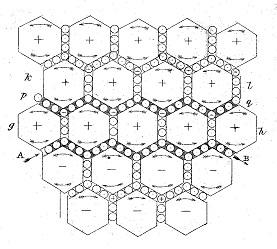
One of the first significant discoveries that Maxwell made was involving the motion of Saturn�s rings. Using purely mathematical reasoning Maxwell concluded that Saturn�s rings could only have stability if they were made up of numerous small particles. The principles behind the inventions of the telephone, radio, television and the radar stem from James Clerk Maxwell�s discoveries concerning electromagnetism. One of the more famous legacies of Maxwell consists of Maxwell's Equations. Maxwell�s Equations include four equations, in which he described the relationships between electricity, magnetism and the propagation of electromagnetic waves. Using these equations Maxwell calculated the speed of an electromagnet wave to be nearly that of the speed of light, from this he concluded that electromagnetic waves were just another form of light waves, he also proposed that electromagnetic waves with different wavelengths should exist as well. One of James Clerk Maxwell�s papers called Physical Lines of Force was an analogy on Faraday�s ideas is which he created a physical explanation for the lines Faraday had first discovered, as shown in the image below.
James Clerk Maxwell is also credited with describing the thermodynamic properties of gas, he was able to do this using mathematics and statistical mechanics. Maxwell improved the kinetic theory of gasses by explaining that temperature and heat were caused only my moving molecules. Maxwell was also the first to apply probability and statistics to describe temperature changes at the molecular level. His theory is still widely used by scientists as a model for rarefied gases and plasmas. [1] To read more into this subject click here
Maxwell also made contributions in the areas of optics and colour vision, he is credited with being the first person to discover colour photographs. Maxwell used blue, green, and red filters and got a photographer to take the same picture 3 times, each time using a different filter. These images on the three different filters were developed and then projected onto a screen using three different projectors; this resulted in a photograph with full colour. He won the Rumford Medal by the Royal Society from his work with colour blindness. The achievements that Maxwell contributed to the many fields of science have led to several present day applications that are now a vital part of everyday life. If you are interested in reading further into his achievements this click here.[2]