
Mabini was born on July 23, 1864 in Barangay Talaga in Tanauan, Batangas.He was the second of eight children of Dionisia Maranan, a vendor in the Tanauan market, and Inocencio Mabini, an unlettered peasant.
Mabini began informal studies under his maternal grandfather, who was the village teacher.
Because he demonstrated uncommon intelligence, he was transferred to a regular school owned by Simplicio Avelino, where he worked as a houseboy, and also took odd jobs from a local tailor - all in exchange for free board and lodging. He later transferred to a school conducted by the Fray Valerio Malabanan, whose fame as an educator merited a mention in José Rizal's novel El Filibusterismo.
In 1881 Mabini received a scholarship to go to the Colegio de San Juan de Letran in Manila. An anecdote about his stay there says that a professor there decided to pick on him because his shabby clothing clearly showed he was poor. Mabini amazed the professor by answering a series of very difficult questions with ease. His studies at Letran were periodically interrupted by a chronic lack of funds, and he earned money for his board and lodging by teaching children.
Mabini's mother had wanted him to take up the priesthood, but his desire to defend the poor made him decide to take up Law instead. A year after receiving his Bachilles en Artes with highest honors and the title Professor of Latin from Letran, he moved on to the University of Santo Tomas, where he received his law degree in 1894.
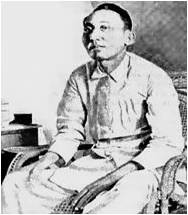 Apolinario 'Lumpo' Mabini y Maranan (July 23, 1864 — May 13, 1903) was a Filipinopolitical philosopher and revolutionary who wrote a constitutional plan for the first Philippine republic of 1899-1901, and served as its first prime minister in 1899. In Philippine history texts, he is often referred to as "the Sublime Paralytic", and as "the Brains of the Revolution." To his enemies and detractors, he is referred to as the "Dark Chamber of the President."

