
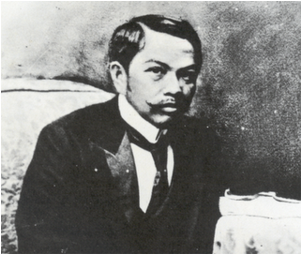
 Organization La Solidaridad, La Liga Filipina
Juan Luna
Organization La Solidaridad, La Liga Filipina
Juan Luna
Juan Luna y Novicio (October 23, 1857 — December 7, 1899) was an IlocanoFilipino painter, sculptor and a political activist of the Philippine Revolution during the late 19th century. He became one of the first recognized Philippine artists.
His winning the gold medal in the 1884 Madrid Exposition of Fine Arts, along with the silver win of fellow Filipino painter Félix Resurrección Hidalgo, prompted a celebration which was a major highlight in the memoirs of members of thePropaganda Movement, with the fellow Ilustrados toasting to the two painters' good health and citing their win as evidence that Filipinos and Spaniards were equals.
Regarded for work done in the manner of the Spanish and French academies of his time, Luna painted literary and historical scenes, some with an underscore of political commentary. His allegorical works were inspired with classical balance, and often showed figures in theatrical poses.
Early life
Born in the town of Badoc, Ilocos Norte in the northern Philippines, Juan Luna was the third among the seven children of Don Joaquin Luna and Doña Laureana Novicio y Ancheta. In 1861, the Luna family moved to Manila and he went toAteneo Municipal de Manila where he obtained hisBachelor of Arts degree. He excelled in painting and drawing, and was influenced by his brother,Manuel Luna, who, according to Filipino patriotJosé Rizal, was a better painter than Juan himself.
Luna enrolled at Escuela Nautica de Manila (now Philippine Merchant Marine Academy) and became a sailor. He took drawing lessons under the illustrious painting teacher Lorenzo Guerrero of Ermita, Manila. He also enrolled in the Academy of Fine Arts (Academia de Dibujo y Pintura) in Manila where he was influenced and taught how to draw by the Spanish artist Agustin Saez. Unfortunately, Luna's vigorous brush strokes displeased his teacher and Luna was discharged from the Academy. However, Guerrero was impressed by his skill and urged Luna to travel to Spain to further pursue his studies.
Travel abroad
In 1877 Manuel and Juan Luna traveled to Europe, where Manuel studied music and Juan painting. Juan entered the Escuela de Bellas Artes de San Fernando, where he befriended the painter DonAlejo Vera. Luna was discontented with the style of teaching in school and decided that it would be much better to work with Vera. Vera brought him to Rome for some of his commissions, and Luna was exposed to the art of the Renaissance painters. It was in 1878 when his artistic talents was established with the opening of the first art exposition in Madrid which was called theExposición Nacional de Bellas Artes (National Demonstration of Beautiful Arts). From then on, Luna became engrossed in painting and produced a collection of paintings that he exhibited in the 1881 Exposition.
His La Muerte de Cleopatra (The Death of Cleopatra) won him a silver medal and came in second place. Luna's growing reputation as an artist led to a pensionado (pension) scholarship at 600 pesos annually through the Ayuntamiento of Manila. The condition was that he was obliged to develop a painting which captured the essence of Philippine history which would then become the Ayuntamiento's property.
The Death of Cleopatra, 1881, Museo del Prado.

