
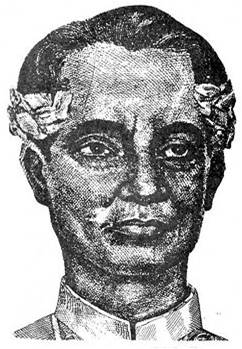
 Organization La Solidaridad, La Liga Filipina
Fransico Baltazar
Organization La Solidaridad, La Liga Filipina
Fransico Baltazar
Francisco Baltazar (April 2, 1788 – February 20, 1862), known much more widely through hisnom-de-plume Francisco Balagtas, was a prominent Filipino poet, and is widely considered as the Tagalog equivalent of William Shakespeare for his impact on Filipino literature. The famous epic, Florante at Laura, is regarded as his defining work.
Early life
Francisco Baltazar was born on April 2, 1788 in Barrio Panginay, Bigaa, Bulacan as the youngest of the forty children of Juan Baltazar, a blacksmith, and Juana de la Cruz. He studied in a parochial school in Bigaa and later in Manila. During his childhood years. Francisco later worked as houseboy in Tondo, Manila.
Life as a poet
Balagtas learned to write poetry from José de la Cruz (Huseng Sisiw), one of the most famous poets of Tondo. It was de la Cruz himself who personally challenged Balagtas to improve his writing. (source: Talambuhay ng mga Bayani, for Grade 6 textbook)
In 1835, Balagtas moved to Pandacan, where he met María Asunción Rivera, who would effectively serve as the muse for his future works. She is referenced in Florante at Laura as 'Celia' and 'MAR'.
Balagtas' affections for MAR were challenged by the influential Mariano Capule. Capule won the battle for MAR when he used his wealth to get Balagtas imprisoned under the accusation that he ordered a servant girl's head be shaved. It was here that he wrote Florante at Laura—In fact, the events of this poem were meant to parallel his own situation.
He wrote his poems in Tagalog, during an age when Filipino writing was predominantly written in Spanish.
Balagtas published Florante at Laura upon his release in 1838. He moved to Balanga, Bataan in 1840 where he served as the assistant to the Justice of peace and later, in 1856, as the Major Lieutenant. He was also appointed as the translator of the court. He married Juana Tiambeng on July 22, 1842 in a ceremony officiated by Fr. Cayetano Arellano, uncle of future Philippine Supreme Court Chief JusticeCayetano Arellano. They had eleven children but only four survived to adulthood.
He died on February 20, 1862 at the age of 73. Upon his deathbed, he asked a favor that none of his children become poets like him, who had suffered under his gift as well as under others. He even went as far as to tell them it would be better to cut their hands off than let them be writers.
Balagtas is so greatly revered in the Philippines that the term for Filipino debate in extemporaneous verse is named for him: balagtasan.
