
Marcelo H. del Pilar was born in Cupang, Bulacan, Bulacan on August 30, 1850, the youngest of ten children of Julián H. del Pilar and Blasa Gatmaitán.[3] His father had held thrice the post of gobernadorcillo in their home town. His oldest brother, Toribio, a secular priest, was exiled to Guam for his involvement in the 1872 Cavite Mutiny. The family adapted the surname Del Pilar pursuant on the decree issued by Governor-General Narciso Claveria in 1849.[4] Del Pilar was descended from the illustrious lineage of Gatmaitán, one of the sons of the pre-colonial ruling families of Bulacan and Pampanga.
He learned his first letters from his paternal uncle Alejo. Because his family was highly cultured, it was not long before he played the piano,violin and flute. In Manila he took a Latin course in the school of José Flores and then transferred at the Colegio de San José, where he finished his Bachiller en Artes. He also studied at the Universidad de Santo Tomas, where he obtained his law degree in 1880. A disagreement with a parish priest concerning baptismal fees in 1869 caused a break of eight years in the fourth year of the study of his profession.
As a student, he favored overthrowing the Spanish government. Often, he met with his classmates like Mariano Ponce, Pedro Serrano Laktawand Apolinario Mabini in his Binondo house, and expounded on the need to peacefully fight Spanish rule. His mastery of Spanish language would help hasten development led him to teach Spanish to children in his neighborhood while he was a boarder of Mariano Sevilla, a Filipino secular priest. Then about the time of Cavite Mutiny, he used to meet regularly in a goods store in Manila with liberal Spanish creoles,mestizos, and Filipino intellectuals by whom he was politically indoctrinated about the affairs of the country.[7] Fortunately, suspicion was not turned on him and he escaped persecution in 1872.
He worked as oficial de mesa in Pampanga and Quiapo in January 1878. He also worked for the Manila Royal Audiencia and at the same time he spread nationalist and anti-friar ideas in Manila and in towns and barrios of Bulacan. He married his second cousin Marciana in February 1878. They had seven children and five died of infancy.
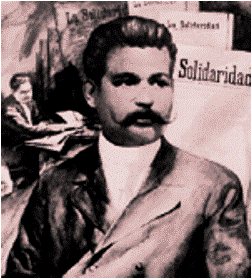 Marcelo Hilario del Pilar y Gatmaitán (August 30, 1850 – July 4, 1896) was a Filipinowriter, journalist, satirist, lawyer and a prominent advocate for reforms in the Philippinesduring the Spanish colonial period. He was one of the leading ilustrado (Knowledgeable[1]) propagandist of the Philippine War of Independence.
He served as editor of the vernacular section of the Diariong Tagalog (Tagalog Newspaper), the first Philippine bilingual newspaper, in 1882. From 1889 to around 1895, he edited the periodical La Solidaridad (The Solidarity), mainly through his 150 essays and 66 editorials published under the nom de plume Plaridel.
Del Pilar's militant and progressive outlook was derived from the classic enlightenmenttradition of the French philosophes and the scientific empiricism of the Europeanbourgeoisie. Part of this outlook was transmitted by freemasonry, to which del Pilar subscribed.
Marcelo Hilario del Pilar y Gatmaitán (August 30, 1850 – July 4, 1896) was a Filipinowriter, journalist, satirist, lawyer and a prominent advocate for reforms in the Philippinesduring the Spanish colonial period. He was one of the leading ilustrado (Knowledgeable[1]) propagandist of the Philippine War of Independence.
He served as editor of the vernacular section of the Diariong Tagalog (Tagalog Newspaper), the first Philippine bilingual newspaper, in 1882. From 1889 to around 1895, he edited the periodical La Solidaridad (The Solidarity), mainly through his 150 essays and 66 editorials published under the nom de plume Plaridel.
Del Pilar's militant and progressive outlook was derived from the classic enlightenmenttradition of the French philosophes and the scientific empiricism of the Europeanbourgeoisie. Part of this outlook was transmitted by freemasonry, to which del Pilar subscribed.

