
Bonifacio's formal schooling was cut short after his parents both died of illness.
In order to support his family, he dropped out of school to earn a living.
Bonifacio became a peddler of canes and paper fans he made himself. He also made posters for business firms.
In his late teens, he worked as a mandatorio for the English trading firm Fleming and Company, where he rose to become a corredor of tar, rattan and other goods.
He later transferred to Fressell and Company, a German trading firm, where he worked as a bodeguero Bonifacio was also a part-time actor who performed in moro-moro plays.
Bonifacio was married twice. His first wife was a certain Monica who died of leprosy.
His second wife was Gregoria de Jesus of Caloocan, whom he married in 1893.
They had one son who died in infancy.
Despite not finishing formal education, Bonifacio was self-educated.
He read books about the French Revolution, biographies of the President of the United States, the Philippine penal and civil codes, and novels such as Victor Hugo, Les Mis�rables, Eug�ne Sue, Le Juif errant and Jos� Rizal's Noli Me Tangere and El Filibusterismo.
Bonifacio was a freemason and a member of the Gran Oriente Espa�ol.
In 1892 he joined Rizal's La Liga Filipina, an organization which called for political reforms in the Spanish government of the Philippines. However, La Liga Filipina disbanded after one meeting as Rizal was arrested and deported to the town of Dapitan in Mindanao. Bonifacio, Apolinario Mabini and others revived La Liga Filipina in Rizal's absence.
Bonifacio was active at organizing local chapters in Manila.
La Liga Filipina contributed moral and financial support to Propaganda Movement|Filipino reformists in Spain.
On July 7, 1892, the day after Rizal's deportation was announced, Bonifacio and others founded the Katipunan, or in full, Kataastaasang Kagalanggalangang Katipunan ng mga Anak ng Bayan ("Highest and Most Respected Society of the Children of the Country").
The secret society sought independence from Spain through armed revolt.
It was influenced by Freemasonry through its rituals and organization, and several members aside from Bonifacio were also Freemasons.
Within the society Bonifacio used the pseudonym May pag-asa ("There is Hope").
For a time, Bonifacio worked with both the Katipunan and La Liga Filipina. But La Liga Filipina eventually split because less affluent members like Bonifacio lost hope for peaceful reforms, and stopped their monetary aid.
Wealthier, more conservative members who still believed in peaceful reforms set up the Cuerpo de Compromisarios, which pledged continued support to the reformists in Spain. The radicals were subsumed into the Katipunan.
From Manila, the Katipunan expanded into several provinces, including Batangas, Laguna, Cavite, Bulacan,Pampanga, and Nueva Ecija.
Most of its members, called Katipuneros, came from the lower and middle classes, with many of its local leaders being prominent figures in their municipalities.
At first exclusively male, membership was later extended to females, with Bonifacio's wife Gregoria de Jes�s as a leading member.
From the beginning, Bonifacio was one of the chief Katipunan officers, though he did not become its Supremo (supreme leader) or Presidente Supremo (Supreme President) until 1895. Bonifacio was the third head of the Katipunan after Deodato Arellano and Rom�n Basa. Prior to this, he served as the society's comptroller and then its fiscal.
The society had its own laws, bureaucratic structure and elective leadership.
For each province it involved, the Katipunan Supreme Council coordinated provincial councils in charge of public administration and military affairs and local councils in charge of affairs on the district or barrio level.
Bonifacio was a member and eventually head of theKatipunan Supreme Council.
Within the society, Bonifacio developed a strong friendship with Emilio Jacinto who served as his adviser and confidant, as well as a member of the Supreme Council.
Bonifacio adopted Jacinto's Kartilla primer as the official teachings of the society in place of his own Decaloguewhich he judged as inferior.
Bonifacio, Jacinto and Pio Valenzuela collaborated on the society's organ Kalayaan (Freedom), which had only one printed issue. Bonifacio wrote several pieces for the paper, including the poem Pag-ibig sa Tinubuang Lup� (roughly, "Love for the homeland) under the pseudonym Agapito Bagumbayan.
The publication of Kalayaan in March 1896 led to a great increase in membership. The Katipunan spread throughout Luzon, to Panay in the Visayas and even as far as Mindanao.
From less than 300 members in January 1896, it had about 30,000 to 40,000 by August.
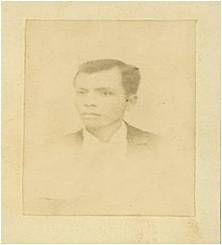 Bonifacio was born to Santiago Bonifacio and Catalina de Castro in Tondo, Manila and was the eldest of six children.
His father was a tailor who served as a teniente mayor of Tondo while his mother worked in a cigarette factory.
Bonifacio was born to Santiago Bonifacio and Catalina de Castro in Tondo, Manila and was the eldest of six children.
His father was a tailor who served as a teniente mayor of Tondo while his mother worked in a cigarette factory.

