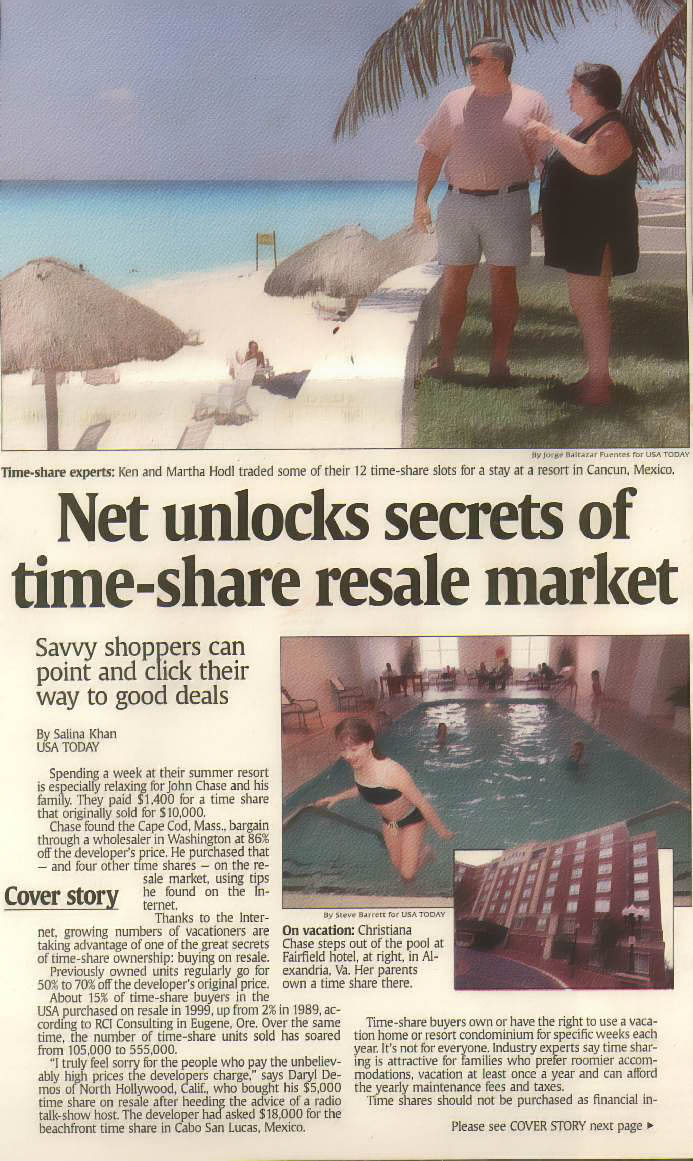
USA Today
Article printed on April 28, 2000
4/27/00- Updated 10:41 PM ET
Net reveals time-share resale secrets
By Salina Khan, USA TODAY
Spending a week at their summer resort is
especially relaxing for John Chase and his family.
They paid $1,400 for a time share that originally
sold for $10,000.
Chase found the Cape Cod, Mass., bargain through
a wholesaler in Washington at 86% off the
developer's price. He purchased that -- and four
other time shares -- on the resale market, using
tips he found on the Internet.
Thanks to the Internet, growing numbers of
vacationers are taking advantage of one of the
great secrets of time-share ownership: buying on
resale.
Previously owned units regularly go for 50% to
70% off the developer's original price.
About 15% of time-share buyers in the USA
purchased on resale in 1999, up from 2% in 1989,
according to RCI Consulting in Eugene, Ore. Over
the same time, the number of time-share units
sold has soared from 105,000 to 555,000.
"I truly feel sorry for the people who pay the
unbelievably high prices the developers charge,"
says Daryl Demos of North Hollywood, Calif., who
bought his $5,000 time share on resale after
heeding the advice of a radio talk-show host. The
developer had asked $18,000 for the beachfront
time share in Cabo San Lucas, Mexico.
Time-share buyers own or have the right to use a
vacation home or resort condominium for specific
weeks each year. It's not for everyone. Industry
experts say time sharing is attractive for families
who prefer roomier accommodations, vacation at
least once a year and can afford the yearly
maintenance fees and taxes.
Time shares should not be purchased as financial
investments because many do not increase in
value.
Options on the resale market are limited.
Developers say owners who buy from them get the
best pick of units, locations and vacation weeks. It
typically takes a year for a new time share to hit
the resale market.
The entry of major hotel companies into
time-share development has brought the business
credibility and visibility. But experts say buyers
should still be wary of scams and disappointments.
Purchasing through a licensed broker is
recommended for novice buyers. Those working
directly with owners should do thorough credit
checks.
Many first-time buyers of time shares purchase
their weeks from developers, often buying
impulsively after listening to hours-long sales
pitches. Attendees are usually lured to the
presentations by free hotel rooms, discounted
theme park tickets or cash. They also get saddled
paying for marketing costs, which are usually half
of the developer's price tag.
Here's where some savvy time-share buyers are
going to find less-expensive resale time shares:
Timeshare Users Group (TUG). Surfing the
volunteer-run TUG Web site (www.tug2.net) is a
good place to start, some buyers say. The site,
which was started by a deceived time-share
owner, provides a message board, time-share ads
and links to other sites. Members ($15 for one year
) can peruse reviews and rankings of resorts by
former visitors. Frank Billingsley, a TV weatherman
in Houston, says the tips he got from TUG
members saved him $21,500.
"I started looking at developer property and almost
paid $27,000 for a place in Colorado -- then found
TUG and looked for resale and almost paid
$11,500 for a place in Orlando," Billingsley says.
"More TUG advice steered me away from overbuilt
Orlando, and I ended up with a Memorial Day
week Marriott Swallowtail property (Hilton Head,
S.C.) for $5,500. In the end, I feel like I got a great
deal on a 'good trader' with great management."
Brokers. Many real estate brokers specializing in
vacation ownership provide information about time
shares online. TRI West Real Estate of Los Angeles
(www.triwest-timeshare.com) provides a
searchable database of original and resale prices
of more than 1,000 resorts.
President Mario Collura says sales of previously
owned time shares were up 25% last year at TRI
West. At its annual auction in September,
time-share units that were 7 to 15 years old sold
for an average $2,500. The average original price
was $10,500.
Other brokers include Holiday Group in Seattle and
TransAction Realty and Timeshare Travel, both in
Salt Lake City.
Online auctions. Knowledgeable shoppers may
find bargains this way. Ken Hodl of Chicago bought
a time share that can be traded for units at top-tier
resorts in Colorado and Mexico for $106 plus
annual maintenance fees and taxes. An owner of
11 other time shares, Hodl found the bargain on
eBay. Web sites such as eBay and Yahoo have
special auction sections for time shares that are
sometimes dirt cheap.
John Weiss of Seattle auctioned off his
seldom-used time share in Duck, N.C., for $1,000
in October. He had paid the developer $9,000 for it
in 1987. Weiss put his time share up for sale after
vacationing there once and trading it for other
locations just twice in 12 years.
Antonette Manoske of Foster City, Calif., quit her
$75,000-a-year job at Wine.com last month to sell
previously owned time shares on the Internet.
Manoske and her husband, Mike, started a Web
site (www.timesharevalues.com) linked to eBay in
December to cash in on the growth in time-share
resales.
"We were real estate investors and kept bumping
into people selling time shares," Mike Manoske
says. The couple made $10,000 in revenue in
January and expect to double sales this month.
Owners. Unhappy owners sometimes create
their own Web sites to unload time shares. Some
are linked to TUG or registered in search engines.
Stacy Larmore, 28, of Ohio designed a Web site
(slarmore.tripod.com) to attract buyers to her
Orlando unit. She says she and her husband can't
keep up with the annual fees, and they regret
buying from a developer three years ago.
"When we went down there, we were pretty
dumb," Larmore says.
Chase found his deal through the Web site of Fern
Modena of San Francisco, who has owned time
shares for 15 years (www.timeshare-guru.com).
Modena's site provides links to brokers,
wholesalers and exchange companies.
"The Internet has really empowered" the shopper,
Chase says. "You were completely on your own
before."
Some resorts run their own resale departments.
Marriott, the first major hotel company to enter the
time-share business 16 years ago, is one example.
By setting its own prices, Marriott retains some
control of its units' prices in the resale market. It
uses a reward system to entice buyers to call its
resale department to buy previously owned time
shares at its 46 resorts. Those who buy through
Marriott can exchange their weeks for points
toward hotel stays, cruises, airline tickets and
rental cars.
Developers say the resale market has not hurt new
time-share sales. That market has grown about
16% a year for the past decade. The popularity of
resales will eventually push resale prices up, says
Bob Miller, president of the American Resort
Development Association.
So today's huge discounts may be harder to get.