Behind the Scenes
At
The Oregon Coast Aquarium
By
Kate Halleron
Introduction
The Oregon Coast Aquarium in Newport, Oregon is one of the top ten aquariums in the United States. Famous primarily as the former home of Keiko, the star of “Free Willy,” the Aquarium also has a high reputation as a center of seabird breeding and marine mammal rehabilitation.
The Visit
I arrived at the Aquarium on Sunday morning, after an early morning trip to Seal Rock to photograph the tide pools during low tide. I had previously read about the behind-the-scenes tour in the quarterly newsletter that the Aquarium sends to its members, and had planned on taking the tour on my next visit. I paid the additional $7.75 admission at the Member desk, and since the tour didn’t start for another 45 minutes, made my way to the gift shop to see if I could add to my octopus collection.
|
|
|
Lissy explains it all. |
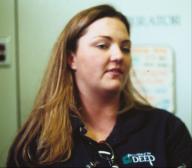
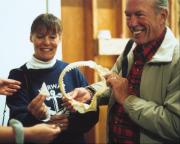
There were four other people in our 11:30 tour group, Barbara and her daughter teenage Ann, Dianne and her husband Bob. Our tour guide was Lissy (Figure 1.) She led us through the “Jewels of the Sea” jellyfish exhibit to the staff entrance, where we were greeted with a bulletin board with over 300 photographs. Lissy explained that the combined volunteer hours at the Aquarium amounted to 88 full-time staff.
After dipping our feet in disinfectant, we entered the first holding area, where small native
|
|
|
Figure 2. Lissy exhibits her jellyfish stings. Note the rounded baffle in the tank behind
her. |
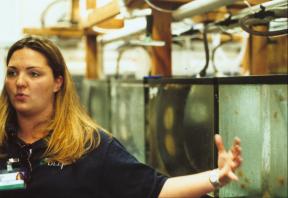
animals were quarantined until needed for the exhibits. A tank full of baby rays charmed everyone, but it was the many jellyfish that were the real interest for most of us, as evidenced by the many questions asked about them (Figure 2). The tanks had rounded baffles in them so that the jellyfish wouldn’t get trapped in the corners of the tanks and die. There was much discussion of what to do if you get stung by a jellyfish, with suggestions ranging from vinegar and meat tenderizer to urine, but the best advice was just to leave them alone if possible. Lissy, who is allergic to bee stings, showed us the rash on her arms from cleaning the tanks; she had not actually touched any jellyfish, but the free nematocysts (stinging cells) in the water had severely irritated her skin.
An empty tank had carpet remnants fastened around the outside, and Lissy explained that this was the octopus holding tank. The carpet remnants were to keep the octopuses from escaping. An octopus could easily lift the top off the tank, but the carpet interfered with its suckers’ gripping ability. Barbara recounted a tale she had heard about an octopus at the Vancouver Aquarium who would escape from his tank at night, go hunting in the other exhibits, and be back in his own tank in the morning, a few shells or an exoskeleton as the only evidence of his crime. I was about to dismiss this as a sort of aquarium “urban legend”, having heard the same sort of tale about octopuses at the New England Aquarium in Boston and the Hatfield Marine Science Center, but Lissy confirmed she had heard the same story from a visiting curator of the Vancouver Aquarium.
The Kitchen
|
|
|
Figure 3. Krill and small fish for the animals. |
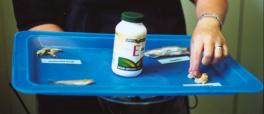
After the holding area, we entered the kitchen, where the day’s meals for all the Aquarium animals are prepared. All the food is frozen, which robs it of nutrients, so vitamins must be added in order to maintain the health of the animals. Each day, more than 300 fish must be “pilled”, a vitamin inserted into the body cavity. Lissy offered us fish and vitamins and an opportunity to try it ourselves. After checking to make sure there was a sink handy, I volunteered, along with Tom and Ann. One bends the fish’s head back and inserts the pill into the body cavity through the gill slit. “Hey, that was quick,” Lissy said admiringly as Tom and I handed in our herrings simultaneously. “Do you want to be a volunteer?”
Bird Rehabilitation
|
|
|
Figure 4. Wild seabird rehab. |
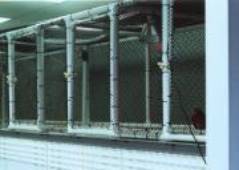
The Oregon Coast Aquarium is a premiere seabird rehabilitation and captive breeding center. It boasts of being the first facility to successfully breed the common murre, the rhinoceros auklet, the black oystercatcher and the pigeon guillemot in captivity. The first common murre chick bred in captivity hatched out only this summer, and the egg was nearly smashed when it rolled off the smooth rock and, luckily, into a volunteer’s hand. It was given to a pair of tufted puffins to hatch, and then reared by humans until old enough to join the exhibit.
Many wild seabirds find their way to the Oregon Coast Aquarium as well – injured or oil slicked birds are cared for until they are strong enough to return to the wild (Figure 4.) A thick-billed murre, which is rare this far south, was released by the Aquarium the same weekend as my visit. It had been brought in with its feathers slicked with oil and suffering with malnutrition.
Sharks
|
|
|
Figure
6. Friendly or curious? |
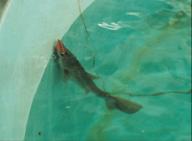
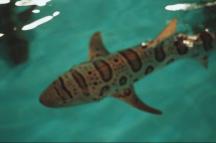
Another dip in disinfectant, and we were in the shark holding area. The sharks are the primary focus of the “Open Sea” portion of the “Passages of the Deep” exhibit. Here the native bred sharks are held until needed for the display. Lissy offered the sharks a few tidbits of herring, but they are so well fed that they generally ignored it. The leopard sharks are by far the most eye-catching of the exhibited sharks (Figure 5), with their attractive markings and graceful, streamlined bodies, but the spiny dogfishes seemed far more interested in us (Figure 6). They weren’t begging for food, because they ignored it when offered, but they repeatedly poked their heads out of the water and regarded us with their large eyes.
|
|
|
Figure 5. Leopard Shark |
Sharks are also the subject of the Aquarium’s new interactive exhibit “What Happened to Surfer Bob?” in which the patrons are invited to solve the mystery of the fictional missing documentary filmmaker Surfer Bob. We were invited to examine the teeth and jawbones of various sharks and their relatives, the rays (Figure 7). Sharks have many rows of teeth, the rear rows lying down much like cards in a Rolodex. When the
|
|
|
Figure 7. Great white shark tooth and jawbone. |
sharks lose a tooth, and they frequently do, a new one moves up to take its place. The teeth in a ray’s jaw have been flattened and modified for crushing rather than biting and tearing. This is because a ray’s diet consists mainly of clams and crustaceans, rather than fish, as is the case with most sharks.
Passages of the Deep
|
|
|
Figure 8. Passages of the Deep from above. The medical tank is on the south end of the map. |
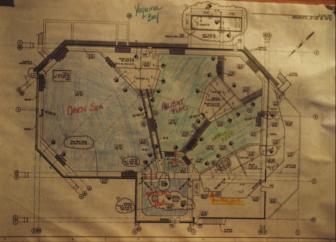
One last dip in disinfectant and we entered the “Passages of the Deep” exhibit. Formerly Keiko’s home, this tank has been modified to accommodate three new exhibits, each representing a separate habitat off the Oregon Coast. A transparent tunnel pierces each habitat, so that the water completely surrounds the viewer. You can even look down through transparent windows to see the animals swimming beneath your feet.
Orford Reef simulates a rocky reef near the shore. There is more color here than in any other part of the exhibit, ranging from leopard sharks to sea anemones, sea cucumbers and other reef-dwelling creatures. Halibut Flats simulates a sandy sea floor, but it’s the Open Sea exhibit that always draws the most attention. People sit or stand for long minutes mesmerized by the many fish and sharks swimming underfoot and overhead.
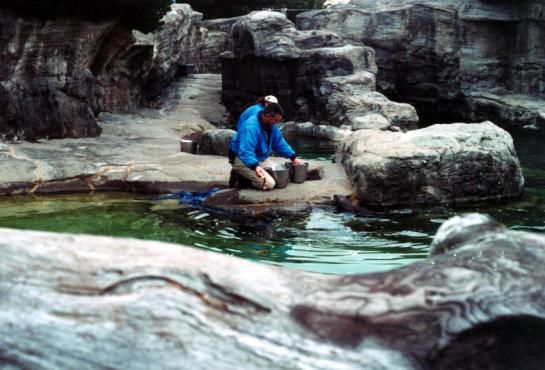
We entered the building from the top, so were able to look down into each exhibit. It was far too dark for pictures, but it was possible to see people in the tunnels below us without them seeing us. Lissy showed us the medical holding tank (Figure 8), where animals that have been injured or ill are kept and treated until ready to reenter the exhibit. Mostly, these consist of sharks that try to go after the same piece of fish in the Open Sea exhibit. It can be a difficult job keeping track of which creatures in the medical tank are eating properly and in good condition, so the keepers try to train each animal to respond to different flashlight signals.
The Finale
|
|
|
Figure 9. Cute, huh? |
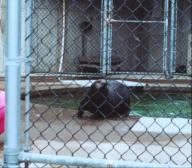
Probably the most popular and charming animals at the Oregon Coast Aquarium are the sea otters. The Aquarium boasts three, all males. Lissy told us about her first time inside the otter pen, when she had to be bracketed by two trainers in order to keep the otters from attacking her. Wild sea otters have been known to attack swimmers who swim into their territory, so while they may be cute, they can be very dangerous.
It was now the end of the tour, so it was out through the back gate and into the main area, where it was otter feeding time (Figure 10).
|
|
|
Figure 10. A nice
juicy squid, anyone? |