 Part of a Lecture delivered at Refresher Course in Chemistry,
 Part of a Lecture delivered at Refresher Course in Chemistry,
April 10, 1997.
Psychology in Learning, Teacher-student relationship.
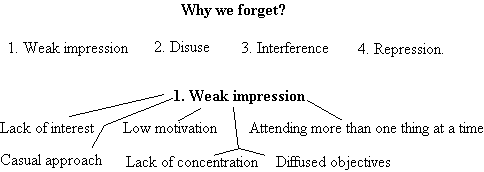
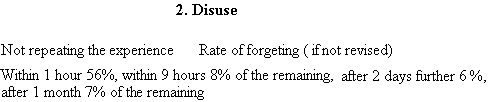

How to remember
Concentrate, concentration span for a given act is 20 min. Only.
Forced concentration may lead to sleep. Develop a habit of concentration.
Evoke enthusiasm. If mind wanders bring it back gently.
Attend to compulsive thoughts. They may be more important to your mind. No use
forcing them out.
You can have good impression. The key words are- {HIRE}
H
abit, Interest, Relaxation, Emotions.Repetition: Understand, Little but often, recite to your-self, over learn, Repeat whole,
think that you can recall (trust your memory), maintain place of study and other
environmental conditions identical or same, you remember completed task better if you are
concerned about the success but other way round if you are not afraid of failure, contrast.
Avoiding interference: Proper gaps, rest, relaxation, if no gaps possible, study two dissimilar subjects one after the other.
Studying for examinations: Prepare your own notes. In doing so follow the following instructions.
Write first the questions, small but simple sentences, use your own language, or be familiar with the language you are using, use common words, use active voice, give clear headings and subheadings placed at the centre, use abbreviations.
Learning notes: understand, do little but often, read and recall (do not read & reread).
P-V formula:
P- preview: general idea, close the book, gather what you have learned.
Q- ask your-self questions.
R- read to understand, underline the key words.
S- summarise.
T- test.
U- use in daily life if possible.
V- visualise.
Points to remember:
1. Personality skeleton gets formed in first six years of age. The foundation for our nature is laid down during this period. This is highly influenced by the surrounding factors, like parents, neighbours, teachers, etc. Our reaction to a particular stimulus is largely governed by the childhood programming. Our response to different situations is normally the cumulative one of what we learn in childhood as the correct responses from surroundings. Thus our reactions to various situations are given by people around us, & for these offending ones we only are the sufferers. Hence it is necessary that we should modify this foundation so that our responses would be what we really want.
2. Childhood programming is registered in a subconscious (unconscious) mind. This represents a part of the brain which governs nonvoluntary actions like breathing, heart function, respiration, emotional behaviour, may be that of love, hatred, fear, anxiety, anger, concentration, memory and other vital functions. Conscious mind represents a part of brain that governs the voluntary actions, that is whatever we do with complete awareness. By increasing control on our subconscious we can easily control all emotional activities.
3.a. Imagination always wins when the will-power (function of unconscious mind) & the imagination (function of subconscious mind) work against each other,. Imagination is programmed in the subconscious For example fear of ghost, & god, hatred about a particular person or situation belief that ghosts come out in the dark, etc.
b. The results are worse if will-power is used against the imagination forcefully. For example if one trusts the concept of ghost it would be impossible to walk through a graveyard at 12 O'clock at night, in spite all the conscious efforts. Your body will develop symptoms to prevent you from acting against your imagination if you make forceful efforts.
c. One succeeds if the will power & imagination are parallel. Better effect is produced if this is accompanied by suitable emotion.
Hence to win over your emotional problems you need to bring about a change in the subconscious mind. This can be better done by using hypnosis though a change can be possible by also doing a few things at conscious level.
You need not be nervous on emotional mistakes because they really are not your own. It is because of the subconscious planning done by others. Hence by no way you should repent on any such issue, but plan to get rid of the problematic attitude.
There are three main ways of reacting.
1. Passive behaviour: Giving up your rights and honest feelings, for any given situation, feeling helpless, anxious, resentful disappointed with yourself, trying to please others, feeling of being manipulated and pushed around all the times. You avoid action, prefer to run away from problems, your self-esteem is seriously affected.
2. Aggressive behaviour i.e.: You feel angry, frustrated, dominating, forcing others to lose, urge to show strength, feel tensed and you may win at the cost of your and other's happiness.
3. Assertive behaviour: Standing up for your personal rights, expressing your thoughts, feeling in direct, firm but gentle way, without violating rights of other's. After the act you feel better and your self-esteem goes up.
Never give casual excuses for not doing or for not being able to do something properly. If you do so you may learn to be liar, and will always tend to run away from the work as you are internally sure that your excuse is going to be accepted. This is wrong interpretation. People quickly can understand your bluffing but do not show if they are not affected. You feel you have win but actually you have lost. You do not understand the damage occurred to your image. By offering excuses you destroy your own integrity day by day. You normally learn this when it is too late.
Dr.B.M.Khadilkar
Fax. 4145614.
Tel. (Off.) 4145616.
E-mail: [email protected]
UDCT, Mumbai 400019.