Nekojarashi
September / October 1998 No.15
Back
Topics
Japanesque
People
Bee Hunting
Oh, Japanesque!
This year the autumn is coming earlier than usual. The field here are oceans of eulalia. Simply put a bunch of
eulalia in a large vase - it's really Japanesque, isn't it? Maybe you'll feel like enjoying the beauty of the mid
autumn moon or turning your eyes to some old and traditional Japanese things.
The autumn ... such a lyrical and sentimental season.
Topics
Event
Won't you come to the 'Sasaeai-no tsudoi,' a get-together for supporting the handicapped?
When: Sep. 12 (Sun.) 12:00 p.m. to 3:30 p.m.
Where: the Fujimi Chomin Centre
It is our third event since last year. Our theme this year is "Let's communicate with and
appreciate the handecspped."
There will be various events such as --- a bazaar, a show, exhibitions, and learning about the
handicapped through simulations.
People regardless of age or sex will be able to enjoy their holidays, in a meaningful way.
Bazaar
Our bazaar, held every autumn, will soon be held in the Event Square in front of Fujimi Community
Plaza.
When: Oct. 25 (Sun.) 10:00 a.m. to 2:00 p.m.
Journey
Let's take the 5th 'Friendship train,' organised by the Suwa Social Welfare Council. It is planning
a journey to Katsunuma in Yamanashi Prefecture for grape picking.
When: Oct. 11 (Sun.)
Contact : tel / fax 0266-27-0956 Mr. Osamu Nakamura
Concert
You might feel a message from ancient people. The instruments in the concert will be a stone
whistle from the Jomon period, a clay whistle from the Yayoi period and a bone whistle from the Inca civilization,
etc.
Sep. 26 (Sat.) 7:00 p.m. to 9:00 p.m. at Shintoku Temple
Sep. 27 (Sun.) 1:30 p.m. to 3:00 p.m. at the Yatsugatake Art Museum
Fee : Advance Ticket (Adult) 2500 yen, (Student) 1000 yen
Ticket at the door (Adult) 2800 yen, (Student) 1300 yen
Contact: tel 0266-74-2701 the Yatsugatake Art Museum
tel 0266-73-4116 Estuo Ito
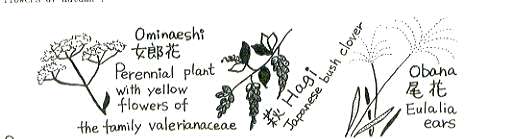
Aki-No-Nanakusa
Have you ever heard of "aki-no-nanakusa," the seven flowers of autumn? In Japan, they have always been
the familiar and typical flowers of autumn.
Ominaeshi : Perennial plant with with yellow
flowers of the family valerianceae
Hagi : Japanese bush clover
Obana : Eulalia ear
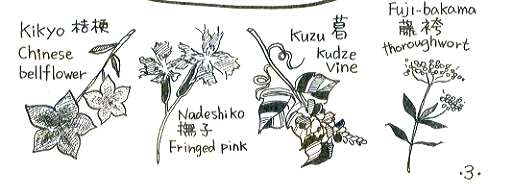
Kikyo : Chinese bellflower
Nadeshiko : Fringed pink
Kuzu : Kudze vine
Fuji-bakama : Thoroughwort
Japanesque Spots
"Onko-chishin" - Japanese proverb meaning "to explore the old
to understand the new better."
If you were to receive a person from a foreign country for a home-stay, would you
have any good idea of where and what to show him or her?
Don't worry, there are lots of economical "Japanesque" spots in and around
Fujimi.
Fujimi Town Historical and Folk Museum
Many people know the Idojiri Archaeological Museum displaying articles such as
Jomon ware, but the Fujimi Town Historical and Folk Museum located next to the Idojiri Archaeological Museum might
be less famous. They have fork artifacts of the middle to modern ages of the Fujimi district, and you will find
most of them very interesting.
Of special interest is a reconstructed ancient farmhouse having a continuation
of an earth-floored part, a kitchen and a horse barn, which is very nostalgic.
One of the keys to make your visit more meaningful is to be accompanied by a native
person over 40 who could explain to you many things such as how the displayed tools were used.
Tel: 0266-65-3572
Open : from 9:00 am to 5:00 p.m.
closed on: Monday, days following holidays and year-end and new year holidays
Admission Fee: 300 yen (may be also used for Idojiri Archaeological Museum)
Saki-ori Hana-musubi
Clap, bang, rap-tap ... the sound of a loom reminds many people in Fujimi of the
old days. Many years ago, every family had a loom, and handloom weaving was one of the important roles of a housewife.
The woven fabric specific to this district is a the Saki-ori (also called "Boro-ori") which was made
from thintorn strips of worn-out summer Kimono or thin nit wear used for the woof. The housewives made various
things such as Kotatsu covers, belt, etc. of this Saki-ori fabric and so they spent the long autumn nights in tearing
the worn-out cloth into thin strips.
There is a shop in front of the Momi-no-yo in Hara Village where you can find lots
of fancy goods made from Saki-ori, e.g. table luncheon mats from 2200 yen.
Tel: 0266-74-2435
Open: 10:00 a.m. to 5:00 p.m. on Fridays, Saturdays, Sundays and Mondays
(End of November to end of March: hibernation!)
Shichi-ken Sake brewery
Driving along Route 20 from Fujimi-machi toward Kofu. Pass the crossing at Hakushu-nakahigashi
and soon you can see the sign for "Shichi-ken"; turn left to the former Koshiu Kaido Street.
In the rows of old houses appear a sake brewery, Shichi-ken, having a brewing history
of over 250 years.
The Hakushu district has been famous for its good water, which is very suitable
for making sake. At Shichi-ken, you can not only try some good sake and buy it but can look around in the old buildings.
The rooms where the Emperor Meiji once stayed are preserved as they were. The transom, which is said to have been
made by a royal carpenter from Suwa, is especially worth seeing.
Tel: 0551-35-2236
People
For this issue, we interviewed Ms. Marichu Nakafutami. She lives with her Japanese
husband and two children in an apartment near Seiyu. Her husband, who is fourteen years older than she, calls her
"Chu". (Cute!)
She was born on the small island of Isabera in the Philippines and was raised in
a town that was cooler and more quiet than Manila. She has eight brothers and sisters and is the fifth child. She
was shy in her childhood, but after moving to Manila when she was in junior high school, she got to be an outgoing
girl.
However, she came to be shy again when she came to Japan 11 years ago. Soon after,
she happend to meet her future husband in Suwa, (she says "Its destiny?") and had a baby. Nevertheless,
she felt uneasy, because she didn't know Japanese well and her relatives whom she relied on lived far away.
One day under these conditions, a district nurse visited her. She was surprised
and also thankful, she felt that Japan was great.
Now she works at the restaurant in Hotel New Fujimi. (By the way, we hear that
you can have lunch there by 500 yen.)
We think that she has gained her happiness through her husband's help and her having
a sense of responsibility and a solid character.
Her dream is to visit Canada, where her relatives live. She says that she'd like
to have her children learn proper English there. (Nice mother!)
Suwa Dialect
| UTTSUKU, UKKAKARU |
to lean |
|
| |
KABE NI UTTUKAU |
lean against a wall |
| UCCHINU |
die, be killed |
|
| |
SONNAKOTOSHITARA UCCHINJIMAU |
If I did so, I would be killed. |
We can tell from the above that the meaning of a verb can be emphasized by adding the prefix "Uttsu... ...."
? ? ?
Bee Hive Hunting
From September to October you might see strange men such as these in the mountains.
First they hide in the bushes focusing intently on one point. Then suddenly they
take off running, looking up at the sky and shouting something to each other. They are not strange people. They
hunt bee hives. It is a traditional out door recreation and popular in the Ina area of Nagano Pref. There are some
experts in hunting the hives in Fujimi. Why don't you ask them to take you along?
Then you'll be able to try those calcium-rich larvae! (Very expensive it store
bought)
Back