
Standard Notation
Standard Notation is the defacto standard for writing music for the bass register. Most bass sites however also use bass tablature or bass tabs, which I will also discuss here. But first let's take a look at Standard Notation.
Standard Notation has been around for quite a long time. How long? I don't really know, but you can Google it and find out for yourself. Most people are familiar with what Standard Notation looks like, piano sheet music comes immediately to mind. But how do you go about deciphering all those symbols?
The Bass Staff
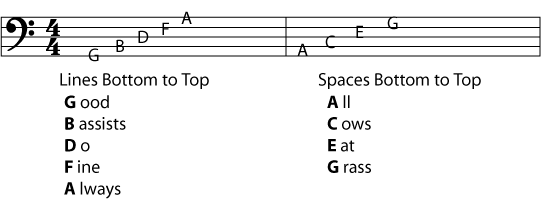
First lets take a look at the staff. It consists of 5 lines and a slew of symbols. Each line on the staff represents the name of a note, as does each space between the lines. The image below shows the bass staff or bass clef, and the names of the notes each line represents. The backwards 'C' looking symbol with the two dots by it is the bass clef, and lets us know that we are looking at the notation we are most interested in as bassists.
Note Names
As you can see from the image above, the musical alphabet consists of only 7 letters. The letters A through G. Not very many, but there are 'modifiers' to the letters that give us much more variety. We'll cover those later, for now just work on familiarizing yourself with the note names, and were they are on the bass staff. (Here's a little helpful hint, look at the line between the two dots in the symbol for the bass clef, the backwards 'C', that line is always F.)
As you can see, under the staff I placed a little mnemonic, a memory helper, to aid in remembering where each note is on the bass staff. You can use the one I provided, come up with one on your own, or even ignore it entirely, the important thing is to remember where each note occurs on the staff.
Measures
Look at the staff again and notice the vertical lines. These lines break up the staff into measures. Our staff above consists of only two measures, but most staves consist of three or more meaesures.
The Time Signature
Right next to the bass clef are two numbers, one above the other, this is the time signature. The time signature tells us two things.
- The number of beats per measure.
- What note value is equal to one beat.
Our example is in 4/4 or 'common' time. It consists of 4 beats per measure, with the quarter note (more on note values in a minute) equal to one beat. This is the most common time signature in Western music, hence the name common time. Occaisionally this time signature will be represented by a 'C' rather than '4/4', so if you seee a 'C' for the time signature you will know it is '4/4' time.
Another commonly used time signature is '3/4', 3 beats per measure with the quarter note equal to one beat. We'll look at more examples of time signatures a bit later.
Note Values
The next thing we want to take a look at are the values for the notes. There are 4 note values that we are most concerned about as bassists. They are the whole note, half note, quarter note, eighth note and sixteenth note. These four note values are the ones used most often by bassists.

Look a bit familiar? These are the standard symbols representing note values in music. It doesn't matter if you are looking at a Treble Clef, Bass Clef, Alto Clef or whatever these symbols all mean the same thing.
These really are fractions. 1 whole note = 2 half notes = 4 quarter notes = 8 eighth notes = 16 sixteenth notes. So in '4/4' time one whole note equals 4 beats, one half note equal 2 beats, one quarter note equal 1 beat, 1 eighth note equal 1/2 beat, one sixteenth note equal 1/4 beat. The image below demonstrates this visually.

Putting the Time Siganture With the Note Values
Now its time to get out your metronome and experience this. (You DO have a metronome don't you?). Set your metronome to about 80 bpm, now count with each beat. "1 - 2 - 3 - 4". Those are your quarter notes in '4/4' time. 4 quarter notes, each getting one beat.
Now try this, on each beat say 'quarter', "Quarter - quarter - quarter - quarter". That's '4/4' time.
Now we'll look at the whole note. How many quarters is that? 4, right? OK, now still using your metronome, say 1 - 2 - 3 - 4, emphasizing the 1. 4 beats, 1 whole note. Pretty simple right? Let's move on.
Time for the half note. 1 - 2 - 3 - 4. Emphasize the 1 and 3 beats. Those are your half notes. 1 - 2 is one half note, 3 - 4 is one half note.
Practice that until you feel comfortable with it, because things are going to get just a little bit harder.
The eighth note is next up. Counting it is a bit more difficult, but I'm sure you'll do just fine. Remember that one quarter note equals two eighth notes. So our counting becomes, "1 and 2 and 3 and 4 and". Don't forget to say the 'and's. '1 and' is two eighth notes or one quarter note or one beat. Make sure each number falls on one beat.
Sixteenth notes are even more tricky, since we now have twice as many notes per beat as with the eighth notes. The counting goes like this: "1 uh and uh 2 uh and uh 3 uh and uh 4 uh and uh". Don't forget the uhs and ands. And again make sure each number falls on one beat.
Keep practicing that until you feel comfortable with it. Next time we'll look at combining note values in our '4/4' time signature.
Feedback is welcome and encouraged, you can email me at mdrisser (at) excite (dot) com.
27016-060429-187294-97 Rate content:


© 2006 All Rights Reserved.