
Eating without upsetting blood sugar control
Al Dhamer Center For Medical Specialties, Jahra
Diet is a corner stone of diabetes therapy. Unfortunately compliance to diabetic diet is very poor. In a study from Saudi Arabia it was found that only 8% of the patients comply well with the diet whereas 81% have good compliance to medication. Because the compliance to medication is good the patients know the need for treatment and proper control of blood glucose. Then why is the compliance to diet so poor?
How can diabetics eat palatable foods without losing blood sugar control?
To answer these questions one has to know what factors related to the food affect the blood sugar levels.
The energy giving components of food are Carbohydrates, protein and fats. The energy content of the food is measured as Calories. Carbohydrates and proteins have 4 Calories/gram whereas fats have 9 Calories /gram.
Currently the diet for diabetics is based on the calorie requirements. The calorie requirement for a person is determined by first estimating the Basal Metabolic Rate ( BMR) based on the age, sex and weight. This is multiplied by a factor based on the activity of the person and the Calorie requirement at the current weight is arrived at. Many diabetics are overweight or obese and this not only leads to poor blood sugar control due to insulin resistance but also increases the complications. Body Mass Index ( BMI) is determined based on the height and weight of the person. The normal is 18.5 to 25 ( 23 for Indians). If the BMI is above 30 a person is obese. Below 30 and above the normal is overweight. If the overweight and obese reduce 500-1000 Calories from the calculated value, they can lose 0.5 � 1 kg per week and achieve normal weight and BMI in course of time. The diet is advised in the lines of the �Food Pyramid� and contains 45-65% Carbohydrates, 20-30% fats and 15- 25% protein in terms of Calories. Special situations like pregnancy, lactation etc and complications like nephropathy etc will require additional adjustments to the diet.
Recent studies have brought out some additional factors which influence blood sugar control. The diagram below shows the blood sugar response to 5 different kinds of foods with almost the same Calorie value, but blood sugar values are quite different.
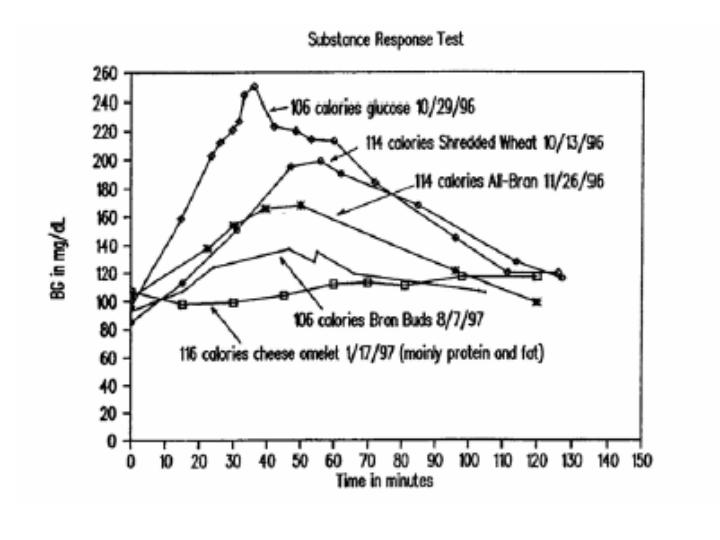
Glycemic Index ( GI) compares the food carbohydrate to oral glucose in its ability to raise the blood glucose. The GI of glucose is taken as 100. Food with low GI raises the blood glucose less than food with high GI. American Diabetes Association in its Position Statement on Standards of Medical Care (2005) has recommended the use of GI in addition to the calories as per the statement below.
�A recent analysis of the randomized, controlled trials that have examined the efficacy of the glycemic index on overall blood glucose control indicates that the use of this technique can provide an additional benefit over that observed when total carbohydrate is considered alone.�
GI is related mainly to the constituents of the food substance, but it is also affected by the way the food is processed or cooked eg. boiled potato has a GI of 56 whereas baked potato has a GI of 85 and French fries of 75 . It is also dependant on the food type and country of production eg. Bengladeshi Rice (BR 16) has GI 38 , parboiled rice 48, Brown South Indian 50, white Basmati 58 and low amylose (Pelde Australia) 87. GI values of some samples of Barley are pearled (Canada) 25, India 43, cracked (Tunisia) 50 and rolled (Australia) 66. Addition of other substances also alters GI. White bread has a GI of 70. If psyllium( isaphgul) is added to the flour ( Mexico) , GI drops to 53.
Addition of foods that are low in carbohydrates and containing mainly proteins and fats reduce the blood glucose elevation caused by carbohydrate rich foods as shown in the following study.