In June of 1863 General Robert E. Lee was preparing his army to invade the North. Union General Joseph Hooker suspecting of an invasion, sent his new cavalry commander, Alfred Pleasonton, on a reconnaissance mission to find Lee's army.
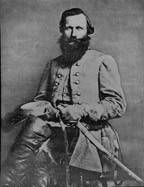
Jeb Stuart, the Confederate cavalry commander and his 10,000 troopers were camped by the river at Brandy Station. Stuarts mission was to cover the Confederate advance north. However, on the 7th of June Stuart took out time to present a grand review of his brigades to a thrilled audience of civilians. He delayed his preparations for the iminent offensive.
Pleasonton and his cavalry of over 11,000 men commenced with their mission on June 8. The next morning, hidden by heavy morning fog, the Union cavalry crossed the Rappahannock and took Stuart's Confederates by suprise.
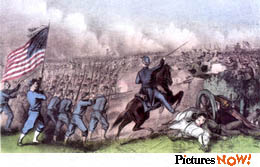
Over the next hours, more than 21,000 cavalrymen from the two sides engaged in a huge hand-to-hand battle, the largest cavalry battle that would ever be fought on the North American Continent.
The scattered Confederate force managed to rally and mount a strong counterassualt that pushed the Union back. When Pleasonton spootted Confederate infantry reinforcements headed toward the field, he ordered a calm withdrawl back across the river. The Union suffered 936 casualties, 486 of whom were captured. The Confederates suffered 523 casualties. Stuart's force had held the field, and Stuart claimed the victory for the Confederacy.
|