 |
| Ulysses S. Grant 1822-1885 |
|
|
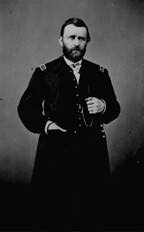 |
| Ulysses S. Grant was a second to none general for the Union army. He became a true military hero-a cunning strategist with courage, tenacity, and the ability to lead. Grant's West Point record was far from spectacular. He graduated twenty-first in his class of 39 cadets. He was given the rank of brevet second lieutenant, and was stationed at Jefferson Barracks, near St. Louis, Missouri. While he was there he learned a lot about soldiering, and also met the woman who would become his wife, Julia Dent. The year after that, Grant was sent to the Southwest frotier; he served there until the Mexican War. After the war Grant served in various Garrisons in Mexico. Grant later resigned his commision on April 11, 1854, due to an argument with his commander. After Grant was done in Mexico he returned to Missouri, where he tried for several years to support his family. He moved to Galena, Illinois, where he worked in his father's leather shop. When the Civil War started, Grant saw his opportunity to get back in the military. He helped organize the first company of Union volunteers in Galena. Grant became colonel of the 21st Illinois Infantry in June 1861. On April 7, 1861, President Abraham Lincoln appointed Grant brigadier general of volunteers and sent him to occupy Paducah, Kentucky. Grant's first offensive against the Confederates was near Belmont, Missouri. He engaged the rebel forces but was pushed back by Confederate reinforcements. In February General Henry W. Halleck authorized Grant to move against Forts Henry and Donelson. With 17,000 men and a flotilla of gunboats, Grant captured both forts in just over two weeks. At Fort Donelson Grant earned his nickname "Unconditional Surrender" Grant. His next action was at the battle of Shiloh, Tennessee. Grant had been suprised by Albert Sidney Johnston's army when it came through poorly fortified Union lines and threatened to drive Grant's men back to the river. After a long battle the following day, Grant was able to regain the lost ground. A few months later Grant was made commander of the department of Tennessee, he would be in charge of taking Vicksburg, a Confederate strong point on the Mississippi River. Grant manuveured his army around Vicksburg and laid siege to the city, the siege lasted three months. Vicksburg finally surrendered to Grant's army on July 4,1863. Grant next saw action in Tennessee where he managed to lift the siege of Chattanooga. Through later battles, Grant managed to secure the region for the Union. Abraham Lincoln promoted Grant to general-in-chief commanding all Union armies in March 1864. Grant made preparations for a campaign involving all four Union armies. Unfortunatly his well-planned venture became a costly war of attrition. Both sides took terrible losses, this earned Grant another nickname, "Grant The Butcher." Finally, in April of 1865, all of Grants manuevers had pushed Robert E. Lee's Confederate army into a corner. Lee surrendered on April 9, 1865, at Appomattox Court House, Virginia. Grant offered Lee and his men very generous terms of surrender, which Lee immediately accepted. Grant was given the grade of full general after the war, in 1866. With his spectacular war record, he became the Republican candidate for president in 1868, he won the election easily. As president, Grant displayed a lack of leadership and discipline, although not personally corrupt, his two-term administration became notorious for its scandals and laissez-faire attitude at a time when the country was on the brink of an economic depression. Grant left his office in 1877. Grant lived his last years in poverty, forced to sell his war mementoes and write his memoirs in order to support his family. Grant's Personal Memoirs eventually earned the Grant family about a half million dollars, but Grant died of throat cancer before receiving the book's rewards. He is buried in the mausoleum dedicated to him in 1897 in New York City. |
 |
 |