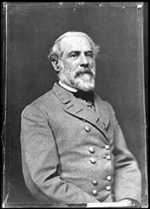
The son of 'Light Horse' Harry Lee, a noted general of the Revolutionary War, who squandered fortune after fortune in his later years, Lee graduated without a single demerit. Noted as an engineer in the Mexican War, 1861 found him as a lieutenant colonel in the 2nd Cavalry. He married after graduation, apparently badly although the couple did have seven children.
Lee joined Virginia when it left the US, having previously been offered, and turned down, command of the US Army. He was commissioned a Confederate brigadier general on May 14, 1861 and a full general shortly afterwards. His first campaign, in West Virginia, was a failure and he was then sent to examine South Atlantic coastal defences. In March 1862 he returned to Richmond as advisor to the president, taking over command of the Army of Northern Virginia when J.E. Johnston was wounded. He held field command of his army until attack in early 1863. In addition, on January 23, 1865, he was given the title of General in Chief of the Armies of the Confederate States, too late to do much good even had he not been distracted by the defense of his own state which he always placed above the new 'Confederate States'.
In later years, Lee refused several lucrative offers to serve in positions where he could trade on his name as the most famous Confederate military leader of the war. Instead, he took charge of a small Virginia college, Washington, now Washington and Lee. He urged reconciliation with the North and peaceful rebuilding of the South. By the time of his death he had surpassed Jackson as the most loved soldier of the Confederacy. Indeed, one of his fellow Virginians wrote of Lee years after his death, 'It is impossible to speak of General Lee without seeming to deal in hyperbole.' During his life, however, other Confederates saw him more clearly. A South Carolina colonel said that after Gettysburg, the Army of Northern Virginia was'.... a demoralized army, and for this I hold General Lee largely responsible. He.... had an utterly undue regard for the value of the elementary teaching of West Point.... General Lee never went outside the regular grades, and was apparently resolute against so doing, to find officers, who might have been very Samsons to help him multiply his scant resources. He never discovered or encouraged a Forrest....' One of his generals called him 'reserved almost to coldness'. He went on to say, 'In truth, the genius of Lee for offensive war had suffered by too long a service as an engineer.' But, the common soldiers under him loved him. As one later wrote, 'He believed in his men and thought they could do anything that mortals could do. His men worshipped him, and I think the greatest man the world ever saw was Robert E. Lee.' Indeed, many of his opponents agreed, Grant later recalling, 'It was not an uncommon thing for my staff-officers to hear from Eastern officers, "Well, Grant has never met Bobby Lee yet." 'However, Grant also'... had known him personally, and knew that he was mortal; and it was just as well I felt this'.
In fact, Lee was a brilliant tactician, although less brilliant as a strategist. He often overlooked the long view, as for example in giving more emphasis to the war in his own state rather than in the West where the South actually lost the war. He was a gambler, always going for the knockout punch at battle like Chancellorsville and Gettysburg, where the more conservative tactics urged by Longstreet could have been more successful but would not actually have been more successful but would not actually have destroyed the Union Army. He failed to discipline his generals sufficiently, allowing men like Stuart to pursue their own interests rather than being sufficiently subordinated to the overall inerests of the cause. This said, it is also true that the fact that the Army of Northern Virginia lasted as long as it did is as much due to Lee's influence over, and belief in, his troops as much as to his opponents' ineptness. |